At its core, the function of an Electric Arc Furnace (EAF) is to melt steel scrap and other iron-based materials using immense electrical energy. It serves as a high-temperature recycling vessel, creating a violent, controlled electrical discharge—an arc—to transform solid, discarded metal into high-quality liquid steel ready for new applications.
An Electric Arc Furnace is more than just a melting pot; it's the heart of modern secondary steelmaking. Its primary function is not just to melt metal, but to provide a highly flexible and efficient method for recycling steel, decoupling production from the traditional, carbon-intensive process of mining and refining iron ore.
How the EAF Performs Its Function: The Melting Process
To understand the function of an EAF, you must first understand its operational sequence. It is a batch process, meaning it melts one "charge" of material at a time in a series of carefully controlled steps.
The Charge: Starting with Recycled Material
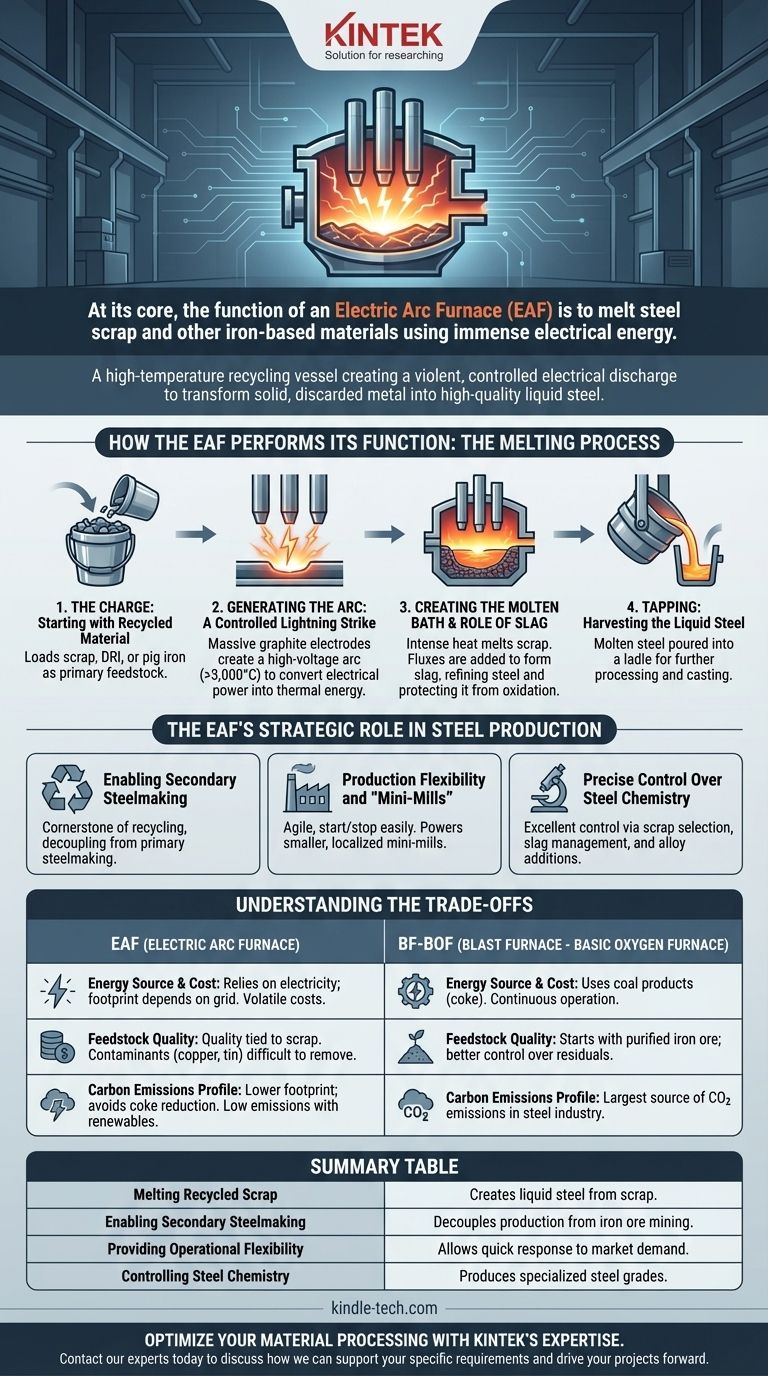
The process begins by loading the furnace with its primary feedstock, known as the charge. This is typically a mix of recycled steel scrap, but it can also include direct reduced iron (DRI) or pig iron to control the final chemistry.
Generating the Arc: A Controlled Lightning Strike
Once the furnace is charged and the roof is closed, three massive graphite electrodes are lowered into the scrap. An extremely high-voltage electric current is passed through them, creating a powerful arc that leaps from the electrode tips to the metal charge.
This arc is the primary source of energy, converting electrical power into intense thermal energy. It's akin to a continuous, controlled lightning strike that can reach temperatures over 3,000°C (5,400°F).
Creating the Molten Bath
The intense radiant heat from the arc rapidly melts the scrap metal, forming a pool of liquid steel at the bottom of the furnace known as the molten bath. Chemical energy, such as oxygen injection, is often used to assist the melting and accelerate the process.
The Role of Slag: Refining and Protecting
During the melting process, materials called fluxes (like lime) are added to the furnace. These combine with impurities in the steel to form a liquid layer called slag that floats on top of the molten bath.
This slag serves two critical functions: it absorbs impurities to refine the steel, and it acts as an insulating blanket, protecting the liquid steel from heat loss and atmospheric oxidation.
Tapping: Harvesting the Liquid Steel
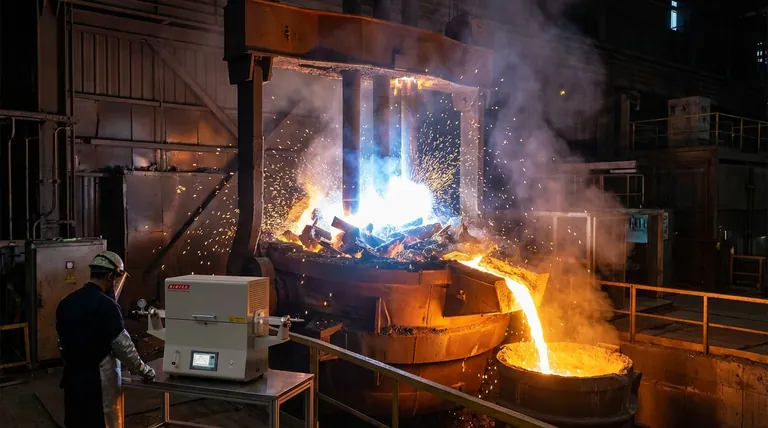
Once the steel reaches the desired temperature and chemical composition, the furnace is tilted. The molten steel is poured out through a tap-hole into a large refractory-lined container called a ladle. This process is known as tapping, and the steel is now ready for further processing and casting.
The EAF's Strategic Role in Steel Production
The simple function of melting scrap underpins a major strategic shift in how steel is made globally. The EAF is the enabling technology for a more agile and distributed production model.
Enabling Secondary Steelmaking
The EAF is the cornerstone of secondary steelmaking, which uses recycled material. This stands in contrast to the traditional primary steelmaking route, which uses a Blast Furnace (BF) and Basic Oxygen Furnace (BOF) to convert iron ore into steel.
Production Flexibility and "Mini-Mills"
Unlike a blast furnace, which must run continuously for years, an EAF can be started and stopped relatively easily. This flexibility allows producers to respond quickly to market demand and electricity price fluctuations.
This has enabled the rise of smaller, more localized plants known as "mini-mills," which can be built with lower capital investment and sited closer to scrap sources and customers.
Precise Control Over Steel Chemistry
The EAF process offers excellent control over the final product. By carefully selecting the scrap charge, managing the slag, and making precise alloy additions in the ladle after tapping, producers can create a vast range of specialized steel grades.
Understanding the Trade-offs
While powerful, the EAF is not a universal solution. Its function comes with a distinct set of advantages and challenges compared to the traditional BF-BOF route.
Energy Source and Cost
The EAF's reliance on electricity is both a strength and a weakness. Its environmental footprint is heavily dependent on the local power grid; it produces very low emissions when powered by renewables but can be carbon-intensive if powered by fossil fuels. Electricity costs can also be highly volatile.
Feedstock Quality and Contaminants
The final quality of EAF steel is directly tied to the quality of the scrap metal used. Contaminants in the scrap, such as copper and tin, are difficult to remove and can negatively impact the properties of the finished steel. Primary steelmaking, which starts with purified iron ore, offers more inherent control over these residual elements.
Carbon Emissions Profile
Even with a fossil-fuel-based grid, the EAF route typically has a significantly lower carbon footprint than the BF-BOF route. This is because it avoids the chemical process of reducing iron ore with coke (a coal product), which is the single largest source of CO2 emissions in the steel industry.
How This Applies to Production Goals
Understanding the EAF's function allows you to see why it is chosen for specific strategic goals.
- If your primary focus is sustainability and recycling: The EAF is the definitive technology, as its core function is to turn scrap back into a high-value product with a lower intrinsic carbon footprint.
- If your primary focus is operational flexibility and market responsiveness: The EAF's ability to operate in smaller-scale mini-mills and adjust output on demand makes it the superior choice over the rigid, continuous operation of a blast furnace.
- If your primary focus is producing commodity steel grades where initial purity is paramount: The traditional BF-BOF route remains a dominant force, as it provides greater control over residual elements by starting with virgin iron ore instead of variable scrap.
The Electric Arc Furnace's ultimate function is to power a more agile and circular future for the global steel industry.
Summary Table:
| Key Function | How It Works | Key Outcome |
|---|---|---|
| Melting Recycled Scrap | Uses a high-voltage electric arc (>3000°C) to melt metal | Creates liquid steel from scrap |
| Enabling Secondary Steelmaking | Batch process using scrap as primary feedstock | Decouples production from iron ore mining |
| Providing Operational Flexibility | Can be started/stopped easily; powers mini-mills | Allows quick response to market demand |
| Controlling Steel Chemistry | Precise management of charge, slag, and alloy additions | Produces a wide range of specialized steel grades |
Optimize Your Material Processing with KINTEK's Expertise
Whether you are exploring advanced thermal processing or require reliable equipment for your operations, KINTEK has the solutions and support you need. We specialize in providing high-quality lab equipment and consumables, serving a wide range of industrial and research laboratory needs.
Let us help you achieve greater efficiency and precision in your work. Contact our experts today to discuss how we can support your specific requirements and drive your projects forward.
Visual Guide
Related Products
- Vacuum Arc Induction Melting Furnace
- Non Consumable Vacuum Arc Induction Melting Furnace
- Electric Rotary Kiln Pyrolysis Furnace Plant Machine Calciner Small Rotary Kiln Rotating Furnace
- Electric Rotary Kiln Small Rotary Furnace for Activated Carbon Regeneration
- Electric Rotary Kiln Continuous Working Small Rotary Furnace Heating Pyrolysis Plant
People Also Ask
- What is vacuum arc melting process? A Guide to High-Purity Metal Production
- What is the function of vacuum arc melting equipment? Creating High-Purity Ferrochrome (CrFe) Alloys
- How do vacuum induction or arc melting furnaces facilitate the synthesis of U-Al-C MAX phases? Precision Heat & Purity
- What are the advantages of a vacuum induction melting furnace? Achieve High-Purity Alloys with Precision VIM
- What is the function of a vacuum arc melting furnace? Master Homogeneity for Fe-Co Metallic Glasses