Knowledge What is the function of the kiln? Unlock Material Transformation with Precision Heat
Author avatar

Tech Team · Kintek Solution

Updated 5 days ago

What is the function of the kiln? Unlock Material Transformation with Precision Heat


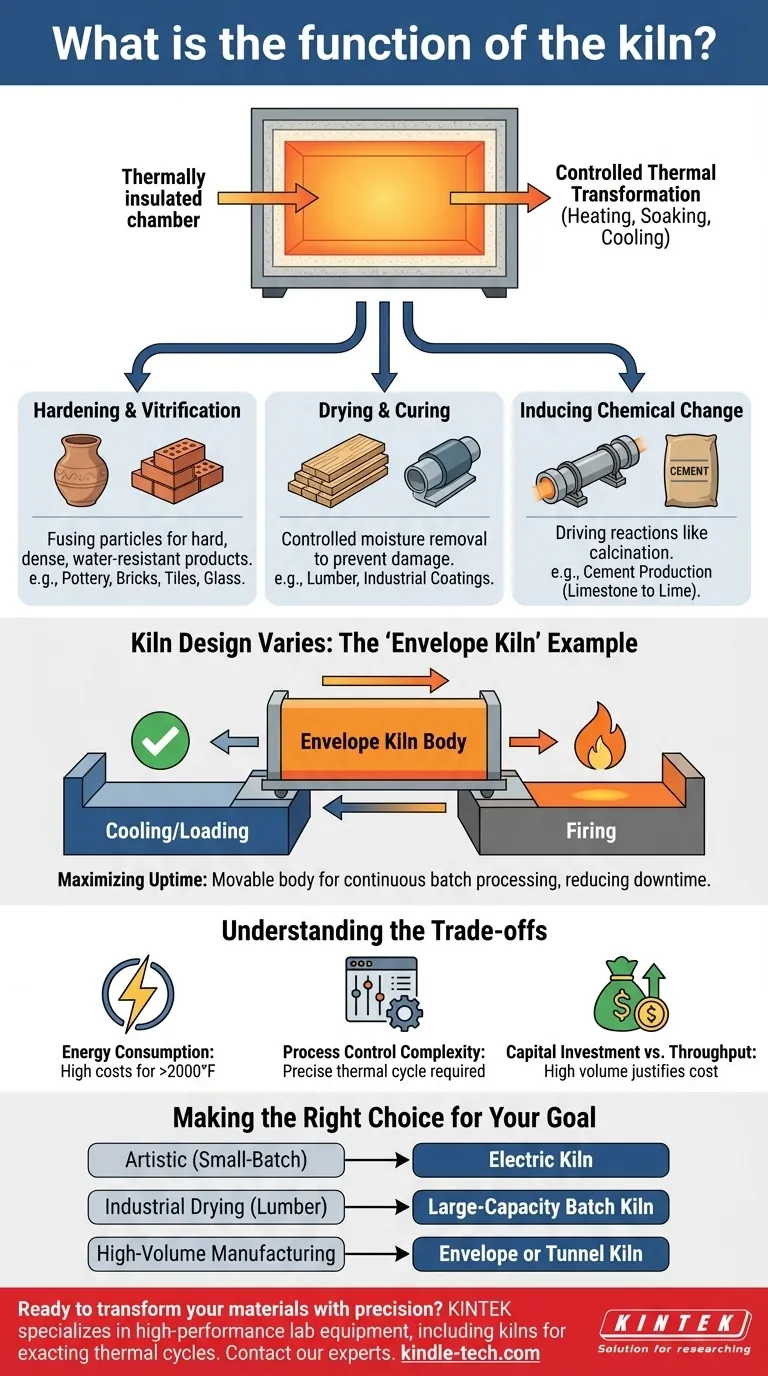
At its core, a kiln is a thermally insulated chamber—a type of specialized oven capable of reaching and maintaining extremely high temperatures. Its primary function is to heat materials to a sufficient temperature to effect a permanent change, such as hardening clay into ceramic, drying lumber, or inducing a specific chemical reaction.

A kiln's function is not simply to generate heat, but to precisely control a high-temperature environment. This control is what transforms materials, and the specific design of the kiln is dictated by the scale, speed, and fragility of the items being processed.
What is the function of the kiln? Unlock Material Transformation with Precision Heat

The Fundamental Principle: Controlled Thermal Transformation

A kiln's purpose extends far beyond simple heating. It facilitates a fundamental change in a material's physical or chemical state through the precise application of a thermal cycle (heating, soaking, and cooling).

Hardening and Vitrification

For materials like clay and glass, the kiln's heat causes particles to fuse together in a process called vitrification. This transforms a soft, fragile object into a hard, dense, and water-resistant final product, such as pottery, bricks, or tiles.

Drying and Curing

In other applications, like drying lumber or curing industrial coatings, the kiln provides a controlled environment to remove moisture. This must be done at a specific rate to prevent the material from cracking, warping, or becoming damaged.

Inducing Chemical Change

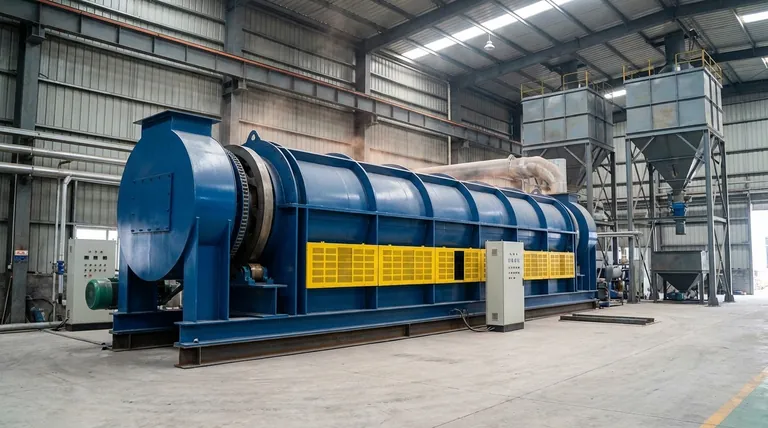
In heavy industry, kilns are used to drive chemical reactions. For example, a rotary kiln heats limestone to produce lime and carbon dioxide, a critical step in manufacturing cement. This process is known as calcination.

Why Kiln Design Varies: The 'Envelope Kiln' Example

The specific design of a kiln is engineered to solve a particular operational problem. The "envelope kiln" described in your reference material is a perfect example of a design optimized for industrial efficiency.

The Problem: Downtime in Batch Processing

A traditional kiln must be loaded, heated, cooled, and unloaded in sequence. The cooling and reloading periods represent significant downtime, where the expensive equipment is not actively producing.

The Envelope Kiln Solution

This design features a movable kiln body (the "envelope") and two or more stationary bases. While one base is being fired, the other can be safely cooled, unloaded, and re-loaded with a new batch.

The Benefit: Maximizing Uptime

Once the first batch is finished, the hot kiln envelope is simply moved over to the second, pre-loaded base, and the firing process begins again almost immediately. This nearly eliminates downtime, making it ideal for large-volume batch processing of heavy or fragile products where continuous operation is key.

Understanding the Trade-offs

While powerful, kilns present significant operational challenges that influence their design and use.

Energy Consumption

Reaching and maintaining temperatures of over 2000°F (1100°C) requires a tremendous amount of energy. Modern kiln designs focus heavily on insulation, heat recovery systems, and efficient fuel sources to manage high operational costs.

Process Control Complexity

The success of a firing depends entirely on following a precise temperature profile. Heating too quickly can cause items to explode from thermal shock, while improper cooling can cause cracks. This requires sophisticated control systems.

Capital Investment vs. Throughput

A simple hobbyist kiln may cost a few thousand dollars. An industrial envelope or tunnel kiln represents a massive capital investment, justified only by the need for high throughput and the operational efficiency it provides.

Making the Right Choice for Your Goal

The right kiln is determined entirely by the material you are processing and your operational goals.

  • If your primary focus is artistic creation or small-batch pottery: A simple top-loading or front-loading electric kiln offers the best balance of precise control and affordability.
  • If your primary focus is industrial drying, like for lumber: A large-capacity, low-temperature batch kiln with integrated humidity control is essential to prevent product damage.
  • If your primary focus is high-volume manufacturing: An envelope or tunnel kiln is required to maximize throughput and minimize costly downtime between batches.

Ultimately, a kiln is a powerful tool for material transformation, and understanding its function allows you to select the right design for your specific purpose.

Summary Table:

Kiln Function Key Process Common Applications
Hardening & Vitrification Fusing particles to create a hard, dense material Pottery, bricks, tiles, glass
Drying & Curing Controlled moisture removal to prevent damage Lumber, industrial coatings
Chemical Change Driving reactions like calcination Cement production (limestone to lime)

Ready to transform your materials with precision? Whether you're in research, manufacturing, or processing, the right kiln is critical to your success. At KINTEK, we specialize in high-performance lab equipment, including kilns designed for exacting thermal cycles. Our experts will help you select the ideal solution for hardening, drying, or chemical processing—ensuring efficiency, control, and reliability. Contact our team today to discuss your specific kiln requirements and achieve superior results!

Visual Guide
What is the function of the kiln? Unlock Material Transformation with Precision Heat Visual Guide

Related Products

People Also Ask

Related Products

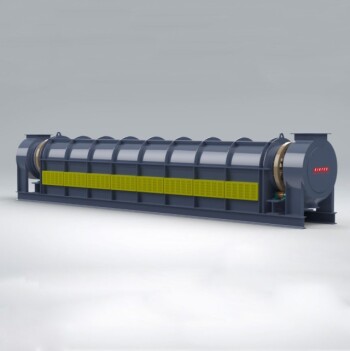
Electric Rotary Kiln Pyrolysis Furnace Plant Machine Calciner Small Rotary Kiln Rotating Furnace

Electric Rotary Kiln Pyrolysis Furnace Plant Machine Calciner Small Rotary Kiln Rotating Furnace

Electric rotary kiln - precisely controlled, it's ideal for calcination and drying of materials like lithium cobalate, rare earths, and non-ferrous metals.

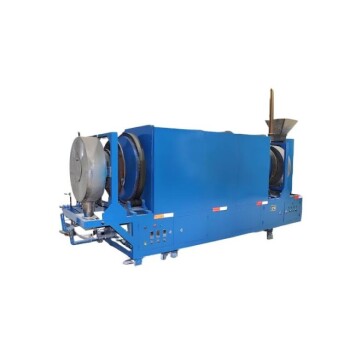
Electric Rotary Kiln Continuous Working Small Rotary Furnace Heating Pyrolysis Plant

Electric Rotary Kiln Continuous Working Small Rotary Furnace Heating Pyrolysis Plant

Efficiently calcine and dry bulk powder and lump fluid materials with an electric heating rotary furnace. Ideal for processing lithium ion battery materials and more.

1700℃ Laboratory Quartz Tube Furnace with Alumina Tube Tubular Furnace

1700℃ Laboratory Quartz Tube Furnace with Alumina Tube Tubular Furnace

Looking for a high-temperature tube furnace? Check out our 1700℃ Tube Furnace with Alumina Tube. Perfect for research and industrial applications up to 1700C.

Laboratory Muffle Oven Furnace Bottom Lifting Muffle Furnace

Laboratory Muffle Oven Furnace Bottom Lifting Muffle Furnace

Efficiently produce batches with excellent temperature uniformity using our Bottom Lifting Furnace. Features two electric lifting stages and advanced temperature control up to 1600℃.

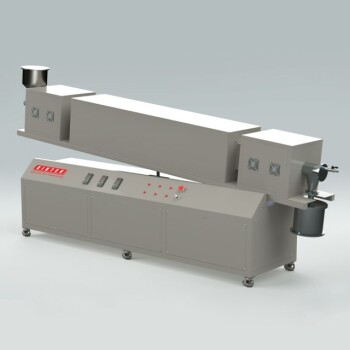
Vacuum Sealed Continuous Working Rotary Tube Furnace Rotating Tube Furnace

Vacuum Sealed Continuous Working Rotary Tube Furnace Rotating Tube Furnace

Experience efficient material processing with our vacuum-sealed rotary tube furnace. Perfect for experiments or industrial production, equipped with optional features for controlled feeding and optimized results. Order now.

1200℃ Split Tube Furnace with Quartz Tube Laboratory Tubular Furnace

1200℃ Split Tube Furnace with Quartz Tube Laboratory Tubular Furnace

KT-TF12 split tube furnace: high-purity insulation, embedded heating wire coils, and max. 1200C. Widely used for new materials and chemical vapour deposition.

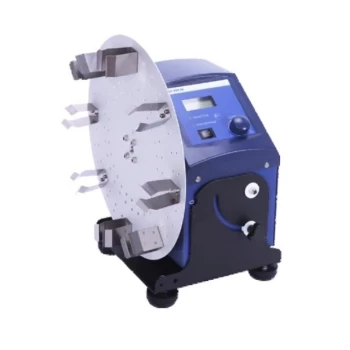
Laboratory Disc Rotary Mixer for Efficient Sample Mixing and Homogenization

Laboratory Disc Rotary Mixer for Efficient Sample Mixing and Homogenization

Efficient Laboratory Disc Rotary Mixer for Precise Sample Mixing, Versatile for Various Applications, DC Motor and Microcomputer Control, Adjustable Speed and Angle.

Graphite Vacuum Continuous Graphitization Furnace

Graphite Vacuum Continuous Graphitization Furnace

High-temperature graphitization furnace is a professional equipment for graphitization treatment of carbon materials. It is a key equipment for the production of high-quality graphite products. It has high temperature, high efficiency and uniform heating. It is suitable for various high-temperature treatments and graphitization treatments. It is widely used in metallurgy, electronics, aerospace, etc. industry.

Engineering Advanced Fine Ceramics Head Tweezers with Pointed Elbow Zirconia Ceramic Tip

Engineering Advanced Fine Ceramics Head Tweezers with Pointed Elbow Zirconia Ceramic Tip

Zirconia ceramic tweezers are a high-precision tool made of advanced ceramic materials, especially suitable for operating environments that require high precision and corrosion resistance. This type of tweezers not only has excellent physical properties, but is also popular in the medical and laboratory fields because of its biocompatibility.

High Temperature Wear-Resistant Alumina Al2O3 Plate for Engineering Advanced Fine Ceramics

High Temperature Wear-Resistant Alumina Al2O3 Plate for Engineering Advanced Fine Ceramics

High temperature wear-resistant insulating alumina plate has excellent insulation performance and high temperature resistance.

Vertical High Temperature Graphite Vacuum Graphitization Furnace

Vertical High Temperature Graphite Vacuum Graphitization Furnace

Vertical high temperature graphitization furnace for carbonization and graphitization of carbon materials up to 3100℃.Suitable for shaped graphitization of carbon fiber filaments and other materials sintered in a carbon environment.Applications in metallurgy, electronics, and aerospace for producing high-quality graphite products like electrodes and crucibles.

Zirconia Ceramic Gasket Insulating Engineering Advanced Fine Ceramics

Zirconia Ceramic Gasket Insulating Engineering Advanced Fine Ceramics

Zirconia insulating ceramic gasket has high melting point, high resistivity, low thermal expansion coefficient and other properties, making it an important high temperature resistant material, ceramic insulating material and ceramic sunscreen material.

Graphite Vacuum Furnace IGBT Experimental Graphitization Furnace

Graphite Vacuum Furnace IGBT Experimental Graphitization Furnace

IGBT experimental graphitization furnace, a tailored solution for universities and research institutions, with high heating efficiency, user-friendliness, and precise temperature control.

Shaking Incubators for Diverse Laboratory Applications

Shaking Incubators for Diverse Laboratory Applications

Precision lab shaking incubators for cell culture & research. Quiet, reliable, customizable. Get expert advice today!

Small Vacuum Heat Treat and Tungsten Wire Sintering Furnace

Small Vacuum Heat Treat and Tungsten Wire Sintering Furnace

The small vacuum tungsten wire sintering furnace is a compact experimental vacuum furnace specially designed for universities and scientific research institutes. The furnace features a CNC welded shell and vacuum piping to ensure leak-free operation. Quick-connect electrical connections facilitate relocation and debugging, and the standard electrical control cabinet is safe and convenient to operate.

Engineering Advanced Fine Alumina Al2O3 Ceramic Rod Insulated for Industrial Applications

Engineering Advanced Fine Alumina Al2O3 Ceramic Rod Insulated for Industrial Applications

Insulated alumina rod is a fine ceramic material. Alumina rods have excellent electrical insulating properties, high chemical resistance and low thermal expansion.

Precision Machined Zirconia Ceramic Ball for Engineering Advanced Fine Ceramics

Precision Machined Zirconia Ceramic Ball for Engineering Advanced Fine Ceramics

zirconia ceramic ball have the characteristics of high strength, high hardness, PPM wear level, high fracture toughness, good wear resistance, and high specific gravity.

Laboratory Vibratory Sieve Shaker Machine Slap Vibrating Sieve

Laboratory Vibratory Sieve Shaker Machine Slap Vibrating Sieve

KT-T200TAP is a slapping and oscillating sieving instrument for laboratory desktop use, with 300 rpm horizontal circular motion and 300 vertical slapping motions to simulate manual sieving to help sample particles pass through better.

Small Jaw Crusher for Laboratory and Small Mines Efficient Flexible Affordable Laboratory Ore Crusher Coal Crusher

Small Jaw Crusher for Laboratory and Small Mines Efficient Flexible Affordable Laboratory Ore Crusher Coal Crusher

Discover the small jaw crusher for efficient, flexible, and affordable crushing in labs and small mines. Ideal for coal, ores, and rocks. Learn more now!

Platinum Sheet Electrode for Laboratory and Industrial Applications

Platinum Sheet Electrode for Laboratory and Industrial Applications

Elevate your experiments with our Platinum Sheet Electrode. Crafted with quality materials, our safe and durable models can be tailored to fit your needs.


Leave Your Message