Knowledge What is the heat transfer of a vacuum oven? Mastering Radiation-Based Heating for Sensitive Materials
Author avatar

Tech Team · Kintek Solution

Updated 5 days ago

What is the heat transfer of a vacuum oven? Mastering Radiation-Based Heating for Sensitive Materials


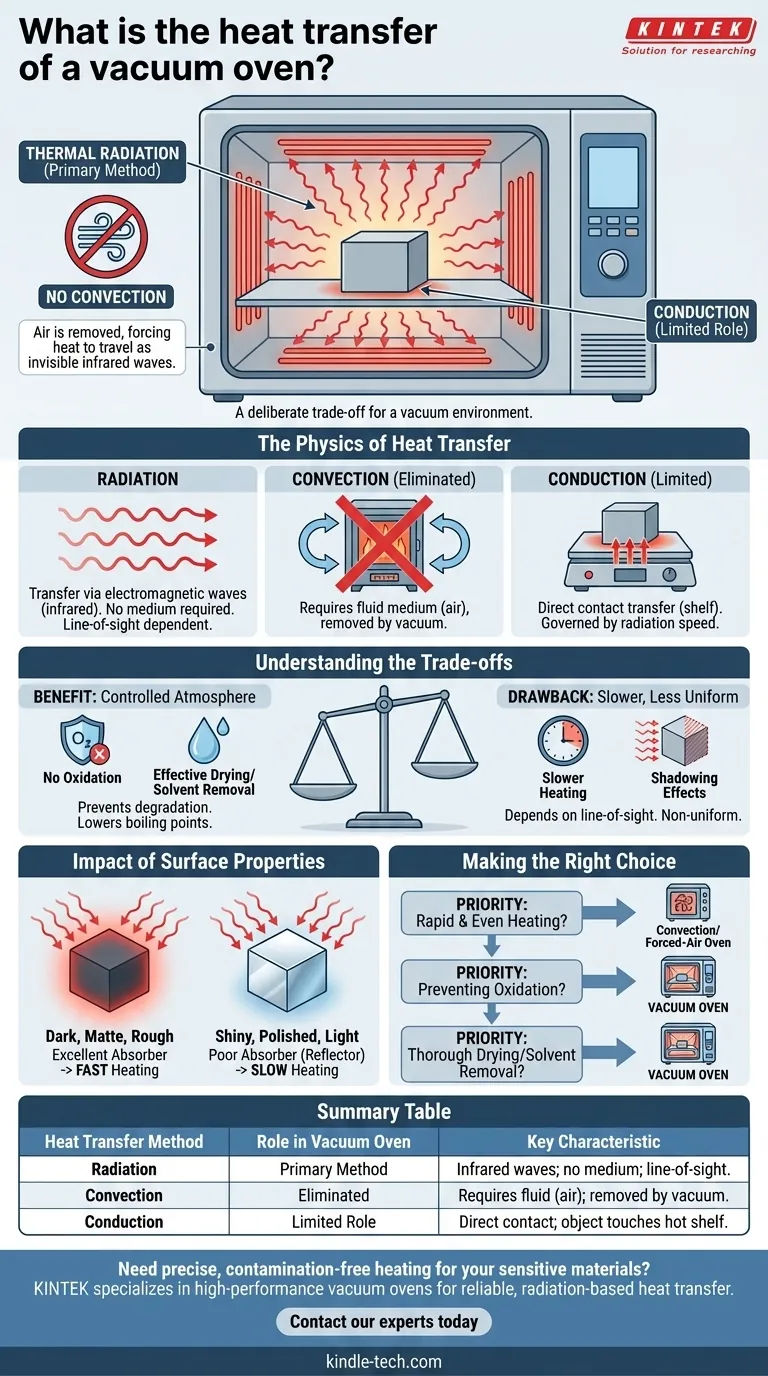
In short, a vacuum oven transfers heat almost exclusively through thermal radiation. Unlike a conventional oven that uses air to circulate warmth, a vacuum oven removes the air, forcing heat to travel as invisible infrared waves from the hot interior walls directly to the object being heated.

The critical takeaway is that removing air fundamentally changes how heat moves. A conventional oven relies on air movement (convection) for fast, even heating, while a vacuum oven depends on the much slower and line-of-sight-dependent process of radiation. This is not a flaw, but a deliberate trade-off to gain the benefits of a vacuum environment.
What is the heat transfer of a vacuum oven? Mastering Radiation-Based Heating for Sensitive Materials

The Physics of Heat Transfer in a Vacuum

To understand how a vacuum oven works, it's essential to grasp the three ways heat can move. Standard furnaces and ovens use a combination of all three, but a vacuum oven intentionally eliminates one to achieve its purpose.

How Radiation Takes Over

Radiation is the transfer of heat through electromagnetic waves, primarily in the infrared spectrum. It requires no medium to travel. The heating elements and hot inner walls of the oven radiate this energy in all directions, just as the sun radiates heat through the vacuum of space to the Earth. Any object placed inside absorbs this energy, causing its molecules to vibrate faster and its temperature to rise.

Why Convection Disappears

Convection is heat transfer through the movement of fluids (like air or water). In a conventional oven, air is heated, becomes less dense, rises, and circulates, efficiently transferring heat to all surfaces of the object inside. By creating a vacuum, you remove the vast majority of the air, thereby eliminating convection as a significant heat transfer method.

The Limited Role of Conduction

Conduction is heat transfer through direct physical contact. This still occurs in a vacuum oven, but its role is limited. The object will heat up where it touches the hot shelf, and heat will conduct through the object itself. However, because the primary heating mechanism for the shelves is also radiation, the overall process is governed by the speed of radiative heat transfer.

Understanding the Trade-offs

Choosing a vacuum oven means accepting a specific set of advantages and disadvantages driven entirely by its method of heat transfer.

The Benefit: A Controlled Atmosphere

The primary reason for using a vacuum oven is not for heating itself, but for the environment it creates. Removing air prevents oxidation and other chemical reactions that would degrade sensitive materials at high temperatures. It is also exceptionally effective at removing moisture and solvents, as the low pressure drastically reduces their boiling point, allowing them to evaporate quickly and completely.

The Drawback: Slower, Less Uniform Heating

The trade-off for this controlled atmosphere is less efficient heat transfer. Radiation is generally slower than convection. Furthermore, heating can be less uniform because it depends on an object's line-of-sight to the hot surfaces. Areas of an object "shadowed" from the radiating walls will heat much more slowly, relying only on conduction through the material itself.

The Impact of Surface Properties

How well an object heats up in a vacuum oven is highly dependent on its surface.

  • Dark, matte, or rough surfaces are excellent at absorbing radiant energy and will heat up relatively quickly.
  • Shiny, polished, or light-colored surfaces are poor absorbers (and good reflectors) of radiant energy and will take significantly longer to reach the target temperature.

Making the Right Choice for Your Goal

Selecting the right tool depends entirely on your priority.

  • If your primary focus is rapid and even heating: A convection or forced-air oven is far more effective because it uses moving air to quickly transfer heat to all surfaces.
  • If your primary focus is preventing oxidation or material degradation: A vacuum oven is the correct choice, as it removes the reactive oxygen that causes these issues during heating.
  • If your primary focus is thoroughly drying materials or removing solvents: A vacuum oven is superior because the low pressure accelerates evaporation far beyond what is possible at atmospheric pressure.

By understanding that a vacuum oven heats by radiation, you can leverage its unique atmospheric benefits while properly managing the slower, line-of-sight nature of its heat transfer.

Summary Table:

Heat Transfer Method Role in Vacuum Oven Key Characteristic
Radiation Primary Method Heat transfer via infrared waves; no medium required; line-of-sight dependent.
Convection Eliminated Requires a fluid medium (air); removed by the vacuum environment.
Conduction Limited Role Heat transfer through direct contact; occurs where the object touches the hot shelf.

Need precise, contamination-free heating for your sensitive materials?

KINTEK specializes in high-performance laboratory equipment, including vacuum ovens designed for reliable, radiation-based heat transfer. Our solutions are ideal for applications requiring oxidation prevention, thorough drying, or gentle processing of delicate samples.

Contact our experts today to find the perfect vacuum oven for your laboratory's unique needs and ensure the integrity of your most critical processes.

Visual Guide
What is the heat transfer of a vacuum oven? Mastering Radiation-Based Heating for Sensitive Materials Visual Guide

Related Products

People Also Ask

Related Products

Small Vacuum Heat Treat and Tungsten Wire Sintering Furnace

Small Vacuum Heat Treat and Tungsten Wire Sintering Furnace

The small vacuum tungsten wire sintering furnace is a compact experimental vacuum furnace specially designed for universities and scientific research institutes. The furnace features a CNC welded shell and vacuum piping to ensure leak-free operation. Quick-connect electrical connections facilitate relocation and debugging, and the standard electrical control cabinet is safe and convenient to operate.

Benchtop Laboratory Vacuum Freeze Dryer

Benchtop Laboratory Vacuum Freeze Dryer

Benchtop laboratory freeze dryer for efficient lyophilization of biological, pharmaceutical, and food samples. Features intuitive touchscreen, high-performance refrigeration, and durable design. Preserve sample integrity—consult now!

Vacuum Heat Treat Furnace with Ceramic Fiber Liner

Vacuum Heat Treat Furnace with Ceramic Fiber Liner

Vacuum furnace with polycrystalline ceramic fiber insulation liner for excellent heat insulation and uniform temperature field. Choose from 1200℃ or 1700℃ max. working temperature with high vacuum performance and precise temperature control.

Graphite Vacuum Furnace High Thermal Conductivity Film Graphitization Furnace

Graphite Vacuum Furnace High Thermal Conductivity Film Graphitization Furnace

The high thermal conductivity film graphitization furnace has uniform temperature, low energy consumption and can operate continuously.

Vacuum Hot Press Furnace Machine for Lamination and Heating

Vacuum Hot Press Furnace Machine for Lamination and Heating

Experience clean and precise lamination with Vacuum Lamination Press. Perfect for wafer bonding, thin-film transformations, and LCP lamination. Order now!

Molybdenum Vacuum Heat Treat Furnace

Molybdenum Vacuum Heat Treat Furnace

Discover the benefits of a high-configuration molybdenum vacuum furnace with heat shield insulation. Ideal for high-purity, vacuum environments like sapphire crystal growth and heat treatment.

Vacuum Dental Porcelain Sintering Furnace

Vacuum Dental Porcelain Sintering Furnace

Get precise and reliable results with KinTek's Vacuum Porcelain Furnace. Suitable for all porcelain powders, it features hyperbolic ceramic furnace function, voice prompt, and automatic temperature calibration.

Benchtop Laboratory Freeze Dryer for Lab Use

Benchtop Laboratory Freeze Dryer for Lab Use

Premium benchtop laboratory freeze dryer for lyophilization, preserving samples with ≤ -60°C cooling. Ideal for pharmaceuticals & research.

Dental Porcelain Zirconia Sintering Ceramic Vacuum Press Furnace

Dental Porcelain Zirconia Sintering Ceramic Vacuum Press Furnace

Get precise dental results with Dental Vacuum Press Furnace. Automatic temperature calibration, low noise tray, and touch screen operation. Order now!

Vacuum Heat Treat and Molybdenum Wire Sintering Furnace for Vacuum Sintering

Vacuum Heat Treat and Molybdenum Wire Sintering Furnace for Vacuum Sintering

A vacuum molybdenum wire sintering furnace is a vertical or bedroom structure, which is suitable for withdrawal, brazing, sintering and degassing of metal materials under high vacuum and high temperature conditions. It is also suitable for dehydroxylation treatment of quartz materials.

Ultra-High Temperature Graphite Vacuum Graphitization Furnace

Ultra-High Temperature Graphite Vacuum Graphitization Furnace

The ultra-high temperature graphitization furnace utilizes medium frequency induction heating in a vacuum or inert gas environment. The induction coil generates an alternating magnetic field, inducing eddy currents in the graphite crucible, which heats up and radiates heat to the workpiece, bringing it to the desired temperature. This furnace is primarily used for graphitization and sintering of carbon materials, carbon fiber materials, and other composite materials.

Laboratory Sterilizer Lab Autoclave Pulse Vacuum Lifting Sterilizer

Laboratory Sterilizer Lab Autoclave Pulse Vacuum Lifting Sterilizer

The pulse vacuum lifting sterilizer is a state-of-the-art equipment for efficient and precise sterilization. It uses pulsating vacuum technology, customizable cycles, and a user-friendly design for easy operation and safety.

Graphite Vacuum Furnace IGBT Experimental Graphitization Furnace

Graphite Vacuum Furnace IGBT Experimental Graphitization Furnace

IGBT experimental graphitization furnace, a tailored solution for universities and research institutions, with high heating efficiency, user-friendliness, and precise temperature control.

2200 ℃ Graphite Vacuum Heat Treat Furnace

2200 ℃ Graphite Vacuum Heat Treat Furnace

Discover the power of the KT-VG Graphite Vacuum Furnace - with a maximum working temperature of 2200℃, it's perfect for vacuum sintering of various materials. Learn more now.

Laboratory Sterilizer Lab Autoclave Vertical Pressure Steam Sterilizer for Liquid Crystal Display Automatic Type

Laboratory Sterilizer Lab Autoclave Vertical Pressure Steam Sterilizer for Liquid Crystal Display Automatic Type

Liquid crystal display automatic vertical sterilizer is a safe, reliable and automatic control sterilization equipment, which is composed of heating system, microcomputer control system and overheating and overvoltage protection system.

Oil Free Diaphragm Vacuum Pump for Laboratory and Industrial Use

Oil Free Diaphragm Vacuum Pump for Laboratory and Industrial Use

Oil-free diaphragm vacuum pump for labs: clean, reliable, chemical-resistant. Ideal for filtration, SPE, and rotary evaporation. Maintenance-free operation.

HFCVD Machine System Equipment for Drawing Die Nano-Diamond Coating

HFCVD Machine System Equipment for Drawing Die Nano-Diamond Coating

The nano-diamond composite coating drawing die uses cemented carbide (WC-Co) as the substrate, and uses the chemical vapor phase method ( CVD method for short ) to coat the conventional diamond and nano-diamond composite coating on the surface of the inner hole of the mold.

Laboratory Test Sieves and Sieving Machines

Laboratory Test Sieves and Sieving Machines

Precision lab test sieves & sieving machines for accurate particle analysis. Stainless steel, ISO-compliant, 20μm-125mm range. Request specs now!

Vacuum Sealed Continuous Working Rotary Tube Furnace Rotating Tube Furnace

Vacuum Sealed Continuous Working Rotary Tube Furnace Rotating Tube Furnace

Experience efficient material processing with our vacuum-sealed rotary tube furnace. Perfect for experiments or industrial production, equipped with optional features for controlled feeding and optimized results. Order now.

Anti-Cracking Press Mold for Lab Use

Anti-Cracking Press Mold for Lab Use

The anti-cracking press mold is a specialized equipment designed for molding various shapes and sizes of film using high pressure and electric heating.


Leave Your Message