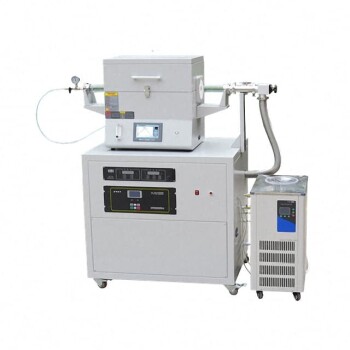
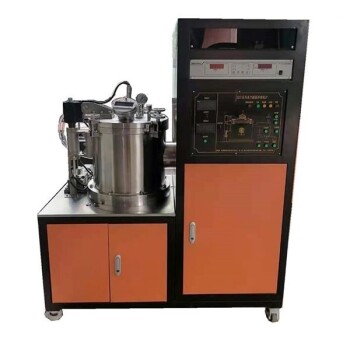
The vacuum tube furnace is the critical enabler for reactive infiltration. It provides a high-vacuum environment (typically up to 10 mTorr) that prevents the oxidation of molten aluminum at process temperatures reaching 1200°C while simultaneously degassing the microscopic pores of the Boron Carbide ($B_4C$) skeleton. This controlled environment is essential for promoting the interfacial reactions required to create a fully dense, high-performance metal-ceramic composite.
The central takeaway is that a vacuum tube furnace ensures the chemical purity and structural integrity of Al/$B_4C$ composites by eliminating atmospheric interference, which allows molten metal to flow freely into the ceramic preform through capillary action.
Preventing Atmospheric Contamination and Oxidation
Protecting Molten Aluminum at High Temperatures
At the infiltration temperature of 1200°C, aluminum is highly reactive and will instantly form an oxide scale if oxygen is present. This oxide layer acts as a physical barrier, preventing the molten metal from bonding with the ceramic or flowing into the preform.
The vacuum tube furnace isolates the metal from oxygen, maintaining the purity of the metal matrix. This ensures the aluminum remains in a liquid state capable of reacting chemically with the boron carbide rather than becoming trapped in a shell of alumina.
Preserving Boron Carbide Purity
High-temperature environments (up to 1500°C) are often required to preheat $B_4C$ green bodies to induce initial necking of particles. Without a vacuum or inert gas environment, the $B_4C$ particles would oxidize, compromising the chemical integrity of the final composite.
By maintaining a vacuum, the furnace ensures the internal pores of the ceramic preform remain clean and free of contaminants. This cleanliness is a prerequisite for the chemical reactions that occur during the infiltration phase.
Facilitating the Infiltration Mechanism
Degassing Microscopic Pores
Ceramic skeletons contain trapped gases within their micropores that can create backpressure, blocking the entry of molten aluminum. A vacuum environment effectively removes these residual gases, clearing the path for the metal.
This degassing process is vital for achieving a dense composite material. Without it, the final product would likely suffer from porosity, significantly weakening its mechanical properties.
Enhancing Wettability and Capillary Action
Wettability refers to the ability of a liquid to maintain contact with a solid surface. In a vacuum, the absence of surface contaminants on the $B_4C$ particles dramatically improves the wettability of the ceramic preform.
Improved wettability allows for rapid capillary action, where the molten aluminum is "sucked" into the pores of the green body. This ensures that even the smallest voids are filled by the metal phase.
Enabling Chemical Phase Transformation
Driving Interfacial Reactions
The vacuum environment facilitates a specific interfacial reaction between the aluminum and the boron carbide. This reaction leads to the formation of reinforcing phases such as $Al_3BC$ and $AlB_2$.
These new phases are what bind the metal and ceramic together at the atomic level. The furnace provides the stable thermal field necessary for these diffusion kinetics to occur uniformly throughout the material.
Ensuring Complete Structural Integrity
Because the vacuum allows for complete filling of the ceramic skeleton, the resulting material is a true composite. The metal phase acts as a continuous matrix that supports the hard ceramic particles.
This reactive infiltration mechanism transforms a loose or porous compact into a high-strength, dense material. This would be impossible to achieve in a standard atmospheric furnace due to the interference of air and moisture.
Understanding the Trade-offs
Vacuum vs. Inert Gas Protection
While a vacuum is superior for degassing, some processes may utilize argon protection within the tube furnace. Argon can prevent oxidation, but it does not provide the same level of pore-clearing capability as a high-vacuum environment (10 mTorr).
Thermal Gradients in Tube Furnaces
Tube furnaces can sometimes experience temperature gradients near the ends of the tube. It is critical to ensure the sample is placed within the "constant temperature zone" to prevent uneven infiltration or incomplete reactions.
Making the Right Choice for Your Goal
- If your primary focus is maximum material density: Utilize a high-vacuum setting (10 mTorr) to ensure total degassing of the ceramic micropores before infiltration.
- If your primary focus is preventing metal oxidation: Ensure the furnace seals are rated for high-temperature operation to maintain a strict oxygen-free environment throughout the heating cycle.
- If your primary focus is achieving specific reinforcing phases: Maintain precise temperature control at 1200°C to facilitate the chemical transition into $Al_3BC$ and $AlB_2$.
By leveraging the controlled environment of a vacuum tube furnace, you can master the complex chemistry of reactive infiltration to produce superior metal-ceramic composites.
Summary Table:
| Key Feature of Vacuum Furnace | Role in Reactive Infiltration | Impact on Final Composite |
|---|---|---|
| High-Vacuum (10 mTorr) | Degasses micropores & prevents oxidation | Eliminates porosity and oxide barriers |
| Precise Thermal Control | Maintains stable 1200°C-1500°C field | Drives interfacial Al3BC/AlB2 phases |
| Inert Gas Integration | Optional protection (Argon) | Prevents contamination during cooling |
| Uniform Heat Zone | Ensures consistent diffusion kinetics | Guarantees complete structural integrity |
Master Your Metal-Ceramic Synthesis with KINTEK
Achieving a fully dense, oxide-free Al/$B_4C$ composite requires more than just heat—it requires the precision of a perfectly controlled vacuum environment. KINTEK specializes in high-performance laboratory equipment designed to meet the rigorous demands of advanced material science.
Our advanced vacuum tube furnaces provide the high-vacuum precision and thermal stability necessary for reactive infiltration, ensuring superior wettability and the formation of critical reinforcing phases. To support your entire workflow, KINTEK offers a comprehensive portfolio including:
- High-Temperature Furnaces: Muffle, tube, vacuum, CVD, and atmosphere models.
- Sample Preparation: Hydraulic presses (pellet, hot, isostatic), crushing/milling systems, and sieving equipment.
- Advanced Reactors: High-temperature high-pressure reactors and autoclaves.
- Specialized Consumables: High-purity ceramics, crucibles, and PTFE products.
Whether you are a researcher developing next-generation materials or an industrial partner seeking reliable OEM/ODM solutions, KINTEK delivers the technical excellence and supply reliability you need to succeed.
Contact our technical experts today to find the ideal furnace configuration for your laboratory and elevate your material performance.
References
- Jesus Rivera, Joshua D. Kuntz. Mechanical responses of architected boron carbide-aluminum lattice composites fabricated via reactive metallic infiltration of hierarchical pore structures. DOI: 10.1016/j.mtcomm.2023.107550
This article is also based on technical information from Kintek Solution Knowledge Base .
Related Products
- Vacuum Sealed Continuous Working Rotary Tube Furnace Rotating Tube Furnace
- Laboratory High Pressure Vacuum Tube Furnace
- Laboratory Vacuum Tilt Rotary Tube Furnace Rotating Tube Furnace
- Split Chamber CVD Tube Furnace with Vacuum Station Chemical Vapor Deposition System Equipment Machine
- 1200℃ Controlled Atmosphere Furnace Nitrogen Inert Atmosphere Furnace
People Also Ask
- What are the advantages of using a rotary tube furnace for MoVOx catalysts? Elevate Uniformity and Crystallinity
- What are the process advantages of using a rotary tube furnace for WS2 powder? Achieve Superior Material Crystallinity
- Why is a vacuum tube furnace with argon protection required for RGO/Cu? Ensure Conductivity and Material Purity
- Why is a rotary tube furnace preferred over a fixed tube furnace for the carbonization of asphaltenes? Superior Quality
- Why is a rotary tube furnace recommended for the calcination stage of potassium vanadium oxide catalysts? Optimize Purity