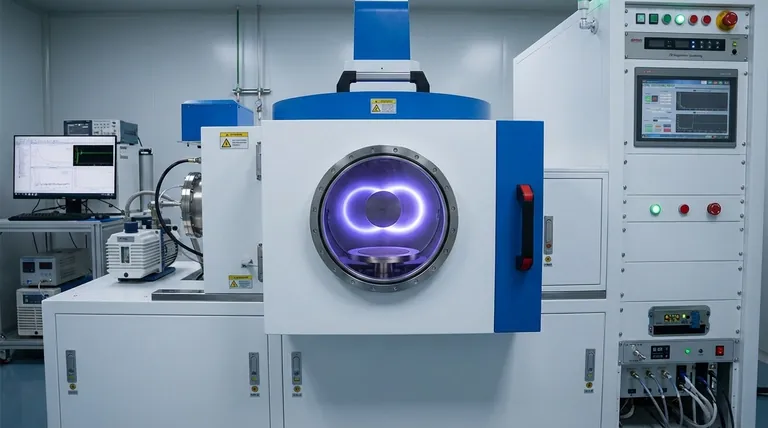
In DC magnetron sputtering, the magnetic field is a critical enhancement that dramatically increases the efficiency of the thin-film deposition process. It functions by creating a magnetic "trap" for electrons near the surface of the material being deposited (the target). This confinement intensifies the plasma responsible for sputtering, leading to faster, more controlled deposition rates while protecting the substrate from unwanted energy bombardment.
The fundamental problem with simple DC sputtering is its low efficiency and high operating pressure. The magnetic field in a magnetron system solves this by acting as an electron trap, creating a dense, localized plasma that significantly increases sputtering rates and allows for lower process pressures, all while protecting the substrate from damaging heat.
The Foundation: How DC Sputtering Works
DC sputtering is a type of Physical Vapor Deposition (PVD) that occurs in a vacuum chamber. The goal is to transfer atoms from a source material onto a substrate to form a thin film.
The Basic Setup: Target, Substrate, and Gas
The system consists of a target (the material to be deposited) which is given a large negative DC voltage, making it the cathode. The object to be coated, the substrate, acts as the anode. The chamber is filled with a small amount of an inert gas, typically Argon (Ar).
The Bombardment Process
The high negative voltage on the target attracts positively charged Argon ions (Ar+) from the surrounding gas. These ions accelerate and collide with the target surface with significant energy.
This bombardment physically knocks out, or "sputters," atoms from the target material. These newly freed atoms travel through the vacuum and condense on the substrate, gradually building a thin, uniform film.
The Limitation of Simple DC Sputtering
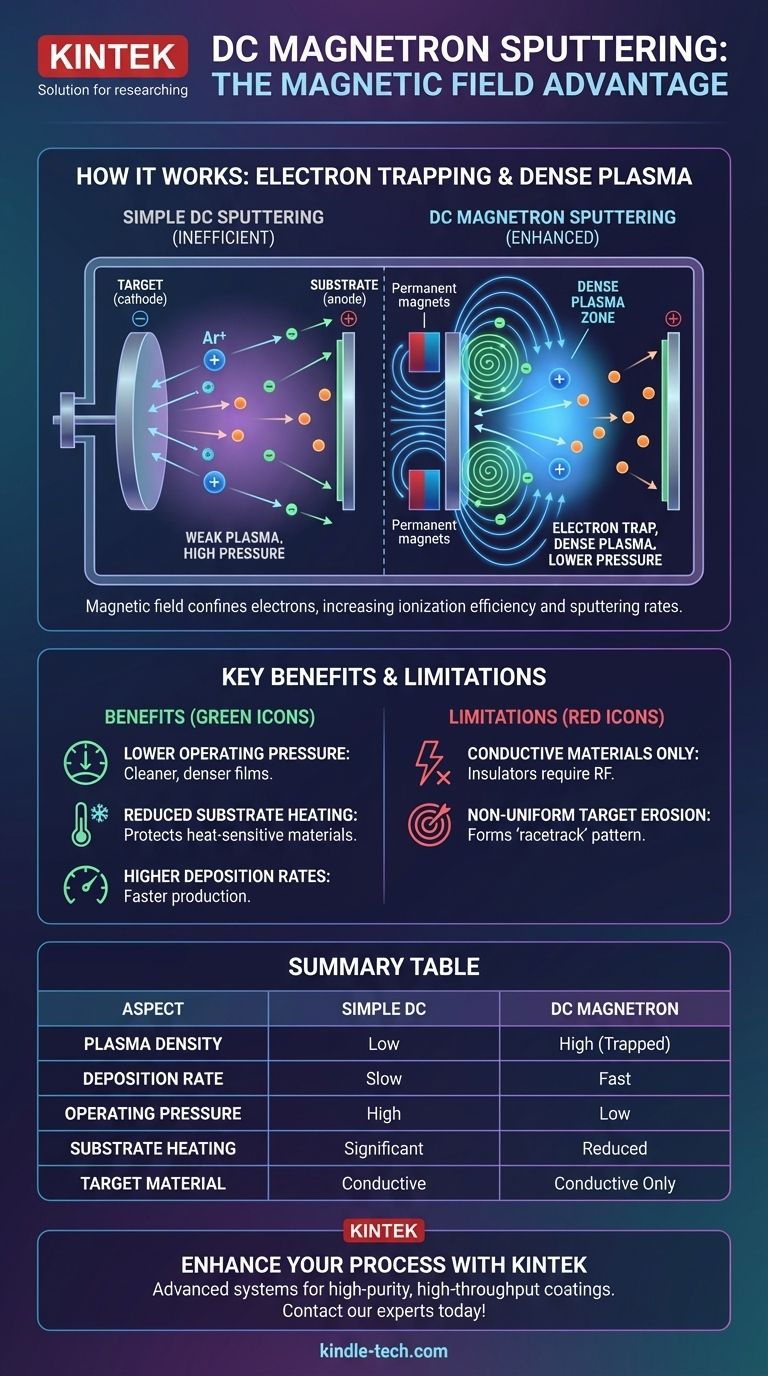
Without a magnetic field, this process is inefficient. The plasma is weak, and many of the secondary electrons released from the target during bombardment travel directly to the substrate or chamber walls without causing further ionization. This requires higher gas pressures to sustain the plasma, which can lead to gas incorporation and impurities in the final film.
The "Magnetron" Advantage: Adding the Magnetic Field
The introduction of a magnetron—a configuration of permanent magnets placed behind the target—is what elevates the process to magnetron sputtering.
Creating an Electron Trap
The magnets generate a field that is parallel to the target's surface. This magnetic field does not significantly affect the heavy Argon ions, but it has a profound effect on the light secondary electrons that are also ejected from the target during bombardment.
The field forces these electrons into a spiral trajectory, effectively trapping them in a zone close to the target surface. Instead of escaping, they travel a much longer path.
The Impact on Plasma Density
Because the electrons are confined and travel a longer distance, the probability of them colliding with neutral Argon gas atoms increases dramatically. Each collision has the potential to ionize an Argon atom (Ar → Ar⁺ + e⁻).
This highly efficient ionization process creates a dense, self-sustaining plasma concentrated directly in front of the target.
The Result: Higher Sputtering Rates
This dense plasma contains a much higher concentration of Ar⁺ ions available to bombard the target. This directly leads to a significantly higher sputtering rate, meaning films can be deposited much faster than with simple DC sputtering.
Understanding the Key Benefits and Trade-offs
The magnetic field enhancement provides several distinct advantages, but it's also important to understand its limitations.
Benefit: Lower Operating Pressure
Because the magnetic field makes ionization so efficient, the plasma can be sustained at much lower gas pressures. This reduces the chance of sputtered atoms colliding with gas atoms on their way to the substrate, resulting in a cleaner, denser, and higher-purity film.
Benefit: Reduced Substrate Heating
By trapping electrons near the target, the magnetic field prevents them from bombarding the substrate. This significantly reduces the heat load on the part being coated, making the process suitable for temperature-sensitive materials like plastics and polymers.
Limitation: Conductive Materials Only
Standard DC magnetron sputtering requires the target material to be electrically conductive. An insulating (dielectric) target would accumulate a positive charge from ion bombardment, effectively neutralizing the negative bias and halting the sputtering process. For insulating materials, Radio Frequency (RF) sputtering is used instead.
Limitation: Non-Uniform Target Erosion
The area where the magnetic field traps the electrons forms a distinct "racetrack" pattern on the target's surface. Sputtering is most intense in this zone, leading to uneven erosion of the target material. This means only a fraction of the target material is consumed before it must be replaced.
Making the Right Choice for Your Application
DC magnetron sputtering is a powerful and widely used technique for thin-film deposition. Choosing it depends on your specific material and production goals.
- If your primary focus is high-throughput production of metallic coatings: DC magnetron sputtering is the ideal choice due to its exceptionally fast deposition rates and suitability for industrial automation.
- If your primary focus is depositing high-purity films with excellent adhesion: The ability to operate at lower pressures minimizes contamination and creates dense, well-bonded coatings.
- If you are working with heat-sensitive substrates: The confined plasma and reduced electron bombardment make this a far safer choice than deposition methods that generate significant heat.
Ultimately, understanding the role of the magnetic field transforms magnetron sputtering from a concept into a precise and powerful tool for engineering materials at the atomic level.
Summary Table:
| Aspect | Simple DC Sputtering | DC Magnetron Sputtering |
|---|---|---|
| Plasma Density | Low | High (due to magnetic confinement) |
| Deposition Rate | Slow | Fast |
| Operating Pressure | High | Low |
| Substrate Heating | Significant | Reduced |
| Target Material | Conductive | Conductive (only) |
Ready to enhance your thin-film deposition process? KINTEK specializes in advanced lab equipment, including DC magnetron sputtering systems designed for high-throughput production of high-purity metallic coatings. Our solutions deliver faster deposition rates and superior film quality while protecting temperature-sensitive substrates. Contact our experts today to find the perfect sputtering system for your laboratory's specific needs!
Visual Guide
Related Products
- Chemical Vapor Deposition CVD Equipment System Chamber Slide PECVD Tube Furnace with Liquid Gasifier PECVD Machine
- Microwave Plasma Chemical Vapor Deposition MPCVD Machine System Reactor for Lab and Diamond Growth
- HFCVD Machine System Equipment for Drawing Die Nano-Diamond Coating
- Customer Made Versatile CVD Tube Furnace Chemical Vapor Deposition Chamber System Equipment
- 915MHz MPCVD Diamond Machine Microwave Plasma Chemical Vapor Deposition System Reactor
People Also Ask
- What are the processes of vapor phase deposition? Understand CVD vs. PVD for Superior Thin Films
- What are the core advantages of PE-CVD in OLED encapsulation? Protect Sensitive Layers with Low-Temp Film Deposition
- What are the advantages of chemical vapor deposition? Achieve Superior Thin Films for Your Lab
- What is the chemical vapor deposition growth process? Build Superior Thin Films from the Atom Up
- How expensive is chemical vapor deposition? Understanding the True Cost of High-Performance Coating