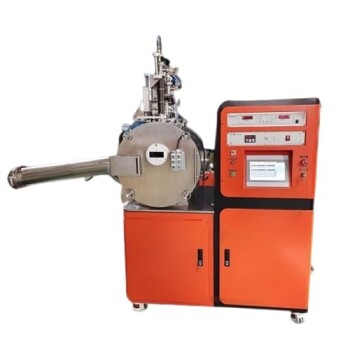
The main advantage of Inductively Coupled Plasma Chemical Vapour Deposition (ICPCVD) is its capability to generate high-density plasma. This allows for the deposition of high-quality, low-damage dielectric films at significantly lower temperatures than traditional methods.
Core Insight: By decoupling plasma generation from the substrate, ICPCVD enables the processing of highly temperature-sensitive devices. It uniquely combines the structural integrity of high-density films with a thermal profile low enough to protect delicate substrates.
The Power of High-Density Plasma
Superior Film Quality at Low Temperatures
The defining characteristic of ICPCVD is the generation of high-density plasma.
This high density allows chemical reactions to occur efficiently without relying on high thermal energy. Consequently, you can deposit films that are dense, stable, and high-quality without subjecting the substrate to extreme heat.
Minimizing Substrate Damage
Traditional deposition methods often require high ion bombardment or high temperatures to achieve dense films, which can damage sensitive underlying layers.
ICPCVD mitigates this issue. The technique creates low-damage dielectric films, preserving the electrical and structural integrity of the device being processed.
Processing Capabilities and Versatility
Handling Temperature-Sensitive Applications
The low-temperature capability of ICPCVD is not just a marginal improvement; it opens up entirely new processing windows.
Systems can operate with electrode temperatures ranging from 5°C to 400°C. This makes it possible to coat substrates that would otherwise degrade or melt under standard Chemical Vapor Deposition (CVD) conditions.
Broad Material Compatibility
Because the process relies on chemical precursors and plasma rather than thermal evaporation alone, it supports a wide variety of materials.
You can effectively deposit materials such as SiO2, Si3N4, SiON, Si, and SiC. This versatility applies even when the substrate temperature is maintained as low as 5°C.
Operational Considerations and Trade-offs
Geometry and Coverage
While ICPCVD excels in film quality, it shares the general benefits of CVD regarding geometry.
Unlike Physical Vapor Deposition (PVD), which is a line-of-sight process, CVD-based techniques use gaseous reactants. This allows for excellent "throwing power," meaning the process can effectively coat restricted access surfaces, deep recesses, and complex shapes with uniform thickness.
Production Efficiency
The process is designed for scalability and economic production.
ICPCVD systems can provide process uniformity on wafers up to 200mm. Furthermore, like general CVD, it supports batch processing, allowing many parts to be coated simultaneously to reduce unit costs.
Making the Right Choice for Your Goal
To determine if ICPCVD is the correct solution for your specific application, consider your primary constraints:
- If your primary focus is temperature sensitivity: Choose ICPCVD for its ability to deposit high-quality films at temperatures as low as 5°C, protecting delicate device structures.
- If your primary focus is complex geometries: Rely on this method for its non-line-of-sight capability, which ensures uniform coverage on irregular shapes and deep recesses.
- If your primary focus is film integrity: Utilize ICPCVD to achieve low-porosity, high-purity films with minimal damage to the underlying substrate.
ICPCVD stands out as the definitive choice when you require the density of high-temperature films without the associated thermal penalty.
Summary Table:
| Key Feature | Core Benefit | Material Applications |
|---|---|---|
| High-Density Plasma | Superior film quality without needing high thermal energy | SiO2, Si3N4, SiON |
| Low Thermal Profile | Safe processing from 5°C to 400°C for sensitive devices | Si, SiC, delicate substrates |
| Low Ion Damage | Preserves electrical and structural integrity of the substrate | Semiconductor & Dielectric films |
| Non-Line-of-Sight | Excellent throwing power for complex shapes and recesses | Uniform coating for 3D structures |
Elevate Your Thin-Film Research with KINTEK
Ready to achieve superior film integrity without the risk of thermal damage? KINTEK specializes in high-performance laboratory equipment, offering a comprehensive range of CVD, PECVD, and MPCVD systems tailored for precision material science.
Beyond deposition, our portfolio features advanced high-temperature furnaces, high-pressure reactors, and specialized battery research tools designed to optimize your laboratory's efficiency. Whether you are working with delicate semiconductors or complex industrial coatings, our experts are here to provide the high-quality consumables and systems you need.
Contact KINTEK today to discover how our customized solutions can transform your production process and protect your most sensitive innovations!
Related Products
- Microwave Plasma Chemical Vapor Deposition MPCVD Machine System Reactor for Lab and Diamond Growth
- Chemical Vapor Deposition CVD Equipment System Chamber Slide PECVD Tube Furnace with Liquid Gasifier PECVD Machine
- Customer Made Versatile CVD Tube Furnace Chemical Vapor Deposition Chamber System Equipment
- Cylindrical Resonator MPCVD Machine System Reactor for Microwave Plasma Chemical Vapor Deposition and Lab Diamond Growth
- RF PECVD System Radio Frequency Plasma-Enhanced Chemical Vapor Deposition RF PECVD
People Also Ask
- How does a microwave plasma reactor facilitate the synthesis of diamond? Master MPCVD with Precision Technology
- What are the advantages of a Microwave Plasma CVD reactor for MCD/NCD coatings? Precision Multilayer Diamond Engineering
- How do vacuum pumps and valves collaborate in MPCVD? Achieve Precise Pressure Control for Superior CNT Synthesis
- How does MPCVD work? A Guide to Low-Temperature, High-Quality Film Deposition
- What is microwave plasma chemical vapor deposition? A Guide to High-Purity Diamond Film Growth