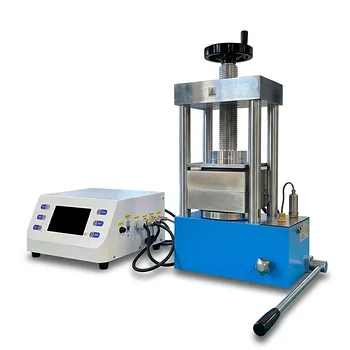
The primary mechanism of a precision hydraulic hot press is the controlled application of heat and force to alter the physical state of the ionomer within the electrode assembly. By maintaining specific parameters—typically 155 °C and 2.4 MPa—the press induces thermoplastic softening, which allows the catalyst layer to detach from its temporary supporting film and bond permanently to the Nafion proton exchange membrane.
The core principle is thermoplastic softening combined with hydraulic force. The heat renders the ionomer pliable, while the pressure forces a "mechanical interlock" between layers, ensuring low contact resistance and structural integrity.
The Physics of the Transfer Process
Thermoplastic Softening
The fundamental mechanism driving the decal transfer method is the manipulation of the ionomer's physical state.
At specific elevated temperatures, such as 155 °C, the ionomer transitions from a rigid solid to a softened, viscoelastic state. This softening is critical because it makes the material receptive to bonding without degrading its chemical structure.
Hydraulic Pressure Application
Once the ionomer is softened, the hydraulic press delivers a constant, uniform pressure, often around 2.4 MPa.
This pressure is necessary to force the catalyst layer against the membrane. It overcomes the surface tension and physical gaps that exist between the distinct layers when they are merely stacked.
The Decal Release
The combination of heat and pressure facilitates the complete transfer of the catalyst layer.
Originally coated on a supporting "decal" film, the catalyst adheres preferentially to the softened Nafion membrane rather than the support film. Upon cooling and pressure release, the support film can be peeled away, leaving the catalyst layer perfectly attached to the membrane.
Achieving Electrochemical Performance
Tight Mechanical Interlocking
The mechanism goes beyond simple surface adhesion; it creates a physical merger of materials.
The hydraulic force pushes the softened catalyst layer into the surface texture of the membrane. This results in tight mechanical interlocking, where the two layers physically grip each other at a microscopic level.
Reducing Contact Resistance
The ultimate goal of this mechanical process is electrochemical efficiency.
By eliminating microscopic air gaps and ensuring a seamless interface, the hot press significantly reduces contact resistance. This ensures that electrons and protons can move freely between the membrane and the catalyst layer during fuel cell operation.
Understanding the Trade-offs
Parameter Precision
The mechanism relies entirely on the precision of the applied heat and pressure.
If the temperature is too low, the ionomer will not soften sufficiently to bond; if the pressure is too low, the transfer will be incomplete. Conversely, excessive heat or pressure can damage the delicate Nafion membrane or crush the porous structure of the catalyst layer.
Time Sensitivity
While temperature and pressure are the active variables, the duration of the press is the control variable.
The press must hold the conditions long enough for the thermal energy to permeate the assembly and for the flow of the softened ionomer to occur. Cutting this duration short interrupts the mechanical interlocking process, leading to delamination later.
Optimizing the Decal Transfer
If your primary focus is Structural Integrity:
- Ensure the pressure (e.g., 2.4 MPa) is uniform across the entire active area to achieve consistent mechanical interlocking and prevent localized delamination.
If your primary focus is Electrochemical Efficiency:
- Calibrate the temperature (e.g., 155 °C) to maximize thermoplastic softening, which directly minimizes contact resistance at the membrane-catalyst interface.
Mastering the hot press mechanism is not just about fusing layers; it is about engineering the perfect interface for ion transport.
Summary Table:
| Parameter | Typical Setting | Function in Mechanism |
|---|---|---|
| Temperature | 155 °C | Induces thermoplastic softening of the ionomer for bonding. |
| Hydraulic Pressure | 2.4 MPa | Ensures mechanical interlocking and eliminates air gaps. |
| Process Goal | Decal Transfer | Moves catalyst from support film to Nafion membrane. |
| Outcome | Low Resistance | Optimizes electron/proton flow for fuel cell efficiency. |
Elevate Your Fuel Cell Research with KINTEK Precision
Achieving the perfect mechanical interlock in Membrane Electrode Assemblies (MEA) requires uncompromising accuracy. KINTEK specializes in advanced laboratory hydraulic presses (pellet, hot, and isostatic) engineered to maintain the precise thermal and pressure profiles necessary for successful decal transfer.
Our comprehensive range of laboratory equipment—from high-temperature furnaces and vacuum systems to specialized electrolytic cells and battery research tools—empowers researchers to minimize contact resistance and maximize electrochemical performance.
Ready to optimize your fabrication process? Contact KINTEK today to discover how our high-precision solutions can enhance your laboratory's structural and electrochemical outcomes.
References
- Sebastian Möhle, Peter Strasser. Iridium Oxide Inverse Opal Anodes with Tailored Porosity for Efficient PEM Electrolysis. DOI: 10.1002/adfm.202501261
This article is also based on technical information from Kintek Solution Knowledge Base .
Related Products
- Automatic High Temperature Heated Hydraulic Press Machine with Heated Plates for Lab
- Heated Hydraulic Press Machine with Heated Plates for Vacuum Box Laboratory Hot Press
- Manual High Temperature Heated Hydraulic Press Machine with Heated Plates for Lab
- 24T 30T 60T Heated Hydraulic Press Machine with Heated Plates for Laboratory Hot Press
- Heated Hydraulic Press Machine with Heated Plates for Vacuum Box Laboratory Hot Press
People Also Ask
- What is a heated hydraulic press used for? Essential Tool for Curing, Molding, and Laminating
- Why is a heated hydraulic press used for warm pressing NASICON green tapes? Optimize Your Solid Electrolyte Density
- Why is a heated laboratory hydraulic press necessary for composite laminates? Achieve Void-Free Structural Integrity
- What is a hot hydraulic press? Harness Heat and Pressure for Advanced Manufacturing
- Why is the heating function of a laboratory hydraulic press essential for MEA assembly in DEFC? Optimize Cell Bonding