The primary function of a high-speed magnetic stirrer is to drive the highly uniform diffusion of palladium salt precursors throughout a gold sol. By operating at intense speeds, such as 1000 rpm, the stirrer generates the mixing efficiency required to prepare the system for hydrogen reduction.
Core Takeaway: The success of this synthesis relies on eliminating local concentration differences before the reduction reaction begins. High-speed stirring ensures that palladium covers the gold surface evenly—ranging from 10 sc% to 300 sc%—rather than aggregating unevenly or leaving surfaces exposed.
The Mechanics of Uniform Diffusion
To understand why high-speed stirring is non-negotiable, you must look at what happens at the molecular level during the mixing process.
Eliminating Concentration Gradients
When palladium precursors are introduced to a gold sol, they do not naturally disperse instantly. Without intervention, "hotspots" of high concentration form near the injection point.
High-speed stirring creates powerful convection that disrupts these local gradients. This ensures the palladium salt is equally available to all gold nanoparticles in the solution simultaneously.
The Role of Mechanical Shear
The "high-speed" aspect (e.g., 1000 rpm) is critical because it generates high-intensity mechanical shear.
This shear force is what physically moves the fluid rapidly enough to achieve homogeneity before the chemical reaction (reduction) takes over. It bridges the gap between macroscopic addition of chemicals and microscopic surface coating.
Impact on Nanostructure
The physical mixing process directly dictates the chemical quality of the final nanoparticle.
Enabling Controlled Coverage
The ultimate goal of this synthesis is specific surface coverage, measured in surface coverage percentage (sc%).
By ensuring uniform diffusion, the stirrer allows you to achieve precise coverage ranging from 10 sc% to 300 sc%. This means you can control whether you are creating a partial sub-monolayer or a multi-layer shell.
Facilitating Hydrogen Reduction
The mixing efficiency provided by the stirrer is a prerequisite for the hydrogen reduction step.
If the palladium salt is not uniformly distributed when reduction begins, the resulting metal deposition will be chaotic. Uniform diffusion ensures that as the palladium reduces, it lands on the gold surface in a controlled manner.
Understanding the Trade-offs
While high-speed stirring is essential, it is important to understand the risks of improper implementation.
The Risk of Insufficient Agitation
If the stirring speed is too low, diffusion becomes the bottleneck of the reaction.
This leads to local concentration gradients where some gold particles receive too much palladium while others receive none. This lack of uniformity compromises the catalytic or optical properties of the final batch.
Agglomeration Risks
Although specifically noted in similar synthesis processes (like tungstic acid), a lack of shear force can generally allow particles to interact too closely without coating.
Proper stirring maintains the separation of the gold sol particles while the palladium precursor diffuses around them, preventing unwanted aggregation of the base material.
Making the Right Choice for Your Goal
To maximize the quality of your Palladium-modified Gold Nanoparticles, align your mixing strategy with your specific targets.
- If your primary focus is precise monolayer control: Ensure your stirrer is calibrated to maintain a consistent 1000 rpm to guarantee the uniform diffusion necessary for specific sc% targets.
- If your primary focus is batch-to-batch reproducibility: Standardize the mixing duration and speed to eliminate variables in precursor diffusion prior to the reduction step.
Uniformity in mixing is the precursor to uniformity in material structure.
Summary Table:
| Feature | Role in Pd-on-Au NP Synthesis |
|---|---|
| Stirring Speed | Typically 1000 rpm to generate high mechanical shear |
| Primary Function | Drives uniform diffusion of palladium salt precursors |
| Key Outcome | Eliminates local concentration gradients (hotspots) |
| Surface Coverage | Enables precise control from 10 sc% to 300 sc% |
| Reaction Prep | Essential prerequisite for controlled hydrogen reduction |
Elevate Your Nanomaterial Synthesis with KINTEK Precision
Achieving the perfect surface coverage in nanoparticle synthesis requires more than just chemistry—it requires precise mechanical control. KINTEK specializes in high-performance laboratory equipment designed to meet the rigorous demands of advanced material research.
Whether you are synthesizing Pd-on-Au NPs or developing next-generation catalysts, our comprehensive range of magnetic stirrers, high-speed homogenizers, and shakers ensures the uniform diffusion and mechanical shear necessary for reproducible results. Beyond mixing, KINTEK provides a full suite of solutions including high-temperature furnaces, electrolytic cells, and specialized ceramics to support your entire laboratory workflow.
Ready to optimize your lab's efficiency and material quality? Contact our technical experts today to find the right equipment for your research!
References
- Zhun Zhao, Michael S. Wong. Volcano-shape glycerol oxidation activity of palladium-decorated gold nanoparticles. DOI: 10.1039/c4sc01001a
This article is also based on technical information from Kintek Solution Knowledge Base .
Related Products
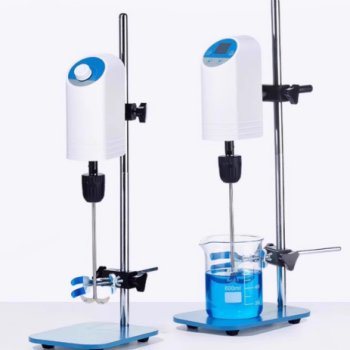
- High Performance Laboratory Stirrers for Diverse Applications
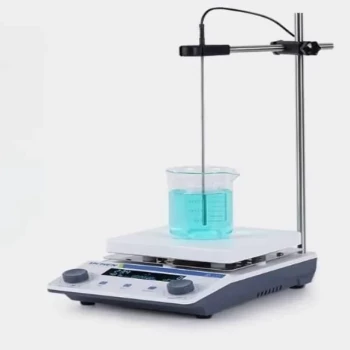
- Laboratory Small Constant Temperature Heated Magnetic Stirrer Heater and Stirrer
- Custom PTFE Teflon Parts Manufacturer for Magnetic Stirring Bar
- Benchtop High Speed Small Lab Centrifuge for Serum Separation and Low Temperature Dehydration
- High-Speed Desktop Centrifuge for Blood Sample Processing
People Also Ask
- How does a laboratory stirrer influence MOF product quality? Master Precision in Non-Solvothermal Synthesis
- What critical role does a Laboratory Stirrer play during leaching? Enhance Titanium-Magnesium Waste Recovery
- What is the primary function of laboratory stirring equipment in the preparation of compost leachate? Optimize Extraction
- What is a laboratory mixer? A Guide to Achieving Perfect Sample Homogeneity
- What is a laboratory mixer used for? Choose the Right Tool for Liquids or Solids