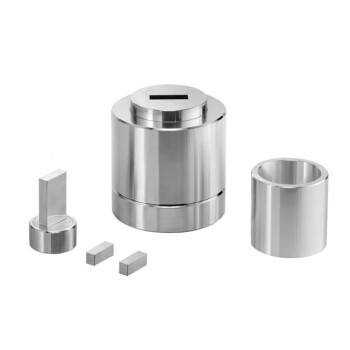
The primary function of a laboratory uniaxial hydraulic press in LLZO processing is to compact loose, synthesized powders into a cohesive solid form known as a "green pellet." By applying controlled unidirectional force—typically between 10 MPa and 30 MPa—the press creates a tightly packed arrangement of particles, providing the necessary initial density and mechanical strength for the material to be handled and processed further.
The press does not produce the final ceramic; rather, it creates the essential "geometric foundation." It transforms ultra-fine powder into a shaped body with sufficient structural integrity to withstand subsequent steps like cold isostatic pressing (CIP) and high-temperature sintering.
The Role of Compaction in LLZO Synthesis
Creating the "Green Body"
The immediate output of the hydraulic press is a "green body." This term refers to a ceramic object that has been shaped but not yet sintered (fired).
Without this step, the loose LLZO nanopowders would be impossible to manage. The press consolidates these powders into a fixed shape, typically a cylindrical pellet (e.g., 15 mm diameter).
Establishing Particle Contact
For solid-state electrolytes to function, the lithium ions must move through a continuous material. The hydraulic press forces loose particles into physical contact with one another.
This initial accumulation is a vital prerequisite. It minimizes the void space between particles, setting the stage for atomic diffusion to occur effectively during the later heating stages.
Ensuring Uniform Sintering
Sintering involves heating the material to high temperatures to achieve full density. If the powder is not pre-pressed uniformly, the final ceramic will shrink unpredictably.
By establishing a consistent geometric shape and density profile, the uniaxial press helps reduce uneven shrinkage or warping when the pellet is eventually fired in graphite molds.
Operational Parameters
Pressure Application
The process utilizes unidirectional pressure, meaning force is applied from the top (and sometimes bottom) along a single axis.
Specific Force Requirements
Depending on the specific doping of the LLZO (e.g., Al-doped or Ga-doped), pressures vary but generally fall within the 10 MPa to 30 MPa range (or roughly 10 kN for standard pellet sizes).
This pressure must be high enough to bind the particles mechanically but controlled to avoid crushing the crystallites or laminating the pellet.
Understanding the Trade-offs
Limited Density Uniformity
A uniaxial press applies force in one direction, which can lead to density gradients. The edges of the pellet may be denser than the center, or the top denser than the bottom.
Not a Standalone Solution
While the press creates a "green pellet," this pellet is not the final product. It is often still too porous for high-performance battery applications.
Consequently, uniaxial pressing is frequently used as a pre-step before Cold Isostatic Pressing (CIP), which applies uniform pressure from all directions to maximize density before sintering.
Making the Right Choice for Your Goal
To maximize the effectiveness of your hydraulic press in LLZO processing, consider your specific objectives:
- If your primary focus is basic handling and shaping: Ensure you apply at least 10 MPa of pressure to achieve sufficient "green strength" so the pellet does not crumble during transfer to the sintering furnace.
- If your primary focus is maximizing final conductivity: View the uniaxial press as a preliminary shaping tool only; plan to follow this immediately with Cold Isostatic Pressing (CIP) to ensure uniform density distribution prior to sintering.
Mastering the uniaxial press ensures you build your solid-state electrolyte on a stable, geometrically sound foundation.
Summary Table:
| Feature | Description |
|---|---|
| Primary Goal | Creating a cohesive "Green Body" from loose powder |
| Pressure Range | Typically 10 MPa to 30 MPa (approx. 10 kN) |
| Mechanism | Controlled unidirectional force application |
| Key Outcome | Established particle contact & geometric foundation |
| Post-Processing | Often followed by CIP and high-temp sintering |
Elevate Your Solid-State Battery Research with KINTEK
Precision starts with the perfect pellet. KINTEK specializes in advanced laboratory equipment, providing the high-performance manual and automated hydraulic presses (including pellet, hot, and isostatic models) essential for LLZO and electrolyte synthesis.
Our comprehensive range—from high-temperature furnaces and crushing systems to specialized battery research tools and consumables—is designed to help researchers achieve maximum material density and ionic conductivity.
Ready to optimize your lab’s workflow? Contact KINTEK experts today to find the ideal compaction solution for your high-performance material needs!
Related Products
- Laboratory Hydraulic Press Split Electric Lab Pellet Press
- Automatic Laboratory Hydraulic Press for XRF & KBR Pellet Press
- Laboratory Hydraulic Press Lab Pellet Press Machine for Glove Box
- Laboratory Hydraulic Press Lab Pellet Press for Button Battery
- Laboratory Hydraulic Pellet Press for XRF KBR FTIR Lab Applications
People Also Ask
- What role does a laboratory hydraulic press play in platinum recovery research? Enhancing Sample Precision
- What are the specific applications of a lab hydraulic press in biochar evaluation? Optimize density and data accuracy.
- What are the roles of a laboratory hydraulic press and stainless steel molds in the preparation of graphite samples?
- What is the role of a laboratory hydraulic press in electrode prep? Maximize Energy Density & Sealing Precision
- Why must a laboratory hydraulic press equipped with cylindrical molds be used when preparing BZY green bodies? High Density