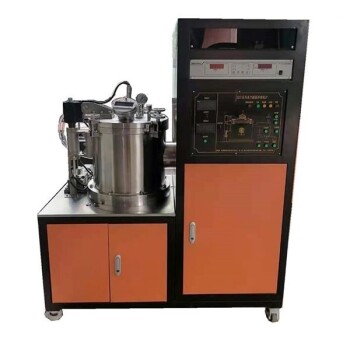
The primary function of a small vertical vacuum furnace is to serve as the core reaction vessel for purifying waste magnesium alloys through physical phase separation. It creates a hermetically sealed, low-pressure environment that significantly lowers the boiling point of magnesium, enabling it to transition directly from a solid state into a vapor.
The furnace leverages vacuum conditions to facilitate sublimation, allowing magnesium to vaporize while leaving heavier impurities behind. This vapor is then re-condensed into pure crystals, effectively separating the metal from contaminants without chemical reagents.
The Physics of Vacuum Separation
Facilitating Sublimation
The central role of the furnace is to manipulate the physical state of the magnesium. Under standard atmospheric pressure, magnesium requires high heat to melt and boil.
By creating a vacuum, the furnace reduces the boiling point of the magnesium. This allows the metal to sublime—transforming directly from a solid to a gas—at manageable thermal levels.
Isolating Contaminants
The refining process relies on the difference in boiling points between magnesium and its impurities.
Contaminants found in waste alloys, such as aluminum, iron, and silicon, have significantly higher boiling points than magnesium. When the furnace heats the alloy under vacuum, only the magnesium vaporizes, leaving these impurities behind in the crucible as solid residue.
Critical Design Features
The Crystallizer Zone
While the bottom of the furnace handles vaporization, the top acts as the collection point.
A component known as the crystallizer is situated at the top of the inner tank. It maintains a specific temperature gradient that forces the rising magnesium vapor to undergo direct condensation, reforming into solid magnesium crystals.
Structural Stability via Double Vacuum
Operating at high temperatures under vacuum places immense stress on the equipment. High heat reduces the structural strength of the inner distillation tank, making it prone to deformation (collapse) due to the pressure difference.
To mitigate this, many vertical furnaces employ a double vacuum resistance design. This system creates a vacuum in both the inner tank and the outer tank, equalizing the pressure to maintain structural integrity and extend equipment life.
Operational Trade-offs
Balancing Temperature and Yield
Precise thermal regulation in the crystallizer zone is a critical balancing act.
If the temperature is too high, you risk "magnesium loss," where vapor fails to condense and escapes. Conversely, if the temperature is too low, the resulting crystals may form loosely, creating a product that is physically unstable and difficult to harvest.
Equipment Size vs. Stability
As the diameter of the distillation tank increases, the risk of structural failure grows.
For tanks approaching 1 meter in diameter, the risk of deformation under vacuum increases significantly. While larger furnaces offer higher capacity, they strictly require the double vacuum design mentioned above to prevent the inner tank from collapsing under atmospheric pressure.
Making the Right Choice for Your Goal
To maximize the efficiency of your magnesium refining process, align your operational parameters with your specific objectives.
- If your primary focus is Purity: Ensure the vacuum level is sufficient to sublime magnesium well below the boiling point of volatile impurities like aluminum.
- If your primary focus is Product Quality: Rigorously control the crystallizer temperature gradient to ensure dense, well-adhered crystal formation.
- If your primary focus is Equipment Longevity: Utilize a double vacuum resistance design to equalize pressure and prevent high-temperature deformation of the inner tank.
Mastering the balance between vacuum pressure and thermal gradients is the key to efficient magnesium recovery.
Summary Table:
| Feature | Function in Magnesium Refining | Benefit |
|---|---|---|
| Vacuum Environment | Lowers boiling point to enable sublimation | High purity without chemical reagents |
| Thermal Gradient | Regulates the temperature between vaporization and crystallization zones | Optimizes crystal density and yield |
| Crystallizer | Provides a cooled surface for vapor-to-solid condensation | Collects refined magnesium crystals |
| Double Vacuum Design | Equalizes pressure between inner and outer tanks | Prevents tank deformation and extends life |
Elevate Your Metal Refining Efficiency with KINTEK
Are you looking to optimize your magnesium recovery or high-temperature material processing? KINTEK specializes in advanced laboratory equipment and consumables designed for precision and durability. Our industry-leading range includes high-performance vacuum furnaces (vertical, tube, and atmosphere), high-temperature high-pressure reactors, and specialized crushing and milling systems tailored for metallurgical research.
Whether you require a double vacuum resistance system for structural stability or precise thermal control for crystal growth, KINTEK provides the comprehensive solutions and high-quality consumables—including ceramics, crucibles, and PTFE products—that your lab needs to succeed.
Ready to upgrade your refining capabilities? Contact KINTEK today for a custom consultation!
Related Products
- Vacuum Hot Press Furnace Heated Vacuum Press Machine Tube Furnace
- 600T Vacuum Induction Hot Press Furnace for Heat Treat and Sintering
- Vacuum Heat Treat Furnace with Ceramic Fiber Liner
- Vacuum Heat Treat and Pressure Sintering Furnace for High Temperature Applications
- Vacuum Heat Treat Furnace and Levitation Induction Melting Furnace
People Also Ask
- What advantages does a vacuum hot press furnace provide for LSLBO ceramic electrolytes? Achieve 94% Relative Density
- What role does a Vacuum Hot Press (VHP) furnace play in the densification of austenitic stainless steel 316 composites?
- What are the advantages of using a vacuum hot pressing furnace? Superior Densification for 2024Al/Gr/SiC Composites
- What are the advantages of a vacuum hot press furnace for LTPO solid electrolytes? Boost Density and Conductivity
- What core processing conditions does a vacuum hot press furnace provide? Achieve High-Density Cu-SiC/Diamond Composites