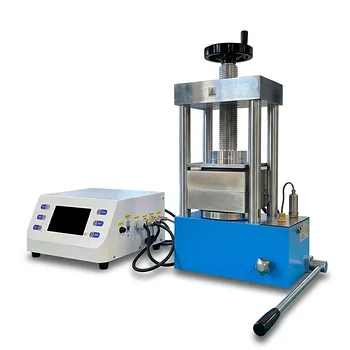
The primary function of a uniaxial hydraulic press in this context is to apply substantial mechanical pressure to consolidate loose powders into a robust geometric form. Specifically, for NiO-BCZYYb anode-supported half-cells, the press applies high pressure (typically around 45 MPa) to compact fuel electrode and electrolyte powders into disk-shaped green bodies. This process transforms loose material into a cohesive structure with defined density and mechanical strength.
Core Takeaway The hydraulic press does not merely shape the component; it establishes the microstructural baseline for performance. By enforcing tight particle packing and minimizing internal porosity, the press creates the necessary physical conditions for the electrolyte layer to achieve full densification during the subsequent co-sintering process.
The Mechanics of Green Body Formation
Establishing Mechanical Integrity
The immediate role of the press is to create a "green body"—a compacted part that holds its shape without chemical bonding. By applying uniform uniaxial pressure, the machine forces loose particles into a structurally sound disk.
This mechanical stability is non-negotiable. The green body must possess sufficient strength to withstand ejection from the die and subsequent handling during transfer to the sintering furnace without fracturing or crumbling.
Void Reduction and Particle Packing
At the microscopic level, the press drives the rearrangement of particles. The application of high pressure reduces the volume of inter-particle voids, effectively increasing the "green density" of the composite.
This tight packing creates a cohesive network of solids. It ensures that the electrolyte and anode materials have maximum physical contact, which is the prerequisite for the chemical processes that occur during heating.
The Impact on Sintering and Performance
Enabling Full Electrolyte Densification
The ultimate goal of the anode-supported half-cell is a gas-tight electrolyte layer. The hydraulic press lays the foundation for this by minimizing initial porosity.
If the green body is too porous, the electrolyte layer may fail to densify completely during co-sintering. Proper compaction ensures the material allows for mass transport and grain bonding, leading to a fully dense, impermeable ceramic layer.
Optimizing Interface Contact
Beyond simple density, the press establishes the quality of the interface between layers. High-pressure compaction forces solid-solid interface contact between individual particles.
This physical intimacy is critical for electrochemical performance. It minimizes interface impedance and facilitates efficient ion transport, ensuring the final cell operates effectively during charge and discharge cycles.
Critical Considerations and Limitations
The Necessity of Uniformity
While the press applies significant force, the uniformity of that pressure is paramount. Uniaxial pressure must be applied evenly to prevent density gradients within the disk.
Inconsistent pressure can lead to structural defects, such as warping or cracking, during the sintering phase. The press acts to minimize these risks by delivering a controlled, even load across the surface of the green body.
Green Strength vs. Sintered Strength
It is vital to distinguish between the strength provided by the press and the final strength of the ceramic. The press relies on mechanical interlocking and plastic deformation of particles to hold the body together.
This "green strength" is temporary and purely physical. It serves only as a bridge to allow the component to reach the sintering stage, where high temperatures will induce the chemical bonding and diffusion required for final durability.
Making the Right Choice for Your Goal
To maximize the quality of your NiO-BCZYYb half-cells, align your pressing parameters with your specific fabrication objectives:
- If your primary focus is Handling and Yield: Ensure the applied pressure is sufficient (e.g., 45 MPa) to create a robust green body that resists breakage during die ejection and transport.
- If your primary focus is Electrochemical Performance: Prioritize maximizing green density to reduce internal porosity, which directly correlates to a denser electrolyte and lower interface impedance after sintering.
The uniaxial hydraulic press acts as the critical bridge between loose raw materials and a high-performance ceramic microstructure.
Summary Table:
| Feature | Function in NiO-BCZYYb Fabrication |
|---|---|
| Primary Role | Consolidates loose powders into cohesive disk-shaped green bodies |
| Applied Pressure | Typically ~45 MPa to ensure uniform particle packing |
| Microstructure | Reduces inter-particle voids and minimizes initial porosity |
| Sintering Prep | Establishes the foundation for a gas-tight, fully dense electrolyte layer |
| Structural Goal | Provides sufficient 'green strength' for handling and transport |
Elevate Your Material Research with KINTEK Precision
Precision compaction is the foundation of high-performance fuel cell research. At KINTEK, we specialize in providing the advanced laboratory equipment needed to bridge the gap between loose powders and high-density ceramic microstructures.
Our extensive portfolio features high-performance hydraulic presses (pellet, hot, isostatic) designed for uniform pressure application, alongside crushing and milling systems, high-temperature furnaces (vacuum, CVD, dental), and PTFE or ceramic consumables. Whether you are fabricating NiO-BCZYYb half-cells or developing next-gen battery tools, KINTEK delivers the reliability and technical excellence your lab demands.
Ready to optimize your fabrication process? Contact us today to find the perfect pressing solution!
Related Products
- Laboratory Manual Hydraulic Pellet Press for Lab Use
- Laboratory Manual Hydraulic Pellet Press for Lab Use
- Automatic Laboratory Hydraulic Press for XRF & KBR Pellet Press
- Laboratory Hydraulic Pellet Press for XRF KBR FTIR Lab Applications
- Manual Lab Heat Press
People Also Ask
- What is the role of a laboratory hydraulic pellet press and stainless steel molds in the fabrication of RuO2/NbC anodes?
- What is the necessity of using a laboratory hydraulic pellet press in the preparation of biomass fuel pellets? Guide
- What is the significance of applying 200 MPa of pressure with a laboratory hydraulic pellet press for composite ceramics?
- How does a laboratory hydraulic pellet press contribute to SiCw/2024 aluminum composite preforms? Optimize Densification
- Why use laboratory manual hydraulic presses for semiconductor pellets? Optimize Annealing & Crystalline Quality