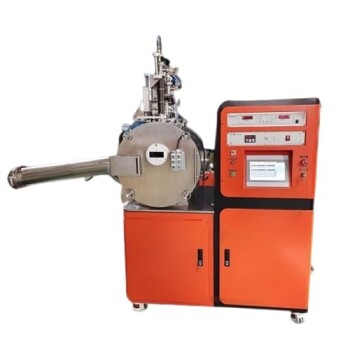
The primary function of a vacuum arc furnace in this context is to melt raw metal materials using high temperatures generated by an electric arc within a protective, high-purity argon atmosphere.
For Fe-Mn-Cr (Iron-Manganese-Chromium) alloys specifically, this process ensures the materials are fully smelted in an oxygen-free environment. By subjecting the materials to repeated flipping and remelting, the furnace creates alloy button ingots with a highly uniform chemical composition, which is a prerequisite for reliable material research.
Core Takeaway While the furnace provides the heat necessary to melt the metal, its true value lies in control. It facilitates repeated remelting in an inert environment to eliminate oxidation and segregation, producing a homogeneous "button ingot" that serves as the trusted foundation for all subsequent structural and property analysis.
The Mechanics of Controlled Melting
High-Temperature Arc Generation
The furnace utilizes an electric arc to generate the intense heat required to melt the raw materials (Iron, Manganese, and Chromium).
This method provides rapid, direct heating, ensuring that even high-melting-point elements are brought to a liquid state efficiently.
The Role of Inert Atmosphere
Unlike open-air melting, this process occurs under a high-purity argon protective atmosphere.
This environment is critical because elements like Chromium are highly reactive to oxygen. The argon shield prevents oxidation during the smelting process, preserving the purity of the constituent elements.
Eliminating Impurities
The vacuum and inert gas capabilities work together to create a "clean" processing chamber.
This setup mirrors the benefits seen in other vacuum technologies, where controlled environments prevent surface contamination and manage impurity levels, ensuring the final alloy retains its intended mechanical and chemical properties.
Achieving Structural Homogeneity
The Importance of Repeated Remelting
A single melt is rarely sufficient to mix elements with different densities and melting points.
The primary reference highlights that repeated flipping and remelting of the alloy is a standard procedure in a vacuum arc furnace. This mechanical intervention forces the elements to mix thoroughly, preventing segregation.
Creating the "Button Ingot"
The output of this process is typically a small, circular mass known as a button ingot.
This ingot represents a sample with highly uniform chemical composition. Without this uniformity, any data derived from the sample regarding the Shape Memory Alloy's structure or performance would be unreliable.
Understanding the Trade-offs
Scale Limitations
Vacuum arc furnaces are typically designed for laboratory-scale or small-batch production (producing "buttons").
They are not intended for mass production or creating large structural components. If your goal is large-scale industrial casting, vacuum induction melting might be more appropriate.
Volatility Management
While the argon atmosphere protects against oxidation, the intense heat of the arc can still cause volatile elements (like Manganese) to vaporize if not carefully controlled.
Operators must balance arc intensity with the vapor pressure of the specific elements in the Fe-Mn-Cr mix to maintain the correct stoichiometric ratio.
Making the Right Choice for Your Goal
To obtain reliable data on Fe-Mn-Cr shape memory alloys, the preparation phase is just as critical as the testing phase.
- If your primary focus is Compositional Accuracy: Ensure you utilize the "flip and remelt" technique multiple times to guarantee the elements are evenly distributed throughout the ingot.
- If your primary focus is Material Purity: Verify the integrity of the argon atmosphere to prevent the formation of oxides that can degrade the shape memory effect.
Uniformity in the furnace leads to reliability in the laboratory.
Summary Table:
| Feature | Function in Fe-Mn-Cr Preparation |
|---|---|
| Heating Source | High-temperature electric arc for rapid smelting of Fe, Mn, and Cr. |
| Atmosphere | High-purity argon gas to prevent oxidation of reactive elements. |
| Process Step | Repeated flipping and remelting to eliminate chemical segregation. |
| Output Form | Homogeneous button ingots for reliable structural analysis. |
| Primary Goal | Achievement of highly uniform chemical composition and purity. |
Elevate Your Material Research with KINTEK Precision
Precise alloy composition is the foundation of reliable material science. KINTEK specializes in advanced laboratory equipment, providing the high-performance vacuum arc furnaces and induction melting systems needed to produce flawless Fe-Mn-Cr shape memory alloys.
Our extensive portfolio also includes high-temperature furnaces, crushing and milling systems, and hydraulic presses, alongside specialized high-pressure reactors and battery research tools.
Ready to ensure the homogeneity and purity of your research samples? Contact us today to discover how KINTEK’s expert solutions can streamline your laboratory workflow and deliver superior results.
References
- Florencia Malamud, A. Baruj. Role of Mn and Cr on structural parameters and strain energy during FCC-HCP martensitic transformation in Fe-Mn-Cr shape memory alloys. DOI: 10.1016/j.matdes.2017.11.017
This article is also based on technical information from Kintek Solution Knowledge Base .
Related Products
- Vacuum Arc Induction Melting Furnace
- Non Consumable Vacuum Arc Induction Melting Furnace
- Vacuum Induction Melting Spinning System Arc Melting Furnace
- Vacuum Hot Press Furnace Heated Vacuum Press Machine Tube Furnace
- Vacuum Sealed Continuous Working Rotary Tube Furnace Rotating Tube Furnace
People Also Ask
- How do vacuum induction or arc melting furnaces facilitate the synthesis of U-Al-C MAX phases? Precision Heat & Purity
- What core role does a Vacuum Induction Melting furnace play in nickel-free steel production? Achieve High-Purity Alloys
- What is the function of a vacuum arc melting furnace? Master Homogeneity for Amorphous Alloy Ribbons
- What is the function of a vacuum arc melting furnace? Prepare High-Purity Alx(CrFeNi)1-x High-Entropy Alloys
- What is the primary function of a vacuum arc melting furnace in RHEA preparation? Achieving Extreme Thermal Fusion