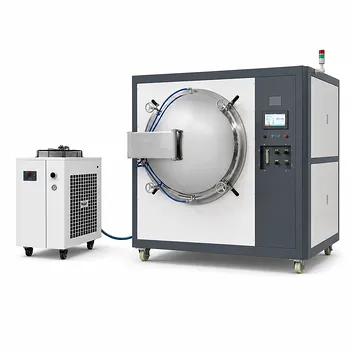
The primary function of a Vacuum Hot Press (VHP) furnace in this stage is to densify and consolidate composite tapes into a single, monolithic plate. By subjecting plasma-sprayed tapes to simultaneous high temperature (870-920°C) and mechanical pressure (typically 30 MPa), the furnace eliminates residual porosity within the matrix. This process transforms layered, semi-finished materials into a structurally sound component through solid-state diffusion bonding.
The VHP furnace serves as the critical consolidation tool, balancing thermal and mechanical forces to fuse material layers while maintaining a high-vacuum environment. Its ultimate goal is to achieve full density and robust metallurgical bonding without damaging the reinforcing fibers or allowing oxidation.
The Mechanics of Consolidation
Elimination of Porosity
The primary challenge in the secondary curing of titanium matrix composites is the existence of voids or "pores" left over from the initial plasma spraying process.
The VHP furnace applies continuous mechanical pressure (e.g., 30 MPa) to physically close these gaps. This pressure forces the matrix material to flow plastically around the reinforcing fibers, effectively squeezing out voids to achieve near-perfect density.
Solid-State Diffusion Bonding
Mere compression is insufficient; the layers must become a single unit. The high operating temperatures facilitate diffusion bonding, a process where atoms migrate across the boundaries of the stacked tape layers.
This atomic movement heals the interfaces between layers, resulting in a cohesive, monolithic plate with uniform mechanical properties throughout.
The Role of Environmental Control
Prevention of Oxidation
Titanium is highly reactive at elevated temperatures. Without protection, it would rapidly absorb oxygen, leading to embrittlement and surface degradation.
The VHP furnace maintains a high vacuum (less than 1×10⁻³ mbar). This environment ensures that the matrix and reinforcement materials remain chemically pure during the prolonged heating cycle, preventing the formation of weak oxide scales.
Control of Interface Reactions
Precise temperature regulation is vital for managing the chemical interaction between the titanium matrix and the reinforcing fibers.
If the temperature fluctuates or exceeds limits, excessive brittle reaction layers (such as Titanium Carbide) can grow at the interface. The VHP furnace's precise thermal control restricts this growth—often keeping it below a critical threshold (e.g., 2 micrometers)—to ensure the bond remains strong rather than brittle.
Understanding the Trade-offs
Fiber Integrity vs. Densification
The most critical risk in this process is the potential damage to the reinforcing fibers. While high pressure is necessary to remove pores, applying it too aggressively can crush or break the fibers.
Success relies on a delicate balance: the pressurization rate must be synchronized with the heating rate. The matrix must be sufficiently soft (hot) to flow before full pressure is applied, ensuring the load is transferred hydrostatically rather than destructively.
Process Efficiency vs. Bond Quality
Higher temperatures generally speed up diffusion bonding, potentially shortening the cycle. However, excessive heat accelerates harmful interface reactions that degrade the composite's performance.
Therefore, the process is constrained by a "thermal budget"—the maximum temperature and time the material can endure before the interface degrades. The VHP process is not just about squeezing; it is about optimizing this narrow processing window.
Making the Right Choice for Your Goal
The effectiveness of the VHP process depends on prioritizing the correct parameters for your specific material requirements.
- If your primary focus is Maximum Density: Prioritize the application of continuous mechanical pressure (30 MPa) to ensure the complete elimination of residual pores between tape layers.
- If your primary focus is Mechanical Longevity: Focus on precise temperature stability to limit brittle interface reaction layers to less than 2 micrometers.
- If your primary focus is Material Purity: Ensure the vacuum level is strictly maintained below 1×10⁻³ mbar to prevent oxidation-induced embrittlement during the heat cycle.
The Vacuum Hot Press is not merely a furnace; it is a precision instrument that orchestrates heat, pressure, and vacuum to forge separate layers into a unified, high-performance composite.
Summary Table:
| Parameter | Function in VHP Process | Targeted Outcome |
|---|---|---|
| Temperature (870-920°C) | Facilitates solid-state diffusion | Atomic bonding between layers |
| Pressure (30 MPa) | Plastic flow of matrix material | Elimination of residual porosity |
| Vacuum (<1x10⁻³ mbar) | High-purity environment control | Prevention of titanium oxidation |
| Interface Control | Precise thermal regulation | Brittle layer thickness < 2μm |
Elevate Your Material Research with KINTEK Precision
Unlock superior structural integrity for your advanced composites with KINTEK’s high-performance Vacuum Hot Press (VHP) systems. Our technology is specifically engineered to meet the rigorous demands of titanium matrix composite consolidation, offering unrivaled control over temperature, pressure, and vacuum levels.
Beyond VHP furnaces, KINTEK specializes in laboratory equipment and consumables, including a comprehensive range of high-temperature furnaces (muffle, tube, rotary, vacuum, CVD, PECVD, MPCVD, atmosphere, dental, induction melting), crushing and milling systems, sieving equipment, and hydraulic presses (pellet, hot, isostatic). Our portfolio also features high-temperature high-pressure reactors and autoclaves, electrolytic cells and electrodes, battery research tools, cooling solutions, and essential consumables like PTFE products, ceramics, and crucibles.
Ready to achieve full density and robust metallurgical bonding in your lab?
Contact KINTEK today for a customized solution
Related Products
- Vacuum Hot Press Furnace Heated Vacuum Press Machine Tube Furnace
- 600T Vacuum Induction Hot Press Furnace for Heat Treat and Sintering
- Vacuum Hot Press Furnace Machine Heated Vacuum Press
- Vacuum Hot Press Furnace Machine for Lamination and Heating
- Vacuum Heat Treat and Pressure Sintering Furnace for High Temperature Applications
People Also Ask
- What advantages does a vacuum hot press furnace provide for LSLBO ceramic electrolytes? Achieve 94% Relative Density
- What role does a Vacuum Hot Press (VHP) furnace play in the densification of austenitic stainless steel 316 composites?
- What are the advantages of using a vacuum hot pressing furnace? Superior Densification for 2024Al/Gr/SiC Composites
- What are the advantages of a vacuum hot press furnace for LTPO solid electrolytes? Boost Density and Conductivity
- What core processing conditions does a vacuum hot press furnace provide? Achieve High-Density Cu-SiC/Diamond Composites