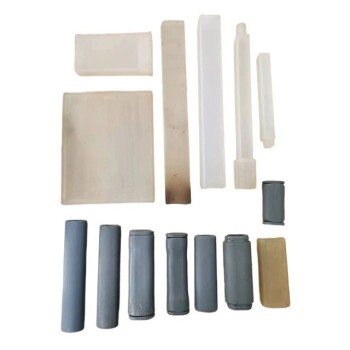
The primary function of a flexible mold sleeve is to act as a sealed barrier that uniformly transfers hydrostatic pressure from the liquid medium to the TZC molybdenum alloy powder. It serves as both a carrier and a sealant, isolating the powder from the liquid while ensuring that every surface of the green body receives equal force during the cold isostatic pressing process.
The flexible sleeve is the critical interface for defect prevention. By guaranteeing uniform pressure distribution, it eliminates common molding failures such as delamination and uneven density, resulting in a structurally sound green body.
The Mechanics of Pressure Transfer
Acting as a Hermetic Seal
The sleeve functions as the physical vessel for the loose TZC molybdenum alloy powder.
Its most immediate role is that of a sealant. It must completely isolate the dry alloy powder from the liquid pressure medium surrounding it in the chamber.
Achieving Isostatic Equilibrium
The effectiveness of Cold Isostatic Pressing (CIP) relies entirely on the sleeve's flexibility.
Because the sleeve is pliable, it yields immediately to the pressure of the liquid medium. This allows the force to be transmitted instantly and evenly to the powder surface, rather than being absorbed by a rigid container.
Why Uniformity Matters for TZC Alloys
Preventing Delamination
When pressure is applied unevenly to powder metals, internal shear stresses can develop.
The flexible sleeve prevents this by ensuring equal force is applied from all directions simultaneously. This uniformity is the primary defense against delamination, where layers of the material separate or crack.
Ensuring Consistent Density
For high-performance alloys like TZC molybdenum, material consistency is paramount.
The sleeve ensures that the powder is compacted at the same rate across the entire geometry. This prevents density gradients, which are areas of varying hardness that can weaken the final product.
Understanding the Trade-offs
The Risk of Sealing Failure
The reliance on a flexible barrier introduces a specific point of failure.
If the sleeve is punctured or the seal is compromised, the liquid medium will penetrate the mold. This contamination ruins the powder batch and degrades the green body immediately.
Balancing Flexibility and Durability
The sleeve must be soft enough to transfer pressure accurately but tough enough to withstand the cycle.
If a sleeve is too rigid, it will not transfer pressure isostatically, leading to the very defects it is meant to prevent. Conversely, if it is too weak, it risks rupture under high pressure.
Making the Right Choice for Your Goal
To ensure the success of your cold isostatic pressing process, consider the following priorities:
- If your primary focus is structural integrity: Ensure the sleeve possesses sufficient flexibility to transmit pressure without resistance, eliminating the risk of density gradients.
- If your primary focus is material purity: Verify the integrity of the sleeve's sealing mechanism to absolutely guarantee isolation from the liquid pressure medium.
The quality of the flexible sleeve effectively dictates the quality of the final green body.
Summary Table:
| Feature | Function in CIP Process | Impact on TZC Molybdenum |
|---|---|---|
| Hermetic Sealing | Isolates powder from liquid medium | Prevents material contamination |
| Pliability | Enables instant pressure transfer | Ensures isostatic equilibrium |
| Pressure Uniformity | Distributes force equally across surfaces | Eliminates delamination and cracks |
| Density Control | Ensures consistent powder compaction | Prevents weak spots and density gradients |
Elevate Your Material Consistency with KINTEK
Precision in cold isostatic pressing starts with high-performance equipment. KINTEK specializes in advanced laboratory solutions designed for rigorous material research. Whether you are working with TZC molybdenum alloys or other advanced ceramics, our range of isostatic presses (cold and hot), hydraulic pellet presses, and crushing and milling systems provides the reliability you need for a perfect green body.
From high-temperature vacuum furnaces to essential consumables like PTFE and ceramics, KINTEK supports your entire workflow. Contact us today to find the ideal pressing solution for your lab!
Related Products
- Isostatic Molding Pressing Molds for Lab
- Electric Split Lab Cold Isostatic Press CIP Machine for Cold Isostatic Pressing
- Anti-Cracking Press Mold for Lab Use
- Manual Cold Isostatic Pressing Machine CIP Pellet Press
- XRF Boric Acid Lab Powder Pellet Pressing Mold for Laboratory Use
People Also Ask
- What are the advantages of isostatic pressing? Achieve Superior Material Integrity and Design Freedom
- How big is the isostatic pressing market? A Deep Dive into the $1.2B+ Advanced Manufacturing Enabler
- What are the applications of isostatic pressing technology? Achieve Superior Material Density and Uniformity
- What is the application of isostatic pressing? Achieve Uniform Density in High-Performance Components
- What is the pressure for isostatic pressing? Unlock the Key to Uniform Material Densification