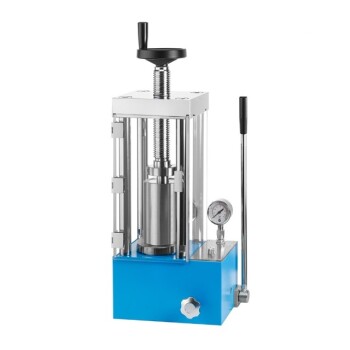
Cold isostatic pressing (CIP) improves microhardness uniformity by applying uniform, high-pressure forces from multiple directions simultaneously to the TiC10/Cu-Al2O3 composite. This multi-directional compression forces the internal microstructure to reorganize and compact further, specifically addressing the lower density often found in the center of materials formed by unidirectional pressing. By equalizing the pressure across the entire volume, CIP significantly narrows the variance in hardness between the material's edge and its center.
Unidirectional pressing often results in composites with hard edges and a softer center; cold isostatic pressing resolves this by applying hydrostatic pressure to equalize density. This process effectively narrows the gap between maximum and minimum hardness values—for example, reducing the variance from 40 HV to 31 HV—resulting in a highly homogeneous and reliable material.
Addressing the Limitations of Unidirectional Pressing
The Edge-Center Disparity
Standard unidirectional hot pressing typically exerts force along a single axis. This mechanical limitation often creates a density gradient where the edges of the composite are significantly harder than the center.
The Risk to Integrity
This uneven distribution creates weak points within the material. In high-performance applications, a soft center can lead to unpredictable failure modes, even if the exterior measurements suggest high hardness.
The Mechanism of Cold Isostatic Pressing
Multi-Directional Force Application
Unlike unidirectional methods, a cold isostatic press utilizes a fluid medium to apply high pressure uniformly from all sides. This "hydrostatic" pressure ensures that every surface of the TiC10/Cu-Al2O3 composite receives the exact same amount of force.
Microstructural Reorganization
Under this intense, uniform pressure, the internal microstructures of the composite are forced to shift and compact. This secondary compaction reduces the porosity that may have survived the initial pressing stage.
Homogenization of Density
As the internal structure reorganizes, the density becomes consistent throughout the volume. The material moves from a state of localized density (hard edges) to a state of global density (uniform hardness).
Quantifiable Improvements in Uniformity
Narrowing the Hardness Gap
The most effective way to measure the success of CIP is by analyzing the difference between maximum and minimum microhardness values.
Measurable Results
Data indicates that CIP can successfully reduce the hardness difference significantly. For instance, the gap between the hardest and softest points can drop from 40 HV to 31 HV.
Enhanced Reliability
This reduction in variance—roughly a 22% improvement in uniformity in the example above—translates directly to reliability. Engineers can predict the material's behavior with greater confidence knowing the properties are consistent throughout.
Understanding the Operational Trade-offs
Process Complexity
While effective, introducing CIP adds a distinct secondary processing step. This increases the total manufacturing time and complexity compared to simple unidirectional pressing.
Diminishing Returns
CIP excels at redistributing and compacting existing structures, but it acts upon the pre-form created by previous steps. If the initial mixture or pre-form has fundamental chemical segregation, CIP improves density but cannot correct compositional errors.
Making the Right Choice for Your Goal
Deciding whether to incorporate cold isostatic pressing depends on your tolerance for variation versus your need for absolute consistency.
- If your primary focus is maximum structural reliability: Implement CIP to eliminate the "soft center" defect and ensure uniform performance across the entire composite volume.
- If your primary focus is minimizing processing steps: Recognize that skipping CIP leaves you with a material where the edges are significantly harder than the core, which may be acceptable for non-critical applications.
By standardizing the internal pressure, you ensure that the TiC10/Cu-Al2O3 composite delivers predictable performance in demanding environments.
Summary Table:
| Feature | Unidirectional Pressing | Cold Isostatic Pressing (CIP) |
|---|---|---|
| Pressure Direction | Single axis (Vertical) | Multi-directional (Hydrostatic) |
| Hardness Distribution | Hard edges, soft center | Uniform throughout volume |
| Microstructure | Potential density gradients | Homogeneous & compacted |
| Hardness Variance | High (e.g., ~40 HV gap) | Low (e.g., ~31 HV gap) |
| Reliability | Variable performance | High & predictable performance |
Elevate Your Material Consistency with KINTEK Precision
Don't let density gradients compromise the integrity of your high-performance composites. KINTEK specializes in advanced laboratory solutions, including high-pressure isostatic presses, hydraulic pellet presses, and sintering furnaces designed to achieve absolute material uniformity. Whether you are developing TiC10/Cu-Al2O3 composites or advanced ceramics, our equipment ensures your materials meet the most rigorous structural standards.
Ready to eliminate the "soft center" defect in your lab? Contact our technical experts today to find the perfect pressing solution for your research and production needs.
Related Products
- Electric Split Lab Cold Isostatic Press CIP Machine for Cold Isostatic Pressing
- Electric Lab Cold Isostatic Press CIP Machine for Cold Isostatic Pressing
- Automatic Lab Cold Isostatic Press CIP Machine Cold Isostatic Pressing
- Manual Cold Isostatic Pressing Machine CIP Pellet Press
- Warm Isostatic Press for Solid State Battery Research
People Also Ask
- How is isostatic pressing equipment utilized to integrate lithium metal anodes during solid-state battery assembly?
- How does isostatic pressing equipment enhance lithium metal anode contact? Optimize Your Solid-State Battery Assembly
- What is the meaning of isostatic pressing? Achieve Uniform Density in Complex Parts
- What is isostatic pressing method for ceramics? Achieve Uniform Density for Complex Parts
- What role does cold isostatic pressing play in the formation of feed rods for single crystal growth? Ensure Stability.