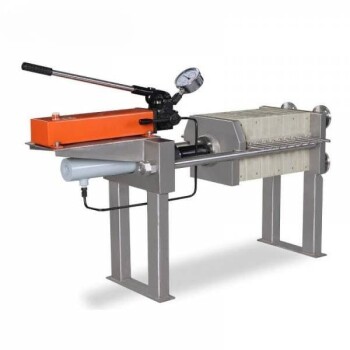
The fundamental purpose of a laboratory hydraulic press in this context is to transform loose mineral powder into a solid, optically transparent medium suitable for analysis. By subjecting a mixture of mineral sample and potassium bromide (KBr) powder to high pressure within a mold, the press creates a thin pellet that allows infrared light to transmit through the material rather than scattering off the surface.
Infrared spectroscopy relies on the unimpeded passage of light to detect molecular vibrations. The hydraulic press eliminates the physical barriers of loose powder, fusing the sample into a uniform disc that enables the spectrometer to accurately analyze the adsorption state of chemical agents on the mineral surface.
The Mechanism of Sample Preparation
Achieving Optical Transparency
The core challenge in mineral FT-IR analysis is that solid minerals are naturally opaque or highly scattering to infrared light.
To solve this, the hydraulic press compresses the mineral with potassium bromide (KBr), a salt that becomes transparent under pressure. This creates a "window" that holds the mineral particles in suspension, allowing the spectrometer's beam to pass through the sample effectively.
Eliminating Light Scattering
Loose powder particles act like tiny mirrors, scattering light in all directions and ruining the signal.
By applying high, balanced axial pressure, the press forces air out of the mixture and compacts the particles into a dense, void-free solid. This consolidation eliminates scattering effects, ensuring the resulting data represents true chemical absorption rather than physical interference.
Critical Impact on Mineral Analysis
Analyzing Surface Adsorption
According to standard methodology, the pelletization process is essential for studying surface chemistry.
Specifically, it allows researchers to observe the adsorption state of chemical agent molecules on the mineral surface. Without the dense, transparent medium created by the press, the subtle spectral signals indicating how chemicals bond to the mineral would be lost in the noise.
Ensuring Structural Stability
A hydraulic press provides the force necessary to create a pellet that is mechanically stable.
This stability prevents the sample from crumbling during the test, ensuring the geometry remains consistent throughout the analysis. A stable sample path is required to identify complex molecular vibrations, such as metal-oxygen bond stretching.
Understanding the Trade-offs
The Balance of Pressure
While high pressure is necessary, it must be carefully controlled.
Insufficient pressure results in a cloudy pellet that scatters light, while excessive pressure can distort the crystal lattice of the mineral or cause the pellet to fracture. The goal is a "glassy" appearance without inducing structural damage to the sample itself.
Matrix Purity and Ratio
The press can only do so much; the quality of the pellet also depends on the KBr matrix.
If the KBr is not perfectly dry or if the ratio of sample to KBr is too high, the pellet will remain opaque regardless of the pressure applied. The press acts as the final step in a preparation chain that demands high-purity reagents.
Making the Right Choice for Your Goal
To maximize the effectiveness of your FT-IR analysis, align your pressing technique with your specific analytical objectives:
- If your primary focus is Surface Chemistry: Ensure your press can deliver sufficient pressure to fully fuse the KBr, as high transparency is required to detect faint adsorption signals on the mineral surface.
- If your primary focus is Reproducibility: Prioritize a press with precise pressure controls to ensure every pellet has identical density, eliminating variables between different test batches.
A properly pressed pellet is not just a sample holder; it is the optical foundation that makes accurate infrared spectroscopy possible.
Summary Table:
| Feature | Role in FT-IR Mineral Analysis |
|---|---|
| Primary Goal | Creating optically transparent pellets from mineral/KBr mixtures |
| Key Mechanism | High axial pressure to eliminate air voids and light scattering |
| Critical Benefit | Enables detection of surface adsorption and molecular vibrations |
| Material Matrix | Uses Potassium Bromide (KBr) as a transparent suspending medium |
| Output Quality | Achieves a dense, glassy disc for unimpeded infrared light transmission |
Elevate Your Spectroscopic Accuracy with KINTEK Precision
Don't let poor sample preparation compromise your research data. At KINTEK, we understand that the integrity of your FT-IR analysis depends on the quality of your pellets. Our high-performance laboratory hydraulic presses (pellet, hot, and isostatic) are engineered to provide the precise pressure control required for flawless mineral surface analysis.
Whether you are studying complex mineralogy or advanced chemical adsorption, our comprehensive range of equipment—from crushing and milling systems to KBr dies and high-purity consumables—ensures your lab achieves repeatable, publication-quality results.
Ready to optimize your sample preparation workflow? Contact KINTEK today to find the perfect pressing solution for your target applications.
Related Products
- Laboratory Hydraulic Press Lab Pellet Press Machine for Glove Box
- Laboratory Hydraulic Press Split Electric Lab Pellet Press
- Laboratory Hydraulic Press Lab Pellet Press for Button Battery
- Automatic Laboratory Hydraulic Press for XRF & KBR Pellet Press
- Automatic Laboratory Hydraulic Pellet Press Machine for Lab Use
People Also Ask
- What is the function of a laboratory hydraulic press in W-Cu composites? Control Porosity and Material Ratio
- What is the role of a laboratory hydraulic press in the initial stages of Li6PS5Cl preparation? Key to Green Pellets
- What role does a laboratory hydraulic press play in triboelectric testing? Achieve Precision Alloy Sample Prep
- How can a laboratory hydraulic press be applied to chitosan for wastewater treatment? Optimize Pores & Strength
- How do a precision laboratory hydraulic press and specialized molds contribute to the fabrication of spherical ceramic samples? Achieving High-Density Material Precision