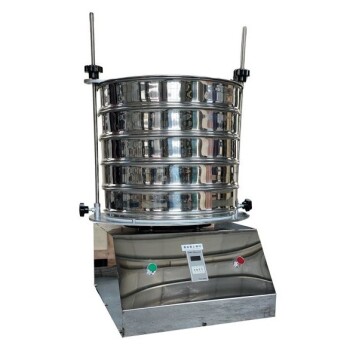
The primary function of a 500-mesh high-precision standard analytical sieve in the preparation of Li6.4La3Zr1.4Ta0.6O12 (LLZTO) ceramic powders is to strictly define the upper limit of the powder particle size. By filtering the material immediately following the ball milling process, the sieve eliminates large particles and remaining aggregates. This filtration is a non-negotiable step for ensuring the structural integrity of ultra-thin solid-state electrolyte membranes.
In the context of solid-state batteries, a single oversized particle acts as a fatal structural defect. The 500-mesh sieve serves as the final quality control gate, preventing large particulates from piercing the electrolyte membrane and causing catastrophic short circuits.
The Critical Role of Particle Size Control
Ensuring Membrane Integrity
The production of LLZTO ceramics often aims to create ultra-thin solid-state electrolyte membranes. These membranes generally feature a thickness of only a few dozen micrometers.
To maintain a continuous, defect-free layer, the constituent powder particles must be significantly smaller than the membrane's final thickness. The 500-mesh sieve ensures that no individual particle exceeds this critical size threshold.
Addressing Ball Milling Limitations
While ball milling is effective for grinding materials, it rarely produces a perfectly uniform distribution on its own. It often leaves behind a small percentage of large particles or clusters of aggregates.
The high-precision sieve mechanically separates these processing artifacts from the usable powder. This ensures that the final feedstock consists solely of fine, uniform particles suitable for casting or sintering.
Implications for Battery Safety
Preventing Internal Short Circuits
The most severe risk in solid-state battery fabrication is the physical puncture of the electrolyte layer. If a large particle remains in the LLZTO powder, it can span the entire width of the membrane.
This creates a conductive bridge or a physical breach between the anode and cathode. Such defects lead directly to internal short circuits, compromising the battery's functionality and safety profile.
Standardizing Electrical Performance
Uniform particle size leads to more consistent packing density during the sintering process. By removing outliers, the sieve helps ensure that the resulting ceramic density is homogeneous.
This homogeneity is vital for uniform ionic conductivity across the electrolyte. It prevents localized "hot spots" of current density that can degrade the battery over time.
Operational Considerations and Trade-offs
Processing Efficiency vs. Quality
Using a 500-mesh sieve (which corresponds to an opening size of approximately 25 micrometers) is a rigorous process. It creates a significant bottleneck compared to coarser sieving, as the throughput of powder is naturally slower.
Material Yield Reduction
Strict sieving inevitably results in material loss. The "oversized" material rejected by the sieve represents waste unless it is re-routed for additional milling. This step prioritizes the quality of the final membrane over the total volume of powder yield.
Strategic Application for Battery Fabrication
To optimize your LLZTO preparation process, align your sieving protocols with your specific end-product requirements.
- If your primary focus is the safety of ultra-thin membranes: Prioritize the integrity of the 500-mesh sieve above all else to ensure no particle exceeds the membrane thickness.
- If your primary focus is process optimization: Analyze the volume of material rejected by the sieve; a high rejection rate indicates that your upstream ball milling parameters need adjustment to produce finer particles.
Consistent particle size distribution is the foundational variable for reliable solid-state electrolyte performance.
Summary Table:
| Feature | Specification/Detail |
|---|---|
| Sieve Mesh Size | 500-mesh (High-Precision) |
| Aperture Size | Approx. 25 micrometers |
| Target Material | LLZTO (Solid-state electrolyte powder) |
| Primary Function | Eliminates aggregates & oversized particles |
| Key Benefit | Prevents membrane puncture & internal short circuits |
| Application | Quality control post-ball milling |
Elevate Your Battery Research with KINTEK Precision
Achieving the perfect particle size distribution is critical for the safety and performance of solid-state electrolytes. KINTEK specializes in high-performance laboratory equipment, offering a comprehensive range of high-precision standard analytical sieves, crushing and milling systems, and vacuum sintering furnaces specifically designed for advanced materials like LLZTO.
Whether you are casting ultra-thin membranes or optimizing ionic conductivity, our team provides the tools you need for defect-free results. Contact KINTEK today to optimize your lab's workflow and explore our full portfolio of hydraulic presses, high-temperature furnaces, and specialized battery research consumables.
Related Products
- Custom PTFE Teflon Parts Manufacturer for PTFE Mesh F4 Sieve
- Laboratory Test Sieves and Sieving Machines
- Three-dimensional electromagnetic sieving instrument
- Laboratory Test Sieves and Vibratory Sieve Shaker Machine
People Also Ask
- What are the primary reasons for selecting PTFE as a matrix? Enhance Composites with Carbon Nanotube Reinforcement
- How is PTFE utilized for insulation in Alloy 22 corrosion setups? Ensure Signal Purity & Accuracy
- Is PTFE corrosion resistant? Discover the Ultimate Chemical Resistance for Your Lab
- What are the specific applications of PTFE in micro-batch slug flow systems? Enhance Your Microfluidic Reaction Purity
- What is the mesh size of a sieve? A Guide to Particle Size and Sieve Selection