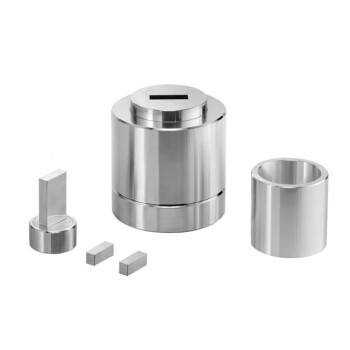
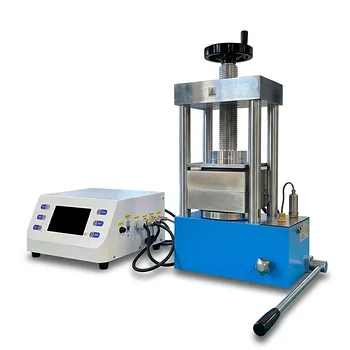
The primary purpose of using a laboratory hydraulic press in this context is to fabricate optically transparent pellets required for accurate infrared spectroscopy. By applying approximately 7 tons/cm² of pressure to a mixture of welding aerosol and high-purity potassium bromide (KBr), the press transforms loose powder into a solid, clear disc that the infrared beam can penetrate.
The hydraulic press acts as a densification tool that eliminates air voids and light-scattering particles, creating a homogeneous sample "window" necessary for the precise identification of molecular vibrations and surface chemical bonds.
The Physics of Sample Preparation
The KBr Pellet Technique
Infrared spectroscopy requires the sample to be suspended in a medium that is transparent to infrared light.
For solid welding aerosols, the standard method involves mixing the sample with high-purity potassium bromide (KBr) powder. This mixture creates a matrix where the sample particles are evenly dispersed.
Achieving Optical Transparency
Loose powder scatters infrared light, resulting in poor signal quality and unreadable spectra.
The hydraulic press applies immense force to fuse the KBr and aerosol mixture. This plastic deformation eliminates porosity, resulting in a glass-like, transparent pellet suitable for transmission spectroscopy.
Critical Process Parameters
Pressure Application
The primary reference indicates that a pressure of typically 7 tons/cm² is required for welding aerosol samples.
This specific pressure level is sufficient to cold-flow the KBr crystals around the hard welding aerosol particles. This creates a tight, void-free encapsulation without chemically altering the sample.
Ensuring Uniformity
Beyond simple compression, the press ensures the pellet is uniform in thickness and density.
As noted in supplementary contexts regarding FTIR analysis, precise pressure control is vital to produce pellets free of air bubbles. Air bubbles or density gradients would cause baseline noise in the final spectral diagram.
Analytical Capabilities Unlocked
Identifying Molecular Vibrations
Once a transparent pellet is formed, the infrared beam can effectively interrogate the sample's molecular structure.
The high-quality spectra obtained allow researchers to detect specific molecular vibrations, such as those from water molecules, carbonates, and carboxylates.
Characterizing Metal-Oxygen Bonds
The clarity provided by the hydraulic press method is particularly important for analyzing the inorganic components of welding fumes.
It enables the distinct observation of metal-oxygen (M-O) bond stretching and bending. These spectral features are critical for identifying the specific oxidation states and chemical composition of the solid aerosol surface.
Understanding the Trade-offs
The Risk of Opacity
If the hydraulic press does not apply sufficient pressure, or if the pressure is not held long enough, the pellet will remain opaque or cloudy.
Cloudy pellets cause significant light scattering. This results in a sloping baseline and low signal-to-noise ratio, making it impossible to detect weak spectral peaks like those of trace carboxylates.
Moisture Contamination
While the press solves the transparency issue, the KBr method introduces a risk of moisture absorption.
KBr is hygroscopic (absorbs water from the air). If the pressing process is not performed quickly or under controlled conditions, the resulting spectrum may show false water peaks that obscure the actual water content of the welding aerosol.
Making the Right Choice for Your Goal
To ensure valid spectroscopic results, tailor your pressing protocol to your specific analytical needs:
- If your primary focus is detecting trace surface compounds: Ensure the press can sustain 7 tons/cm² consistently to maximize transparency and signal sensitivity.
- If your primary focus is analyzing metal-oxygen (M-O) bonds: Verify that your pellet is completely free of air bubbles, as these defects can distort the low-frequency region where M-O bonds appear.
Success in solid-state infrared analysis relies not just on the spectrometer, but on the mechanical precision of the sample compression.
Summary Table:
| Process Component | Specification / Goal | Role in Spectroscopic Analysis |
|---|---|---|
| Applied Pressure | Approx. 7 tons/cm² | Cold-flows KBr crystals to encapsulate aerosol particles |
| Matrix Material | High-purity KBr | Serves as an IR-transparent medium for solid samples |
| Sample Form | Homogeneous Pellet | Eliminates air voids and light scattering for clear signals |
| Key Detection | M-O Bonds & Vibrations | Identifies oxidation states and surface chemical compositions |
Elevate Your Analytical Precision with Kintek
Precise sample preparation is the foundation of reliable spectroscopic data. KINTEK specializes in high-performance laboratory hydraulic presses (pellet, hot, and isostatic) designed to produce the high-quality, transparent pellets required for critical welding aerosol research and FTIR analysis.
Beyond sample preparation, our comprehensive portfolio supports your entire lab workflow with:
- Crushing and milling systems for perfect sample homogenization.
- High-temperature furnaces and high-pressure reactors for advanced material synthesis.
- PTFE products and ceramics for contamination-free processing.
Don't let poor pellet quality compromise your research. Contact KINTEK today to find the perfect pressing solution for your laboratory's needs!
References
- Т. L. Rakitskaya, V. Ya. Volkova. Physicochemical and Catalytic Properties of the Solid Component of Welding Aerosol. DOI: 10.15407/hftp05.04.396
This article is also based on technical information from Kintek Solution Knowledge Base .
Related Products
- Automatic Laboratory Hydraulic Press for XRF & KBR Pellet Press
- Laboratory Hydraulic Pellet Press for XRF KBR FTIR Lab Applications
- kbr pellet press 2t
- Automatic Laboratory Hydraulic Pellet Press Machine for Lab Use
- Laboratory Hydraulic Press Lab Pellet Press for Button Battery
People Also Ask
- What is the significance of applying 200 MPa of pressure with a laboratory hydraulic pellet press for composite ceramics?
- What is the role of a laboratory hydraulic pellet press and stainless steel molds in the fabrication of RuO2/NbC anodes?
- What is the necessity of using a laboratory hydraulic pellet press in the preparation of biomass fuel pellets? Guide
- How does a laboratory hydraulic pellet press contribute to SiCw/2024 aluminum composite preforms? Optimize Densification
- What role does a laboratory hydraulic pellet press play in fly ash utilization? Enhancing Adsorption and Flow Control