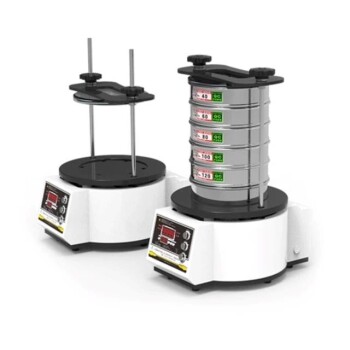
The primary purpose of using a standard sieve (such as a 100-mesh screen) before pressing TiC-reinforced steel matrix composites is to ensure mechanical uniformity by removing large agglomerated particles. These agglomerates, often formed during the drying and granulation phases, must be eliminated to guarantee that the powder flows evenly and packs consistently into the mold.
The sieving process is the critical bridge between raw powder preparation and consolidation. By standardizing particle size, it ensures the "green body" (the pressed but unsintered part) has uniform density, which is the single most important factor in preventing cracks and defects during the final sintering stage.
1. Ensuring Powder Consistency
Before the powder can be pressed, its physical characteristics must be standardized.
Removing Agglomerates
During the drying and granulation steps of manufacturing, fine powder particles naturally cluster together.
If left unchecked, these large agglomerated particles create inconsistencies within the mix. A standard sieve physically breaks these clusters apart or removes them entirely.
Establishing Particle Size Uniformity
The sieve acts as a quality control gate, ensuring only particles within a specific size range pass through.
This creates a narrow particle size distribution, which is essential for predictable material behavior under pressure.
2. Optimizing Mold Filling
The way the powder behaves as it enters the mold dictates the quality of the final part.
Enhancing Flowability
Agglomerated or irregular powders tend to clump, leading to erratic flow.
Sieving ensures the powder possesses excellent flowability, allowing it to fill complex mold geometries quickly and evenly without mechanical assistance.
Maximizing Packing Density
To achieve a high-quality composite, the spaces between particles must be minimized.
Sieved powder settles more efficiently, improving the packing density within the mold. This establishes a solid foundation for the consolidation process.
3. The "Bridging Effect" and Common Pitfalls
One of the most significant risks in powder metallurgy is the "bridging effect," a phenomenon where particles lock together and create artificial voids.
Preventing Particle Bridging
Large or irregular particles can interlock above a gap rather than filling it, leaving empty spaces (voids) in the powder bed.
By removing these large particles, sieving drastically reduces the bridging effect, ensuring that the powder settles into a naturally dense configuration.
Avoiding Structural Anisotropy
If powder distribution is uneven, the final material may have different properties in different directions (anisotropy).
Standardized granulation through sieving promotes structural isotropy, meaning the material performs consistently regardless of the direction of stress.
4. Impact on the Final Product
The quality of the "green body" directly correlates to the quality of the sintered steel matrix composite.
Uniform Green Body Density
When the powder is uniform, the pressure applied during pressing is distributed evenly throughout the material.
This results in a green body with density uniformity, preventing weak spots or distinct density gradients that could cause warping.
Reducing Sintering Defects
Defects in the green body are rarely healed during sintering; they are usually magnified.
By ensuring a homogeneous green body, sieving minimizes the risk of cracking, distortion, or incomplete densification during the subsequent sintering process.
Making the Right Choice for Your Goal
When integrating sieving into your manufacturing workflow, focus on these specific outcomes:
- If your primary focus is Dimensional Accuracy: Ensure your sieve mesh is fine enough to remove all agglomerates, as this guarantees uniform shrinkage during sintering.
- If your primary focus is Mechanical Strength: Prioritize flowability to maximize packing density, as higher green density typically leads to superior final hardness and toughness.
Ultimately, sieving is not just a sorting step; it is the fundamental process control that safeguards the structural integrity of your composite material.
Summary Table:
| Process Objective | Key Benefit | Impact on Material |
|---|---|---|
| Agglomerate Removal | Eliminates large clusters | Prevents internal voids and weak spots |
| Improved Flowability | Uniform mold filling | Ensures consistent density in green bodies |
| Reduced Bridging | Minimizes particle interlocking | Maximizes packing density before pressing |
| Structural Isotropy | Uniform particle distribution | Guarantees consistent mechanical performance |
Optimize Your Materials Research with KINTEK
Achieving superior structural integrity in TiC-reinforced steel matrix composites starts with the right tools. KINTEK provides high-precision sieving equipment and crushing systems to ensure your powder quality, alongside world-class hydraulic presses for perfect green body formation.
From high-temperature furnaces (vacuum, CVD, sintering) to isostatic presses and PTFE consumables, we empower laboratories to achieve maximum density and zero-defect results.
Ready to elevate your material performance? Contact our technical experts today to find the perfect laboratory solutions for your production needs.
Related Products
- Custom PTFE Teflon Parts Manufacturer for PTFE Mesh F4 Sieve
- Laboratory Test Sieves and Sieving Machines
- Three-dimensional electromagnetic sieving instrument
- Vibratory Sieve Shaker Machine Dry Three-Dimensional Vibrating Sieve
- Laboratory Vibratory Sieve Shaker Machine for Dry and Wet Three-Dimensional Sieving
People Also Ask
- What are the primary reasons for selecting PTFE as a matrix? Enhance Composites with Carbon Nanotube Reinforcement
- How is PTFE utilized for insulation in Alloy 22 corrosion setups? Ensure Signal Purity & Accuracy
- Is PTFE corrosion resistant? Discover the Ultimate Chemical Resistance for Your Lab
- What are the specific applications of PTFE in micro-batch slug flow systems? Enhance Your Microfluidic Reaction Purity
- What is the mesh size of a sieve? A Guide to Particle Size and Sieve Selection