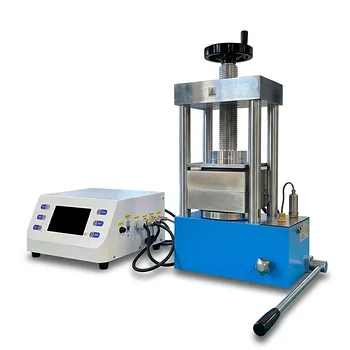
The primary purpose of using a uniaxial hydraulic press in this context is to consolidate loose, aerated mixed powders into a cohesive solid form known as a "green body." This pre-pressing step is essential to expel trapped air, significantly increase the material's initial packing density, and provide sufficient structural strength for safe handling and loading into a sintering furnace.
Core Takeaway While the obvious function of the press is to shape the powder, its critical technical role is to establish a solid foundation for thermodynamics. By forcing particles into tight contact, you minimize void space and maximize the surface area available for heat conduction and mass transfer, which are the driving forces of effective sintering.
Establishing Physical Integrity
Increasing Packing Density
Loose mixed powders naturally contain a significant amount of void space.
A uniaxial hydraulic press applies force to mechanically rearrange these particles, reducing porosity.
This drastically increases the initial packing density, bringing the material closer to its final desired state before heat is ever applied.
Expelling Trapped Air
Air trapped between powder particles acts as a thermal insulator and can cause structural defects during heating.
The compression process forces this air out of the matrix.
Removing air prevents expansion issues later in the process, such as bloating or cracking, when the material is subjected to high vacuum or temperature.
Creating "Green Strength"
Loose powder cannot be moved without losing its mix homogeneity or shape.
Pressure induces mechanical interlocking and, in some metals, plastic deformation between particles.
This creates a self-supporting object with enough "green strength" to be ejected from the die, stored, and loaded into a furnace without crumbling.
Optimizing for Sintering Mechanics
Enhancing Heat Conduction
Sintering relies on the uniform application of heat throughout the material.
The tight particle-to-particle contact established by the press creates a continuous path for thermal energy.
This ensures that when the green body enters the vacuum hot-press sintering stage, heat is distributed efficiently, preventing cold spots or uneven melting.
Facilitating Mass Transfer
For an alloy to sinter correctly, atoms must diffuse across particle boundaries (mass transfer).
Pre-pressing minimizes the distance these atoms must travel.
By ensuring intimate contact between reactants (such as in solid-state reactions), the efficiency of the chemical and physical bonding processes improves significantly.
Understanding the Trade-offs
Non-Uniform Density Distribution
Uniaxial pressing applies force from one direction (or two opposing directions).
Friction between the powder and the die walls can cause density gradients, where the edges are denser than the center.
This can lead to uneven shrinkage or warping during the final sintering phase.
Risk of Lamination and Cracking
Applying pressure too quickly or aggressively can trap pockets of compressed air.
Upon release of the pressure, this air expands, causing the green body to crack or separate into layers (lamination).
Proper pressure ramp-rates and dwell times are critical to avoiding these "spring-back" defects.
Making the Right Choice for Your Goal
To maximize the effectiveness of your pre-pressing stage, consider your specific end-goals:
- If your primary focus is Handling and Storage: Prioritize achieving sufficient green strength through mechanical interlocking to prevent breakage during furnace loading.
- If your primary focus is Reaction Efficiency: Focus on maximizing packing density to ensure the tightest possible particle contact for improved solid-state diffusion.
- If your primary focus is Dimensional Accuracy: Monitor the pressure distribution to minimize density gradients, ensuring the part shrinks uniformly during sintering.
The quality of your final sintered alloy is largely determined by the uniformity and density of the green body you create today.
Summary Table:
| Technical Function | Description | Benefit to Sintering |
|---|---|---|
| Particle Consolidation | Increases initial packing density & reduces porosity | Accelerates mass transfer & diffusion |
| Air Expulsion | Removes trapped air from the powder matrix | Prevents bloating, cracking, and oxidation |
| Green Strength | Induces mechanical interlocking & plastic deformation | Enables safe handling and furnace loading |
| Thermal Pathing | Creates continuous particle-to-particle contact | Ensures uniform heat conduction and distribution |
Elevate Your Material Research with KINTEK Precision
Achieving the perfect green body is the foundation of high-performance alloy development. KINTEK specializes in advanced laboratory equipment designed to meet the rigorous demands of material science. Our comprehensive range of uniaxial hydraulic presses (pellet, hot, and isostatic) ensures optimal packing density and green strength for your mixed powders.
Pair your sample preparation with our industry-leading high-temperature vacuum hot-press furnaces, tube furnaces, and crushing systems to achieve flawless sintering results. Whether you are working on battery research, ceramics, or metallurgy, KINTEK provides the tools and consumables—including crucibles, ceramics, and PTFE products—to streamline your workflow.
Ready to optimize your sintering process? Contact KINTEK today for expert solutions and high-quality lab equipment!
Related Products
- Heated Hydraulic Press Machine with Integrated Manual Heated Plates for Lab Use
- Automatic Laboratory Hydraulic Press for XRF & KBR Pellet Press
- Laboratory Hydraulic Pellet Press for XRF KBR FTIR Lab Applications
- Laboratory Hydraulic Press Split Electric Lab Pellet Press
- 24T 30T 60T Heated Hydraulic Press Machine with Heated Plates for Laboratory Hot Press
People Also Ask
- Why is a heated laboratory hydraulic press necessary for composite laminates? Achieve Void-Free Structural Integrity
- What role does a heated hydraulic press play in Cold Sintering (CSP)? Enhancing LATP-Halide Densification
- What technical conditions does a heated hydraulic press provide for PEO batteries? Optimize Solid-State Interfaces
- Why is the heating function of a laboratory hydraulic press essential for MEA assembly in DEFC? Optimize Cell Bonding
- What are heated hydraulic presses used for? Molding Composites, Vulcanizing Rubber, and More