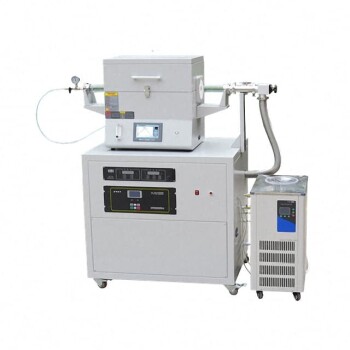
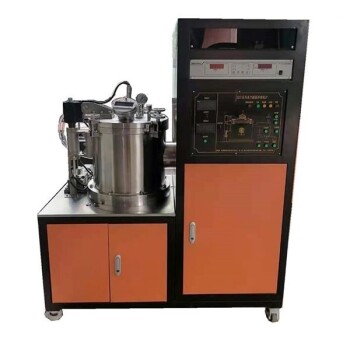
Wrapping porcelain boats with tin foil serves as a dual-purpose mechanism to protect expensive equipment and ensure sample uniformity. During the pyrolysis of biomass, the foil acts as a physical barrier that traps corrosive volatiles and creates a stable micro-atmosphere. This configuration is essential for producing biochar with consistent physicochemical properties while maintaining the operational integrity of the vacuum tube furnace.
This technique is a strategic compromise designed to isolate the biomass reaction from the furnace environment. It prevents the deposition of decomposition byproducts on the furnace tube while simultaneously stabilizing the thermal conditions surrounding the sample.
Protecting the Integrity of the Furnace System
Prevention of Tube Contamination
As biomass undergoes thermal decomposition, it releases a variety of volatile substances and tars that can condense on the cooler inner walls of the furnace tube. These deposits are often difficult to clean and can cause permanent staining or devitrification of quartz tubes.
Extending Equipment Lifespan
By acting as a sacrificial shield, the foil wrapping prevents these corrosive volatiles from interacting with the heating elements or the tube surface. This significantly reduces the frequency of tube maintenance and prevents cross-contamination between different experimental batches.
Optimizing the Pyrolysis Environment
Creation of a Controlled Micro-Atmosphere
The foil wrapping helps maintain a localized micro-atmosphere immediately surrounding the biomass powder. This environment prevents the rapid escape of intermediate gaseous products, which can be critical for achieving specific chemical reactions or deep carbonization.
Promoting Thermal Uniformity
In a vacuum environment, heat transfer can be uneven; the foil helps to distribute heat more effectively around the porcelain boat. This results in uniform heating of the precursor material, ensuring that the resulting biochar has consistent structural and chemical characteristics across the entire sample.
Understanding the Trade-offs
Temperature Limitations
The most significant limitation of using foil (typically aluminum) is its melting point. If the pyrolysis process exceeds the thermal threshold of the foil, it can melt and fuse to the porcelain boat or the furnace tube, causing the exact damage it was intended to prevent.
Potential for Elemental Interference
While porcelain is chemically inert, the foil itself might introduce trace impurities if it reacts with the biomass at high temperatures. Researchers must ensure that the foil material does not interfere with the specific chemical analysis intended for the biochar.
Applying This Technique to Your Project
Making the Right Choice for Your Goal
- If your primary focus is equipment longevity: Use the foil wrapping to capture condensable tars, especially when working with high-lipid or high-resin biomass that produces significant smoke.
- If your primary focus is sample purity: Ensure the foil does not come into direct contact with the biomass, or consider using a dedicated porcelain lid if the temperature exceeds the foil's melting point.
- If your primary focus is research reproducibility: Standardize the tightness and layers of the foil wrap to ensure the micro-atmosphere remains consistent across all experimental trials.
Understanding the interaction between your sample and the furnace environment is the key to achieving high-quality, reproducible carbon materials.
Summary Table:
| Feature | Main Benefit | Key Consideration |
|---|---|---|
| Contamination Control | Prevents tar/volatile deposits on furnace tubes | Foil melting point limits |
| Micro-Atmosphere | Stabilizes reactions for consistent biochar | Consistency of foil wrapping |
| Thermal Uniformity | Distributes heat evenly around the boat | Potential for trace impurities |
| Equipment Safety | Extends lifespan of quartz tubes & elements | Use dedicated lids for high temps |
Optimize Your Pyrolysis Results with KINTEK
Elevate your materials research with KINTEK’s advanced laboratory solutions. Whether you are performing biomass pyrolysis in our high-performance vacuum tube furnaces or require durable porcelain boats, ceramics, and crucibles, we provide the precision tools needed for reproducible results.
Our extensive portfolio also features high-temperature high-pressure reactors, CVD systems, and hydraulic presses, ensuring comprehensive support for your lab's unique requirements. Contact our technical experts today to discover how KINTEK can optimize your experimental setup, provide reliable consumables, and protect your equipment investment.
References
- Tao-Tao Shi, Jin‐Gang Yu. Efficient and Selective Removal of Organic Cationic Dyes by Peel of Brassica juncea Coss. var. gemmifera Lee et Lin-Based Biochar. DOI: 10.3390/molecules28083353
This article is also based on technical information from Kintek Solution Knowledge Base .
Related Products
- Vacuum Sealed Continuous Working Rotary Tube Furnace Rotating Tube Furnace
- Laboratory High Pressure Vacuum Tube Furnace
- Laboratory Vacuum Tilt Rotary Tube Furnace Rotating Tube Furnace
- Split Chamber CVD Tube Furnace with Vacuum Station Chemical Vapor Deposition System Equipment Machine
- 1200℃ Controlled Atmosphere Furnace Nitrogen Inert Atmosphere Furnace
People Also Ask
- What are the process advantages of using a rotary tube furnace for WS2 powder? Achieve Superior Material Crystallinity
- What are the advantages of using a rotary tube furnace for MoVOx catalysts? Elevate Uniformity and Crystallinity
- Why is a vacuum tube furnace with argon protection required for RGO/Cu? Ensure Conductivity and Material Purity
- Why is a rotary tube furnace preferred over a fixed tube furnace for the carbonization of asphaltenes? Superior Quality
- Why is a rotary tube furnace recommended for the calcination stage of potassium vanadium oxide catalysts? Optimize Purity