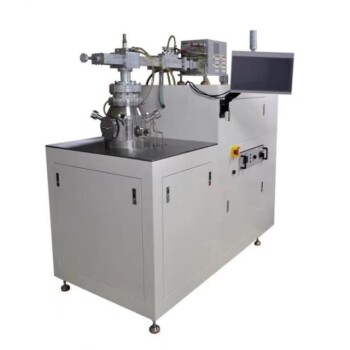
The primary role of a Chemical Vapor Deposition (CVD) system in fabricating silicon microwire arrays is to provide the strictly controlled environment required for the Vapor-Liquid-Solid (VLS) growth mechanism. By managing high temperatures and the flow of reactant precursor gases, the system facilitates the directional growth of wires on catalyst-coated substrates. This process transforms volatile inputs into well-aligned, single-crystal silicon structures.
Core Takeaway: The CVD system functions as the critical "growth engine" for microwire arrays, creating the precise conditions needed to organize silicon atoms into highly ordered, single-crystal structures rather than random, amorphous films.
Facilitating the Vapor-Liquid-Solid (VLS) Process
Precise Environmental Control
The CVD system is responsible for maintaining a high-temperature environment essential for the VLS mechanism.
This heat is necessary to maintain the catalyst in a liquid state and to supply the energy required for the chemical interaction and breakdown of source materials.
Managing Reactant Precursors
The system introduces and regulates the flow of volatile precursor gases (the source material).
By controlling this flow, the CVD system ensures a consistent supply of silicon that dissolves into the catalyst droplets, eventually supersaturating them to precipitate solid silicon microwires.
Ensuring Structural Integrity and Alignment
Achieving Single-Crystal Quality
A key function of the CVD system in this specific application is promoting single-crystal growth.
Unlike standard deposition which might result in amorphous films, the VLS process supported by the CVD system organizes the silicon atoms into a continuous, defect-free crystal lattice.
Directional Alignment
The system creates conditions that allow for directional growth.
Rather than forming a disorganized tangle, the microwires grow perpendicular to the substrate, resulting in a well-aligned array necessary for advanced applications.
Understanding the Trade-offs
The Necessity of Precision
The quality of the microwire array is entirely dependent on the system's ability to maintain process stability.
Any fluctuation in temperature, pressure, or gas flow can disrupt the VLS equilibrium, potentially leading to kinking, defects, or the cessation of growth.
Process Intensity
As noted in supplementary contexts, CVD processes often utilize plasma, heat, and higher pressures.
This requires robust equipment infrastructure and careful safety management, as the energy inputs are significant to achieve the breakdown of source materials.
Application and Geometric Control
Tunable Geometric Parameters
The CVD system allows operators to control the physical dimensions of the microwires, such as length and aspect ratio.
This is achieved by managing process variables like time and power, similar to how film thickness is managed in standard deposition.
Foundation for Light Absorption
The ultimate output of this CVD process is a structure optimized for high-efficiency light absorption.
The alignment and single-crystal nature of the arrays make them ideal candidates for solar cells and photon-harvesting devices.
Optimizing Microwire Fabrication
To leverage a CVD system effectively for silicon microwire arrays, align your process controls with your specific end-goals:
- If your primary focus is Electronic Quality: Prioritize thermal stability and gas purity to ensure the growth of defect-free, single-crystal structures.
- If your primary focus is Physical Geometry: Focus on the precise calibration of process duration and power to control the length and density of the wire array.
Ultimately, the CVD system is the enabling tool that translates raw chemical potential into the structured, high-performance architecture of silicon microwire arrays.
Summary Table:
| Feature | CVD Role in Microwire Fabrication | Impact on Quality |
|---|---|---|
| Growth Mechanism | Facilitates Vapor-Liquid-Solid (VLS) process | Ensures directional, vertical alignment |
| Temperature Control | Maintains liquid state of catalyst droplets | Promotes defect-free single-crystal lattice |
| Precursor Management | Regulates flow of volatile silicon sources | Controls wire length and growth consistency |
| Process Stability | Manages pressure and plasma energy | Prevents structural kinking and defects |
Elevate Your Semiconductor Research with KINTEK Precision
Unlock the full potential of your silicon microwire fabrication with KINTEK’s high-performance CVD and PECVD systems. Whether you are developing high-efficiency solar cells or advanced photonic devices, our equipment provides the thermal stability and gas flow precision required for flawless VLS growth.
Our laboratory solutions include:
- Advanced CVD & PECVD Systems: For superior control over thin-film and microwire geometry.
- Thermal Processing: High-temperature muffle, tube, and vacuum furnaces.
- Material Preparation: Crushing, milling, and high-pressure hydraulic presses.
- Support & Consumables: From PTFE products to specialized ceramics and crucibles.
Ready to optimize your lab’s output? Contact KINTEK today to discuss your specific research requirements and see how our comprehensive range of laboratory equipment can accelerate your innovation.
References
- Shane Ardo, Nathan S. Lewis. Unassisted solar-driven photoelectrosynthetic HI splitting using membrane-embedded Si microwire arrays. DOI: 10.1039/c5ee00227c
This article is also based on technical information from Kintek Solution Knowledge Base .
Related Products
- Chemical Vapor Deposition CVD Equipment System Chamber Slide PECVD Tube Furnace with Liquid Gasifier PECVD Machine
- Microwave Plasma Chemical Vapor Deposition MPCVD Machine System Reactor for Lab and Diamond Growth
- 915MHz MPCVD Diamond Machine Microwave Plasma Chemical Vapor Deposition System Reactor
- Customer Made Versatile CVD Tube Furnace Chemical Vapor Deposition Chamber System Equipment
- HFCVD Machine System Equipment for Drawing Die Nano-Diamond Coating
People Also Ask
- What are the advantages of chemical vapor deposition? Achieve Superior Thin Films for Your Lab
- What types of substrates are used in CVD to facilitate graphene films? Optimize Graphene Growth with the Right Catalyst
- What is the chemical vapor deposition growth process? Build Superior Thin Films from the Atom Up
- How expensive is chemical vapor deposition? Understanding the True Cost of High-Performance Coating
- Why is Chemical Vapor Deposition (CVD) equipment uniquely suited for constructing hierarchical superhydrophobic structures?