Knowledge What is the role of a corundum crucible in magnesium powder production? Ensuring Purity in Resistance Evaporation
Author avatar

Tech Team · Kintek Solution

Updated 1 day ago

What is the role of a corundum crucible in magnesium powder production? Ensuring Purity in Resistance Evaporation


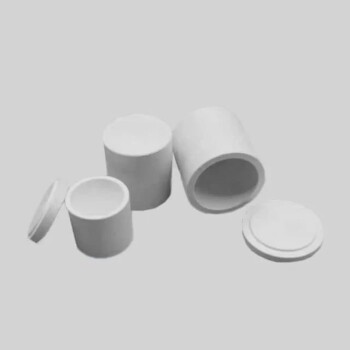
The corundum crucible serves as the primary containment vessel responsible for isolating molten magnesium during the resistance heating evaporation process. Its fundamental role is to hold the metallic magnesium liquid at extreme temperatures while acting as a chemically inert barrier. By preventing reactions between the vessel and the highly active molten magnesium, the crucible directly enables the production of ultrafine magnesium powder with exceptional purity.

In this process, the crucible is not merely a container; it is the defining safeguard against contamination. The use of corundum allows for evaporation at temperatures up to 1473 K without compromising the chemical integrity of the final magnesium product.

The Mechanics of Purity Preservation

Isolating Active Molten Metals

In the resistance heating evaporation method, metallic magnesium must be heated until it transitions into a liquid state.

Magnesium is highly active chemically, meaning it aggressively seeks to react with surrounding materials when molten.

The corundum crucible provides a stable reservoir that physically contains this volatile liquid without degrading under the thermal load.

Chemical Inertness as a Barrier

The defining characteristic of a corundum (alumina) crucible is its superior high-temperature chemical stability.

Unlike standard containment materials, corundum remains inert even when in direct contact with reactive magnesium liquid.

This inertness prevents chemical leaching or reactions that would otherwise introduce impurities into the magnesium vapor.

Ensuring Ultrafine Quality

The goal of this process is to produce ultrafine magnesium powder.

Any reaction between the crucible wall and the magnesium would alter the composition of the vapor.

By eliminating this variable, the corundum crucible ensures the final condensed powder retains high purity and meets strict specification requirements.

Operational Parameters

Thermal Endurance

The evaporation process requires sustaining high temperatures to volatilize the magnesium.

Corundum crucibles are capable of operating stably within a range of 1273 K to 1473 K.

This thermal resistance allows the process to maintain the necessary evaporation rate without the risk of the crucible softening or failing.

Stability of Experimental Data

For research or precise production contexts, process variables must be controlled.

Because the corundum crucible does not participate in the chemical reaction, it ensures that the resulting data reflects only the behavior of the magnesium.

This allows for accurate, reproducible results regarding the evaporation kinetics and powder formation.

Critical Considerations for Quality Control

The Consequence of Material Substitution

While other ceramics exist, few offer the specific balance of thermal resistance and chemical inertness required for magnesium.

Using a crucible with lower chemical stability will lead to immediate cross-contamination.

This results in a magnesium powder that is impure and potentially unusable for high-performance applications.

Temperature Limits

While corundum is robust, it functions best within the specific window of 1273 K to 1473 K for this application.

Exceeding these temperatures could stress the material or alter the evaporation dynamics unpredictably.

Operators must maintain strict thermal controls to ensure the crucible performs as the intended inert barrier.

Optimizing Production for Purity

To ensure the success of your magnesium powder production, select your containment materials based on your specific quality targets:

  • If your primary focus is Maximum Purity: Prioritize high-grade corundum crucibles to strictly prevent chemical interaction with the active magnesium liquid.
  • If your primary focus is Process Stability: Maintain operating temperatures between 1273 K and 1473 K to utilize the crucible’s optimal range for thermal and chemical resistance.

The corundum crucible is the silent guarantor of quality, bridging the gap between raw molten metal and high-value ultrafine powder.

Summary Table:

Feature Role in Magnesium Production
Material High-grade Corundum (Alumina)
Operating Temp 1273 K to 1473 K
Primary Function Chemical isolation of molten magnesium
Key Benefit Prevents reactions & ensures ultrafine powder purity
Stability High thermal resistance and chemical inertness

Elevate Your Powder Metallurgy with KINTEK Quality

Achieving ultrafine magnesium powder requires more than just high temperatures—it demands uncompromising material integrity. KINTEK specializes in premium laboratory equipment and consumables, including high-grade ceramics, crucibles, and high-temperature furnaces designed for the most reactive materials.

Whether you are performing resistance heating evaporation or complex CVD/PECVD processes, our high-purity corundum solutions provide the chemical inertness your research demands. Beyond crucibles, explore our extensive range of high-temperature reactors, crushing systems, and cooling solutions tailored for advanced battery research and material science.

Ready to optimize your production purity? Contact KINTEK today to discuss your laboratory needs!

Related Products

People Also Ask

Related Products

Alumina Al2O3 Ceramic Crucible Semicircle Boat with Lid for Engineering Advanced Fine Ceramics

Alumina Al2O3 Ceramic Crucible Semicircle Boat with Lid for Engineering Advanced Fine Ceramics

Crucibles are containers widely used for melting and processing various materials, and semicircular boat-shaped crucibles are suitable for special smelting and processing requirements. Their types and uses vary by material and shape.

Arc-Shaped Alumina Ceramic Crucible High Temperature Resistant for Engineering Advanced Fine Ceramics

Arc-Shaped Alumina Ceramic Crucible High Temperature Resistant for Engineering Advanced Fine Ceramics

In the journey of scientific exploration and industrial production, every detail is crucial. Our arc-shaped alumina ceramic crucibles, with their excellent high temperature resistance and stable chemical properties, have become a powerful assistant in laboratories and industrial fields. They are made of high-purity alumina materials and manufactured through precision processes to ensure excellent performance in extreme environments.

Electron Beam Evaporation Coating Tungsten Crucible and Molybdenum Crucible for High Temperature Applications

Electron Beam Evaporation Coating Tungsten Crucible and Molybdenum Crucible for High Temperature Applications

Tungsten and molybdenum crucibles are commonly used in electron beam evaporation processes due to their excellent thermal and mechanical properties.

Engineering Advanced Fine Ceramics Alumina Crucibles (Al2O3) for Thermal Analysis TGA DTA

Engineering Advanced Fine Ceramics Alumina Crucibles (Al2O3) for Thermal Analysis TGA DTA

TGA/DTA thermal analysis vessels are made of aluminum oxide (corundum or aluminum oxide). It can withstand high temperature and is suitable for analyzing materials that require high temperature testing.

Engineering Advanced Fine Alumina Al2O3 Ceramic Crucible for Laboratory Muffle Furnace

Engineering Advanced Fine Alumina Al2O3 Ceramic Crucible for Laboratory Muffle Furnace

Alumina ceramic crucibles are used in some materials and metal melting tools, and flat-bottomed crucibles are suitable for melting and processing larger batches of materials with better stability and uniformity.

Custom Machined and Molded PTFE Teflon Parts Manufacturer with PTFE Crucible and Lid

Custom Machined and Molded PTFE Teflon Parts Manufacturer with PTFE Crucible and Lid

PTFE crucibles, made from pure Teflon, offer chemical inertness and resistance from -196°C to 280°C, ensuring compatibility with a wide range of temperatures and chemicals. These crucibles feature machine-finished surfaces for easy cleaning and prevention of contamination, making them ideal for precise laboratory applications.

Boron Nitride (BN) Crucible for Phosphorous Powder Sintered

Boron Nitride (BN) Crucible for Phosphorous Powder Sintered

Phosphorus powder sintered boron nitride (BN) crucible has a smooth surface, dense, pollution-free and long service life.

Electron Beam Evaporation Coating Gold Plating Tungsten Molybdenum Crucible for Evaporation

Electron Beam Evaporation Coating Gold Plating Tungsten Molybdenum Crucible for Evaporation

These crucibles act as containers for the gold material evaporated by the electron evaporation beam while precisely directing the electron beam for precise deposition.

Evaporation Crucible for Organic Matter

Evaporation Crucible for Organic Matter

An evaporation crucible for organic matter, referred to as an evaporation crucible, is a container for evaporating organic solvents in a laboratory environment.

Electron Beam Evaporation Coating Oxygen-Free Copper Crucible and Evaporation Boat

Electron Beam Evaporation Coating Oxygen-Free Copper Crucible and Evaporation Boat

Electron Beam Evaporation Coating Oxygen-Free Copper Crucible enables precise co-deposition of various materials. Its controlled temperature and water-cooled design ensure pure and efficient thin film deposition.

Electron Beam Evaporation Coating Conductive Boron Nitride Crucible BN Crucible

Electron Beam Evaporation Coating Conductive Boron Nitride Crucible BN Crucible

High-purity and smooth conductive boron nitride crucible for electron beam evaporation coating, with high temperature and thermal cycling performance.

High Temperature Muffle Oven Furnace for Laboratory Debinding and Pre Sintering

High Temperature Muffle Oven Furnace for Laboratory Debinding and Pre Sintering

KT-MD High temperature debinding and pre-sintering furnace for ceramic materials with various molding processes. Ideal for electronic components such as MLCC and NFC.

1200℃ Muffle Furnace Oven for Laboratory

1200℃ Muffle Furnace Oven for Laboratory

Upgrade your lab with our 1200℃ Muffle Furnace. Achieve fast, precise heating with Japan alumina fibers and Molybdenum coils. Features TFT touch screen controller for easy programming and data analysis. Order now!

Molybdenum Disilicide (MoSi2) Thermal Elements Electric Furnace Heating Element

Molybdenum Disilicide (MoSi2) Thermal Elements Electric Furnace Heating Element

Discover the power of Molybdenum Disilicide (MoSi2) Heating Element for high-temperature resistance. Unique oxidation resistance with stable resistance value. Learn more about its benefits now!

Dental Porcelain Zirconia Sintering Ceramic Furnace Chairside with Transformer

Dental Porcelain Zirconia Sintering Ceramic Furnace Chairside with Transformer

Experience top-notch sintering with Chairside Sintering Furnace with Transformer. Easy to operate, noise-free pallet, and automatic temperature calibration. Order now!

Glassy Carbon Sheet RVC for Electrochemical Experiments

Glassy Carbon Sheet RVC for Electrochemical Experiments

Discover our Glassy Carbon Sheet - RVC. Perfect for your experiments, this high-quality material will elevate your research to the next level.

Twin Screw Extruder Plastic Granulation Machine

Twin Screw Extruder Plastic Granulation Machine

Twin screw extruder plastic granulation machine is designed for the mixing and processing experiments of engineering plastics, modified plastics, waste plastics and masterbatches.

Cylindrical Press Mold with Scale for Lab

Cylindrical Press Mold with Scale for Lab

Discover precision with our Cylindrical Press Mold. Ideal for high-pressure applications, it molds various shapes and sizes, ensuring stability and uniformity. Perfect for lab use.

Vertical Laboratory Tube Furnace

Vertical Laboratory Tube Furnace

Elevate your experiments with our Vertical Tube Furnace. Versatile design allows for operation under various environments and heat treatment applications. Order now for precise results!

MgF2 Magnesium Fluoride Crystal Substrate Window for Optical Applications

MgF2 Magnesium Fluoride Crystal Substrate Window for Optical Applications

Magnesium fluoride (MgF2) is a tetragonal crystal that exhibits anisotropy, making it imperative to treat it as a single crystal when engaging in precision imaging and signal transmission.


Leave Your Message