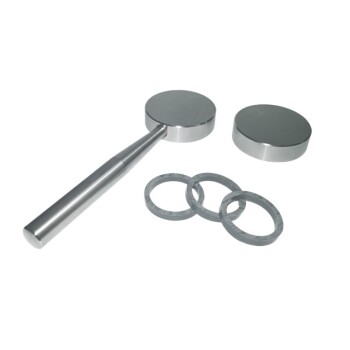
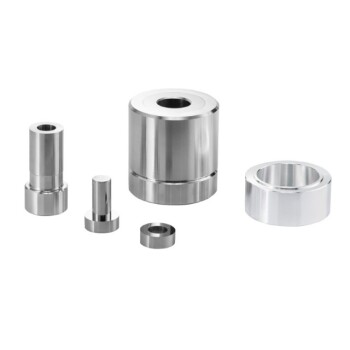
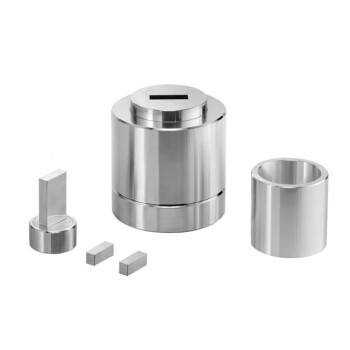
A laboratory hydraulic press and pellet die are the critical tools used to execute the KBr pelletizing technique for FTIR analysis. By compressing a mixture of BiVO4@PANI and spectroscopic-grade potassium bromide (KBr) powder, these instruments create a solid, transparent disk essential for accurate spectral readings.
The hydraulic press applies high, precise pressure to transform loose powder into an optically transparent window. This process eliminates light scattering caused by particle gaps, ensuring infrared light can fully penetrate the sample to verify the chemical structure of the BiVO4@PANI heterojunction.
The Mechanics of Sample Preparation
Creating an Optical Window
To analyze solid materials like BiVO4@PANI using transmission FTIR, the sample must be suspended in a medium transparent to infrared light. The laboratory hydraulic press compacts the sample with spectroscopic grade potassium bromide (KBr), a salt that does not absorb IR radiation in the region of interest.
The Role of Uniaxial Pressure
The hydraulic press and pellet die work together to apply precise uniaxial pressure (often around 40 MPa) to the powder mixture. This mechanical force is necessary to fuse the discrete particles into a singular, cohesive mass.
Eliminating Light Scattering
Loose powders naturally scatter light due to the air gaps and porosity between particles. By applying sufficient pressure, the press reduces porosity and eliminates light scattering, resulting in a highly transparent disk that allows the infrared beam to pass through without distortion.
Characterizing the BiVO4@PANI Heterojunction
Detecting BiVO4 Lattice Vibrations
Once the transparent pellet is formed, the FTIR instrument can accurately detect the low-frequency signals associated with the inorganic core. The spectra reveal the characteristic lattice vibrations of the Bismuth Vanadate (BiVO4), confirming the crystal structure of the base material.
Identifying PANI Chemical Bonds
The high-quality pellet allows for the precise resolution of organic functional groups within the Polyaniline (PANI) coating. Specifically, the analysis targets C=N and C=C stretching vibrations, which serve as chemical fingerprints for the polymer.
Confirming Heterojunction Construction
The ultimate goal of using the press for this preparation is to view these signals simultaneously. By observing both the inorganic lattice vibrations and the organic polymer bonds, researchers can definitively confirm the successful construction of the heterojunction between the two materials.
Understanding the Trade-offs
Precision vs. Force
While high pressure is required to reduce porosity, applying uncontrolled force can be detrimental. Precise pressure control is vital; too little pressure results in an opaque pellet that scatters light, while excessive pressure can potentially alter the crystal structure of sensitive samples.
Sample Concentration Balance
The ratio of sample to KBr is as critical as the pressure applied by the press. A pellet that is too dense with BiVO4@PANI will block the IR beam regardless of how well it is pressed, leading to "bottomed out" spectra where absorption peaks are unreadable.
Making the Right Choice for Your Goal
To maximize the quality of your FTIR data, consider how the preparation step impacts your specific analytical needs:
- If your primary focus is Structural Verification: Ensure the pellet is transparent enough to resolve the specific C=N and C=C peaks of PANI without noise, as these confirm the polymer presence.
- If your primary focus is Inorganic Quality: Prioritize a uniform mix and consistent pressure to ensure the BiVO4 lattice vibrations are distinct and not obscured by scattering artifacts.
Mastering the use of the hydraulic press ensures that your spectral data reflects the true chemistry of your composite, not the physical defects of your sample preparation.
Summary Table:
| Component | Role in FTIR Preparation | Impact on BiVO4@PANI Analysis |
|---|---|---|
| Hydraulic Press | Applies high uniaxial pressure (approx. 40 MPa) | Fuses powder into a cohesive, transparent disk |
| Pellet Die | Houses and shapes the KBr/sample mixture | Ensures uniform thickness and prevents sample leakage |
| KBr Powder | Acts as an IR-transparent medium | Provides the matrix to suspend particles without IR interference |
| Pressure Control | Eliminates air gaps and porosity | Minimizes light scattering for clear lattice vibration signals |
Elevate Your Material Research with KINTEK Precision
Precision in sample preparation is the foundation of accurate FTIR analysis. KINTEK specializes in high-performance laboratory hydraulic presses (pellet, hot, isostatic) and precision-engineered pellet dies designed to deliver the optical clarity required for complex characterizations like BiVO4@PANI heterojunctions.
Our extensive portfolio supports diverse lab needs, from crushing and milling systems to high-temperature furnaces and vacuum solutions. Whether you are conducting battery research or advanced polymer studies, KINTEK provides the reliable consumables—including PTFE products, ceramics, and crucibles—to ensure your results are never compromised by physical defects.
Ready to achieve superior spectral resolution? Contact KINTEK today for a customized equipment consultation!
References
- Jari S. Algethami, Amal F. Seliem. Bismuth Vanadate Decked Polyaniline Polymeric Nanocomposites: The Robust Photocatalytic Destruction of Microbial and Chemical Toxicants. DOI: 10.3390/ma16093314
This article is also based on technical information from Kintek Solution Knowledge Base .
Related Products
- Automatic Laboratory Hydraulic Press for XRF & KBR Pellet Press
- Laboratory Hydraulic Press Lab Pellet Press Machine for Glove Box
- Laboratory Hydraulic Pellet Press for XRF KBR FTIR Lab Applications
- Automatic Laboratory Hydraulic Pellet Press Machine for Lab Use
- Laboratory Hydraulic Press Lab Pellet Press for Button Battery
People Also Ask
- What is the significance of applying 200 MPa of pressure with a laboratory hydraulic pellet press for composite ceramics?
- What is the role of a laboratory hydraulic pellet press and stainless steel molds in the fabrication of RuO2/NbC anodes?
- What is the necessity of using a laboratory hydraulic pellet press in the preparation of biomass fuel pellets? Guide
- How does a laboratory hydraulic pellet press contribute to SiCw/2024 aluminum composite preforms? Optimize Densification
- What role does a laboratory hydraulic pellet press play in fly ash utilization? Enhancing Adsorption and Flow Control