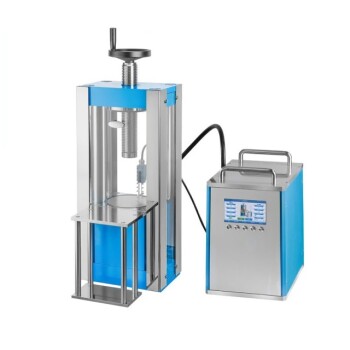
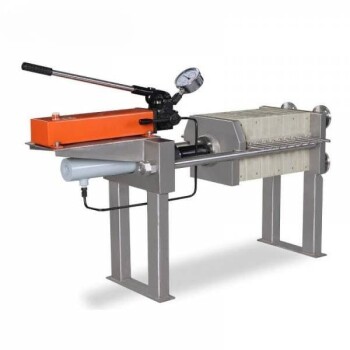
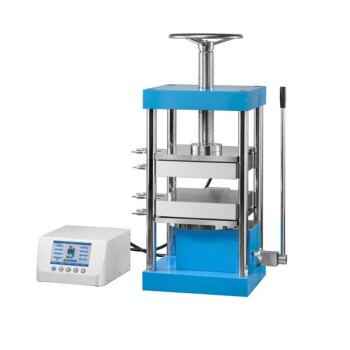
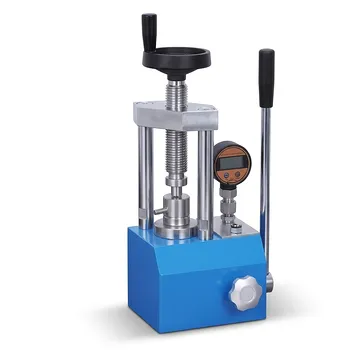
The primary role of a laboratory hydraulic press in this context is to function as a precise compression testing machine. By applying a controlled, strictly axial load to hardened concrete specimens containing waste eggshell powder, the device measures the exact force required to cause structural failure. This process provides the quantitative data necessary to calculate the compressive strength, which is the defining metric for the material's mechanical performance.
The viability of sustainable construction relies heavily on verifiable data. The hydraulic press bridges the gap between theoretical mixture design and practical application, quantifying exactly how eggshell additives impact the structural integrity of concrete.
The Mechanics of Evaluation
Applying Controlled Axial Load
The fundamental function of the hydraulic press is the application of force. It exerts a standardized, consistent load along the vertical axis of the concrete specimen.
This consistency is vital. It ensures that the force is distributed evenly, replicating the types of downward pressure a structural element would face in a real-world building scenario.
Determining the Point of Failure
The machine does not merely squeeze the sample; it pushes it to the breaking point. The press increases the load continuously until the concrete cracks or crumbles.
By recording the maximum load sustained at the precise moment of failure, the equipment provides a definitive measurement of ultimate compressive strength.
Assessing Material Performance
Quantifying Structural Contribution
Introducing waste materials like eggshell powder alters the internal chemistry and physical structure of concrete. The hydraulic press acts as the judge of this alteration.
It generates data that reveals whether the eggshell additive acts as a reinforcement or a defect. This allows researchers to assess the specific contribution of the additive to the material's overall durability.
Validating Mixture Dosages
Similar to how equipment is used to verify the effects of nanomaterials (such as nano-silica or nano-alumina), the press is essential for optimizing eggshell dosages.
It allows for quantitative verification, helping engineers identify the exact ratio of eggshell powder that maintains or enhances strength without compromising safety.
Understanding the Trade-offs
The Requirement for Standardization
The data generated by a hydraulic press is only as good as the testing protocol. The machine must deliver a standardized load rate; any fluctuation in how fast the pressure is applied can skew the results.
If the load is applied too quickly or unevenly, the resulting data may misrepresent the true mechanical properties of the eggshell-enhanced concrete.
Scope of Measurement
While the hydraulic press is the gold standard for compressive strength, it is a specialized tool. It primarily measures resistance to crushing.
It does not inherently measure other critical properties, such as tensile strength or elasticity, unless specific distinct adapters or tests are utilized. It answers the question of "how much weight can it hold," not "how much can it stretch."
Making the Right Choice for Your Goal
To effectively utilize a hydraulic press for evaluating sustainable concrete, consider your specific research objectives.
- If your primary focus is structural feasibility: Use the press to determine if the eggshell-modified concrete meets the minimum compressive strength measurements required by building codes.
- If your primary focus is mixture optimization: Use the machine to test a range of dosages to pinpoint the exact percentage of eggshell powder that yields the highest failure point.
By rigorously testing these specimens to failure, you transform theoretical waste reduction into statistically proven structural engineering.
Summary Table:
| Feature | Role in Concrete Evaluation | Impact on Research |
|---|---|---|
| Axial Loading | Applies standardized, consistent pressure | Ensures replicable and reliable structural data |
| Failure Detection | Identifies the exact point of structural collapse | Determines ultimate compressive strength limits |
| Dosage Validation | Compares different ratios of eggshell additives | Optimizes the mixture for maximum durability |
| Performance Benchmarking | Tests against building code requirements | Verifies feasibility for real-world construction |
Elevate Your Sustainable Material Research with KINTEK
Precise data is the foundation of innovation in sustainable construction. KINTEK specializes in high-performance laboratory equipment designed to bridge the gap between theoretical material science and structural reality. Whether you are optimizing eggshell additives or testing advanced nanomaterials, our precision-engineered hydraulic presses (pellet, hot, isostatic) provide the accuracy you need to verify compressive strength and structural integrity.
Beyond mechanical testing, KINTEK offers a comprehensive range of solutions for your laboratory, including:
- High-temperature furnaces and reactors for material synthesis.
- Crushing, milling, and sieving systems for precise additive preparation.
- Battery research tools and high-pressure autoclaves for advanced chemical analysis.
Ready to transform your research into proven engineering? Contact KINTEK today to discuss our custom laboratory solutions and find the perfect equipment for your specific research goals.
References
- Omojola Awogbemi, Victor Sunday Aigbodion. Pathways for Sustainable Utilization of Waste Chicken Eggshell. DOI: 10.32604/jrm.2022.019152
This article is also based on technical information from Kintek Solution Knowledge Base .
Related Products
- Laboratory Hydraulic Press Lab Pellet Press Machine for Glove Box
- Laboratory Hydraulic Press Split Electric Lab Pellet Press
- Automatic Laboratory Hydraulic Press for XRF & KBR Pellet Press
- Laboratory Hydraulic Press Lab Pellet Press for Button Battery
- Automatic Laboratory Hydraulic Pellet Press Machine for Lab Use
People Also Ask
- What is the function of a laboratory hydraulic press in W-Cu composites? Control Porosity and Material Ratio
- What is the role of a laboratory hydraulic press in the initial stages of Li6PS5Cl preparation? Key to Green Pellets
- What role does a laboratory hydraulic press play in triboelectric testing? Achieve Precision Alloy Sample Prep
- How can a laboratory hydraulic press be applied to chitosan for wastewater treatment? Optimize Pores & Strength
- How do a precision laboratory hydraulic press and specialized molds contribute to the fabrication of spherical ceramic samples? Achieving High-Density Material Precision