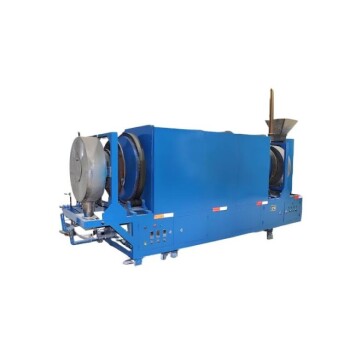
The role of a precision heat treatment furnace in this context is to provide a strictly controlled thermal environment that relieves internal stresses and fine-tunes the material's microstructure. By maintaining a constant temperature, typically around 873 K (600°C), the furnace facilitates the diffusion of carbon atoms and allows engineers to manipulate pearlite lamellar spacing, directly influencing the steel's ductility.
Precision annealing is not merely about heating; it is a mechanism for microstructural architecture. By accurately controlling the annealing duration, you can double the material's elongation capability without sacrificing its inherent strength.
The Mechanics of Microstructural Control
To understand the furnace's value, we must look beyond simple temperature application and focus on how it alters the steel at the atomic level.
Releasing Thermal Stresses
The production of nanostructured eutectic steel often involves rapid cooling. This process inevitably generates significant thermal stresses within the material.
The precision furnace provides a stable, constant-temperature environment—specifically at 873 K (600°C)—to effectively release these tensions. Without this relaxation phase, the internal stress could lead to premature material failure.
Facilitating Carbon Diffusion
Beyond stress relief, the furnace acts as a vessel for atomic movement. The stable thermal environment provides the necessary energy to facilitate carbon atom diffusion.
This diffusion is critical for homogenizing the nanostructure. It ensures that the chemical composition is uniform throughout the steel, which is a prerequisite for consistent mechanical performance.
Optimizing Mechanical Properties
The ultimate goal of using a high-precision furnace is to break the traditional trade-off between strength and ductility.
Adjusting Pearlite Lamellar Spacing
The defining capability of the precision furnace is the control it offers over annealing duration.
By varying the time the steel remains at temperature, you can adjust the pearlite lamellar spacing. This spacing is a defining characteristic of the microstructure that dictates how the material deforms under load.
Enhancing Elongation
The impact of this adjustment is substantial. Proper regulation of the annealing process can increase the elongation of the steel from 16% to 33%.
This significant jump in ductility transforms the steel from a rigid material into one that can withstand greater deformation before fracturing.
Preserving Strength
Crucially, this increase in flexibility does not degrade the material's load-bearing capacity. The process is specifically tuned to enhance elongation without compromising the steel's strength.
Understanding the Trade-offs
While precision heat treatment offers significant benefits, it requires rigorous control variables. Deviation in furnace performance can negate these gains.
The Risk of Temperature Instability
If the furnace lacks temperature uniformity, the stress relief process becomes inconsistent.
Variations in temperature can lead to uneven carbon diffusion. This results in a heterogeneous microstructure where some regions remain stressed or brittle, creating weak points in the final component.
Sensitivity to Duration
The relationship between annealing time and pearlite spacing is highly sensitive.
If the annealing duration is not controlled accurately, the lamellar spacing may become too coarse or remain too fine. This misalignment prevents the material from achieving the optimal 33% elongation target, leaving potential performance on the table.
Making the Right Choice for Your Goal
To fully leverage a precision heat treatment furnace for nanostructured eutectic steel, align your process parameters with your specific engineering objectives.
- If your primary focus is maximum ductility: Prioritize precise control over the annealing duration to optimize pearlite lamellar spacing, targeting the upper limit of 33% elongation.
- If your primary focus is structural integrity: Ensure your furnace guarantees absolute temperature stability at 873 K to fully release thermal stresses generated during rapid cooling.
True precision in annealing turns thermal processing into a tool for exact material design.
Summary Table:
| Process Parameter | Action in Precision Furnace | Material Impact |
|---|---|---|
| Temperature Control | Constant 873 K (600°C) | Releases thermal stresses & enables carbon diffusion |
| Annealing Duration | Precise timing regulation | Adjusts pearlite lamellar spacing |
| Microstructural Aim | Homogenization | Increases elongation from 16% to 33% |
| Mechanical Result | Optimized Ductility | Enhances flexibility without sacrificing strength |
Unlock the Full Potential of Your Material Science Research
Achieve unmatched microstructural control with KINTEK’s high-precision thermal solutions. Whether you are optimizing nanostructured steels or developing advanced alloys, our comprehensive range of high-temperature muffle, vacuum, and atmosphere furnaces provides the thermal stability required for critical annealing processes.
From crushing and milling systems to high-pressure reactors and battery research tools, KINTEK delivers the reliable laboratory equipment and consumables needed to transform your engineering objectives into consistent, high-performance results.
Ready to enhance your lab's precision? Contact our technical experts today to find the perfect solution for your specific application.
References
- Zhengning Li, Yupeng Wei. Enhancing Ductility of 1045 Nanoeutectic Steel Prepared by Aluminothermic Reaction through Annealing at 873 K. DOI: 10.1155/2017/5392073
This article is also based on technical information from Kintek Solution Knowledge Base .
Related Products
- 600T Vacuum Induction Hot Press Furnace for Heat Treat and Sintering
- Vacuum Heat Treat Furnace with Ceramic Fiber Liner
- 2200 ℃ Graphite Vacuum Heat Treat Furnace
- Molybdenum Vacuum Heat Treat Furnace
- Vacuum Heat Treat and Pressure Sintering Furnace for High Temperature Applications
People Also Ask
- What role does an induction vacuum hot pressing furnace play in sintering? Achieve 98% Density in Carbide Blocks
- What advantages does a vacuum hot press furnace provide for LSLBO ceramic electrolytes? Achieve 94% Relative Density
- What role does a Vacuum Hot Press (VHP) furnace play in the densification of austenitic stainless steel 316 composites?
- What role does mechanical pressure play during the vacuum diffusion bonding of tungsten and copper? Keys to Solid Bonding
- What are the advantages of a vacuum hot press furnace for W-50%Cu? Achieve 99.6% Density at Lower Temperatures