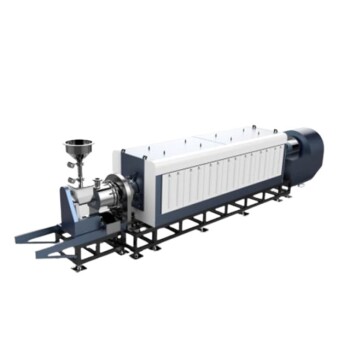
The tube furnace acts as the controlled thermal reactor for biomass decomposition. By providing a stable high-temperature environment and a strictly controlled inert atmosphere (such as Argon), the furnace ensures that durian shells undergo thorough devolatilization and carbonization without reacting with oxygen. This process transforms raw biomass into a carbon powder characterized by a preliminary micron-scale pore structure, serving as the essential foundation for further activation.
Core Takeaway: A tube furnace is the critical tool for biomass carbonization because it isolates the material from oxygen while applying precise thermal profiles. This allows for the steady removal of volatiles and the formation of a stable carbon skeleton necessary for high-performance activated carbon.
The Role of Atmosphere Control
Preventing Oxidation and Material Loss
The primary function of a tube furnace is to maintain sealing integrity to exclude oxygen. In an oxygen-rich environment, biomass would simply combust into ash at high temperatures; the furnace instead facilitates pyrolysis.
Maintaining an Inert Environment
A constant flow of inert gas, typically Argon (Ar) or Nitrogen (N2), is pumped through the tube. This atmosphere protects the carbon framework as it forms and carries away released volatile organic compounds.
Facilitating Chemical Integration
The controlled environment allows for the stable integration of heteroatoms, such as nitrogen or sulfur, into the carbon lattice. This integration is vital for tailoring the final material's chemical characteristics for specific adsorption tasks.
Precision Thermal Processing
Controlled Devolatilization
A tube furnace allows for a precise heating rate, often around 5 °C per minute. This gradual increase ensures the steady removal of volatiles, preventing the structural collapse of the material during the transition from biomass to biochar.
Establishing the Carbon Skeleton
For materials like durian shells, the furnace maintains a steady temperature—often 600 °C for 3 hours. This specific duration and heat level ensure that the dehydration and degassing processes are complete, leaving behind a robust skeletal carbonization.
Inducing Preliminary Porosity
As volatile components escape, the furnace environment induces the formation of an amorphous carbon framework. This creates a rich initial pore structure and increases the specific surface area, which is critical for the material’s future ability to adsorb impurities.
Understanding the Trade-offs
Scale vs. Precision
Tube furnaces are exceptional for laboratory-scale precision and research-grade consistency. However, they are typically batch-process devices, which may limit throughput compared to industrial rotary kilns.
Gas Consumption and Costs
Maintaining a strictly inert atmosphere requires a continuous flow of high-purity gas. Depending on the duration of the carbonization (such as a 3-hour soak), the cost of Argon or Nitrogen can become a significant factor in the overall production budget.
Thermal Gradients
In larger tubes, there is a risk of radial temperature gradients where the center of the sample is cooler than the edges. Users must ensure proper sample distribution and thermocouple placement to maintain the high level of uniformity required for consistent carbon quality.
How to Apply This to Your Project
Making the Right Choice for Your Goal
To achieve the best results when carbonizing biomass like durian shells, tailor your furnace settings to your specific objective.
- If your primary focus is maximizing surface area: Utilize a slower heating rate (e.g., 5 °C/min) to 600 °C to ensure the pore structure remains open and does not collapse during devolatilization.
- If your primary focus is chemical doping: Use the furnace’s precise atmosphere control to introduce specific precursor gases alongside the inert flow to integrate nitrogen or sulfur into the carbon lattice.
- If your primary focus is structural integrity: Ensure the furnace is completely purged of oxygen before heating to prevent any partial oxidation that could weaken the carbon skeleton.
The tube furnace remains the gold standard for transforming raw biomass into the high-quality carbon precursors required for advanced material science.
Summary Table:
| Feature | Role in Carbonization | Key Benefit for Biomass |
|---|---|---|
| Atmosphere Control | Provides inert environment (Ar/N2) | Prevents combustion; ensures pure pyrolysis |
| Thermal Precision | Controlled heating rates (e.g., 5°C/min) | Prevents structural collapse during degassing |
| Sealing Integrity | Excludes oxygen and contaminants | Protects carbon skeleton and heteroatom integration |
| Uniform Heating | Maintains steady soak temperatures | Ensures thorough dehydration and preliminary porosity |
Elevate Your Material Research with KINTEK Precision
Are you looking to transform raw biomass into high-performance carbon materials? KINTEK specializes in high-quality laboratory equipment designed for the most demanding research applications. Our advanced tube furnaces (available in vacuum and atmosphere-controlled models) provide the thermal uniformity and sealing integrity essential for consistent biomass carbonization.
Beyond furnaces, KINTEK offers a comprehensive ecosystem to support your entire workflow:
- Sample Preparation: Precision crushing and milling systems and sieving equipment.
- Processing: High-temperature high-pressure reactors and hydraulic pellet presses.
- Specialized Tools: CVD/PECVD systems, electrolytic cells for battery research, and high-purity ceramic crucibles.
Ready to achieve laboratory-grade consistency in your next project? Contact KINTEK today to consult with our experts and find the ideal thermal solution for your research goals!
References
- Nantikron Ngamjumrus, Chesta Ruttanapun. Two Steps for Improving Reduced Graphene Oxide/Activated Durian Shell Carbon Composite by Hydrothermal and 3-D Ball Milling Process for Symmetry Supercapacitor Device. DOI: 10.3390/en16196962
This article is also based on technical information from Kintek Solution Knowledge Base .
Related Products
- Graphite Vacuum Furnace Bottom Discharge Graphitization Furnace for Carbon Materials
- Vertical Laboratory Tube Furnace
- Laboratory Vacuum Tilt Rotary Tube Furnace Rotating Tube Furnace
- 1200℃ Split Tube Furnace with Quartz Tube Laboratory Tubular Furnace
- Electric Rotary Kiln Small Rotary Furnace Biomass Pyrolysis Plant
People Also Ask
- What is the use of graphite furnace? Achieve Extreme-Temperature Processing for Advanced Materials
- What is the disadvantage of graphite furnace? Managing Reactivity and Contamination Risks
- What gas is used in graphite furnace? Maximize Accuracy with the Right Inert Gas
- Why is graphite furnace more sensitive than flame? Unlocking Ultra-Trace Detection for Your Lab
- What is the function of the graphite furnace? Achieve Extreme Heat for Analysis & Materials Processing