Knowledge Vacuum Furnace What is the step by step process of case hardening? A Guide to Creating Durable, Wear-Resistant Parts
Author avatar

Tech Team · Kintek Solution

Updated 3 months ago

What is the step by step process of case hardening? A Guide to Creating Durable, Wear-Resistant Parts


In short, case hardening is a heat treatment process that creates a hard, wear-resistant surface layer (the "case") over a softer, tougher interior (the "core"). This is a distinct manufacturing process and should not be confused with metal sintering—the subject of the provided references—which involves fusing metal powders together to form a solid part.

The fundamental goal of case hardening is to engineer a dual-property component. It imbues a metal part with a highly durable surface to resist wear and abrasion, while preserving a ductile, shock-absorbent core to prevent catastrophic failure under impact.
What is the step by step process of case hardening? A Guide to Creating Durable, Wear-Resistant Parts

The Foundational Steps of Case Hardening

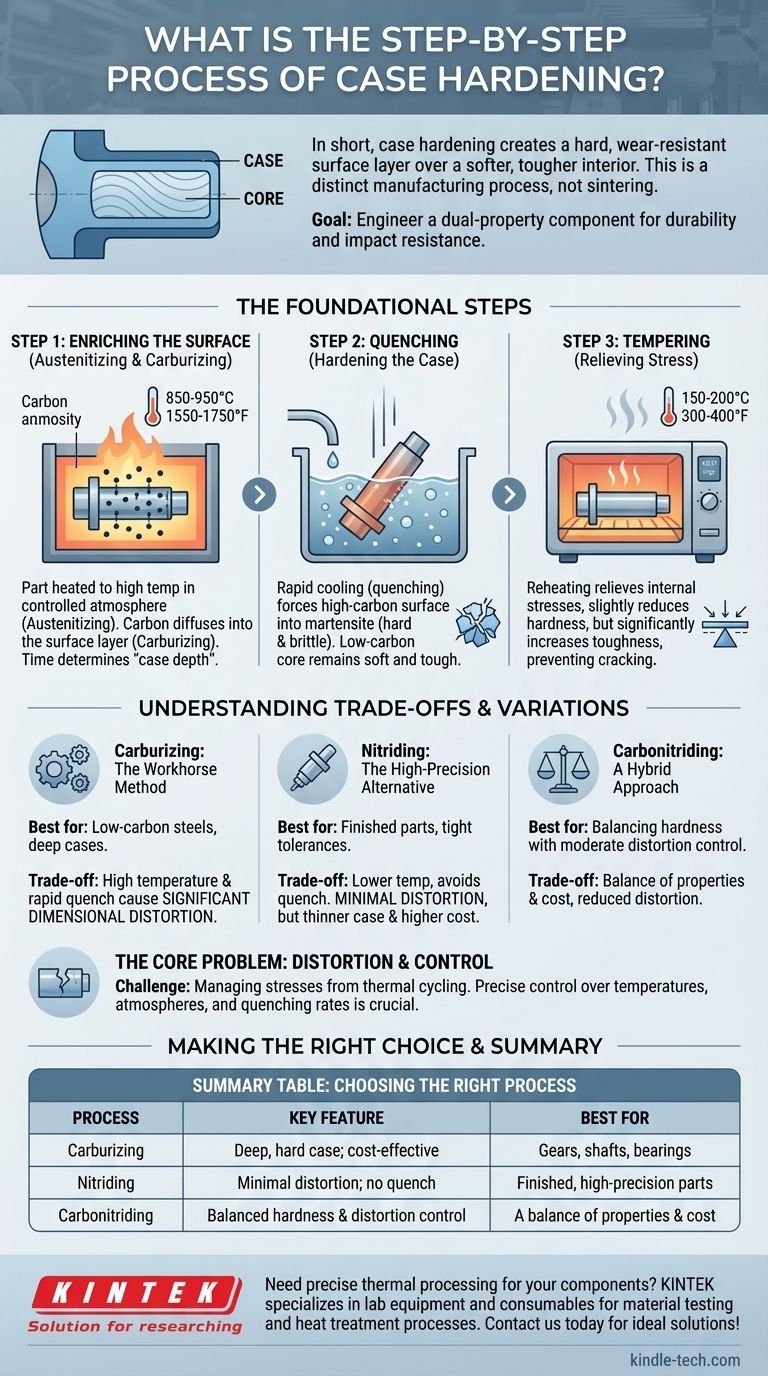
Case hardening is not a single action but a sequence of controlled thermal and chemical processes. The most common method, especially for low-carbon steels, involves three critical stages.

Step 1: Enriching the Surface (Austenitizing & Carburizing)

The first step is to change the chemical composition of the part's surface. The metal, typically a low-carbon steel, is heated to a high temperature (around 850-950°C or 1550-1750°F) in a controlled atmosphere.

At this temperature, the steel's crystal structure changes to austenite, which can readily absorb more carbon. The part is held at this temperature in an environment rich in carbon. This process, called carburizing, allows carbon atoms to diffuse into the surface layer of the steel. The longer the part is held, the deeper the carbon penetrates, determining the "case depth."

Step 2: Quenching (Hardening the Case)

Once the surface has absorbed enough carbon, the part is rapidly cooled, or quenched, by submerging it in a medium like oil, water, or brine.

This rapid cooling forces the high-carbon surface layer (the austenite) to transform into martensite, an extremely hard and brittle crystal structure. The low-carbon core, however, does not harden as dramatically, remaining relatively soft and tough.

Step 3: Tempering (Relieving Stress)

The quenching process leaves the hardened case in a state of high internal stress, making it very brittle. To counteract this, the part is tempered.

Tempering involves reheating the component to a much lower temperature (typically 150-200°C or 300-400°F) and holding it for a set time. This process relieves the internal stresses and slightly reduces the hardness of the case, but significantly increases its toughness, preventing it from chipping or cracking in service.

Understanding the Trade-offs and Variations

While carburizing is the most common method, several variations and alternatives exist, each with distinct advantages and disadvantages.

Carburizing: The Workhorse Method

Carburizing is highly effective for low-carbon steels and is relatively cost-efficient for creating deep, hard cases. However, the high temperatures and subsequent rapid quench can introduce significant dimensional distortion, which may require final grinding or machining.

Nitriding: The High-Precision Alternative

Nitriding achieves a similar result by diffusing nitrogen—not carbon—into the surface. A key advantage is its lower process temperature, which completely avoids the quenching step. This results in minimal distortion, making it ideal for finished parts with tight tolerances. The trade-off is often a thinner case and potentially higher cost.

Carbonitriding: A Hybrid Approach

This process diffuses both carbon and nitrogen into the surface. It offers a balance of properties, often providing a harder case than carburizing at a lower temperature, which helps reduce but not eliminate distortion.

The Core Problem: Distortion and Control

The primary challenge in all case hardening is managing the stresses from thermal cycling. Uneven heating or cooling can cause parts to warp, bend, or even crack. Success depends on precise control over furnace atmospheres, temperatures, and quenching rates.

Making the Right Choice for Your Goal

Selecting the correct process requires understanding the final application of the component. Your decision should be guided by the part's operational demands.

  • If your primary focus is maximum wear resistance and impact strength: Standard carburizing followed by quenching and tempering provides a deep, durable case with a tough core, ideal for gears, shafts, and bearings.
  • If your primary focus is maintaining tight dimensional tolerances: Gas nitriding is the superior choice, as the lack of a quench step results in minimal part distortion.
  • If your primary focus is balancing hardness with cost and moderate distortion control: Carbonitriding offers a compromise, delivering excellent surface hardness with less distortion than traditional carburizing.

By understanding these distinct processes, you can specify the precise treatment needed to achieve a component with the ideal balance of surface durability and core strength.

Summary Table:

Process Key Feature Best For
Carburizing Deep, hard case; cost-effective Gears, shafts, bearings
Nitriding Minimal distortion; no quench Finished, high-precision parts
Carbonitriding Balanced hardness & distortion control A balance of properties & cost

Need precise thermal processing for your components? The right case hardening method is critical for part performance and longevity. KINTEK specializes in lab equipment and consumables for material testing and heat treatment processes. Our experts can help you select the ideal solution to achieve the perfect balance of surface hardness and core toughness for your specific application. Contact us today to discuss your project requirements!

Visual Guide
What is the step by step process of case hardening? A Guide to Creating Durable, Wear-Resistant Parts Visual Guide

Related Products

People Also Ask

Related Products

Dental Porcelain Zirconia Sintering Ceramic Furnace Chairside with Transformer

Dental Porcelain Zirconia Sintering Ceramic Furnace Chairside with Transformer

Experience top-notch sintering with Chairside Sintering Furnace with Transformer. Easy to operate, noise-free pallet, and automatic temperature calibration. Order now!

Vacuum Heat Treat Sintering Brazing Furnace

Vacuum Heat Treat Sintering Brazing Furnace

A vacuum brazing furnace is a type of industrial furnace used for brazing, a metalworking process that joins two pieces of metal using a filler metal that melts at a lower temperature than the base metals. Vacuum brazing furnaces are typically used for high-quality applications where a strong, clean joint is required.

High Temperature Muffle Oven Furnace for Laboratory Debinding and Pre Sintering

High Temperature Muffle Oven Furnace for Laboratory Debinding and Pre Sintering

KT-MD High temperature debinding and pre-sintering furnace for ceramic materials with various molding processes. Ideal for electronic components such as MLCC and NFC.

Mesh belt controlled atmosphere furnace

Mesh belt controlled atmosphere furnace

Discover our KT-MB mesh belt sintering furnace - perfect for high-temperature sintering of electronic components & glass insulators. Available for open air or controlled atmosphere environments.

Ultra-High Temperature Graphite Vacuum Graphitization Furnace

Ultra-High Temperature Graphite Vacuum Graphitization Furnace

The ultra-high temperature graphitization furnace utilizes medium frequency induction heating in a vacuum or inert gas environment. The induction coil generates an alternating magnetic field, inducing eddy currents in the graphite crucible, which heats up and radiates heat to the workpiece, bringing it to the desired temperature. This furnace is primarily used for graphitization and sintering of carbon materials, carbon fiber materials, and other composite materials.

Horizontal High Temperature Graphite Vacuum Graphitization Furnace

Horizontal High Temperature Graphite Vacuum Graphitization Furnace

Horizontal Graphitization Furnace: This type of furnace is designed with the heating elements placed horizontally, allowing for uniform heating of the sample. It's well-suited for graphitizing large or bulky samples that require precise temperature control and uniformity.

Vacuum Heat Treat and Pressure Sintering Furnace for High Temperature Applications

Vacuum Heat Treat and Pressure Sintering Furnace for High Temperature Applications

Vacuum pressure sintering furnaces are designed for high temperature hot pressing applications in metal and ceramic sintering. Its advanced features ensure precise temperature control, reliable pressure maintenance, and a robust design for seamless operation.

Vacuum Heat Treat and Molybdenum Wire Sintering Furnace for Vacuum Sintering

Vacuum Heat Treat and Molybdenum Wire Sintering Furnace for Vacuum Sintering

A vacuum molybdenum wire sintering furnace is a vertical or bedroom structure, which is suitable for withdrawal, brazing, sintering and degassing of metal materials under high vacuum and high temperature conditions. It is also suitable for dehydroxylation treatment of quartz materials.

Vacuum Heat Treat Furnace with Ceramic Fiber Liner

Vacuum Heat Treat Furnace with Ceramic Fiber Liner

Vacuum furnace with polycrystalline ceramic fiber insulation liner for excellent heat insulation and uniform temperature field. Choose from 1200℃ or 1700℃ max. working temperature with high vacuum performance and precise temperature control.

Molybdenum Vacuum Heat Treat Furnace

Molybdenum Vacuum Heat Treat Furnace

Discover the benefits of a high-configuration molybdenum vacuum furnace with heat shield insulation. Ideal for high-purity, vacuum environments like sapphire crystal growth and heat treatment.

1200℃ Controlled Atmosphere Furnace Nitrogen Inert Atmosphere Furnace

1200℃ Controlled Atmosphere Furnace Nitrogen Inert Atmosphere Furnace

Discover our KT-12A Pro Controlled atmosphere furnace - high precision, heavy duty vacuum chamber, versatile smart touch screen controller, and excellent temperature uniformity up to 1200C. Ideal for both laboratory and industrial application.

1700℃ Controlled Atmosphere Furnace Nitrogen Inert Atmosphere Furnace

1700℃ Controlled Atmosphere Furnace Nitrogen Inert Atmosphere Furnace

KT-17A Controlled atmosphere furnace: 1700℃ heating, vacuum sealing technology, PID temperature control, and versatile TFT smart touch screen controller for laboratory and industrial use.

Multi Heating Zones CVD Tube Furnace Machine Chemical Vapor Deposition Chamber System Equipment

Multi Heating Zones CVD Tube Furnace Machine Chemical Vapor Deposition Chamber System Equipment

KT-CTF14 Multi Heating Zones CVD Furnace - Precise Temperature Control and Gas Flow for Advanced Applications. Max temp up to 1200℃, 4 channels MFC mass flow meter, and 7" TFT touch screen controller.

600T Vacuum Induction Hot Press Furnace for Heat Treat and Sintering

600T Vacuum Induction Hot Press Furnace for Heat Treat and Sintering

Discover the 600T Vacuum Induction Hot Press Furnace, designed for high-temperature sintering experiments in vacuum or protected atmospheres. Its precise temperature and pressure control, adjustable working pressure, and advanced safety features make it ideal for nonmetal materials, carbon composites, ceramics, and metal powders.

Controlled Nitrogen Inert Hydrogen Atmosphere Furnace

Controlled Nitrogen Inert Hydrogen Atmosphere Furnace

KT-AH Hydrogen atmosphere furnace - induction gas furnace for sintering/annealing with built-in safety features, dual housing design, and energy-saving efficiency. Ideal for lab and industrial use.

1200℃ Split Tube Furnace with Quartz Tube Laboratory Tubular Furnace

1200℃ Split Tube Furnace with Quartz Tube Laboratory Tubular Furnace

KT-TF12 split tube furnace: high-purity insulation, embedded heating wire coils, and max. 1200C. Widely used for new materials and chemical vapour deposition.

Vacuum Sealed Continuous Working Rotary Tube Furnace Rotating Tube Furnace

Vacuum Sealed Continuous Working Rotary Tube Furnace Rotating Tube Furnace

Experience efficient material processing with our vacuum-sealed rotary tube furnace. Perfect for experiments or industrial production, equipped with optional features for controlled feeding and optimized results. Order now.

1400℃ Controlled Atmosphere Furnace with Nitrogen and Inert Atmosphere

1400℃ Controlled Atmosphere Furnace with Nitrogen and Inert Atmosphere

Achieve precise heat treatment with KT-14A controlled atmosphere furnace. Vacuum sealed with a smart controller, it's ideal for lab and industrial use up to 1400℃.

Laboratory Muffle Oven Furnace Bottom Lifting Muffle Furnace

Laboratory Muffle Oven Furnace Bottom Lifting Muffle Furnace

Efficiently produce batches with excellent temperature uniformity using our Bottom Lifting Furnace. Features two electric lifting stages and advanced temperature control up to 1600℃.

Laboratory Rapid Thermal Processing (RTP) Quartz Tube Furnace

Laboratory Rapid Thermal Processing (RTP) Quartz Tube Furnace

Get lightning-fast heating with our RTP Rapid Heating Tube Furnace. Designed for precise, high-speed heating and cooling with convenient sliding rail and TFT touch screen controller. Order now for ideal thermal processing!


Leave Your Message