Knowledge rotary furnace What is the temperature range for calcination? Master the 800°C to 1300°C Process
Author avatar

Tech Team · Kintek Solution

Updated 2 months ago

What is the temperature range for calcination? Master the 800°C to 1300°C Process


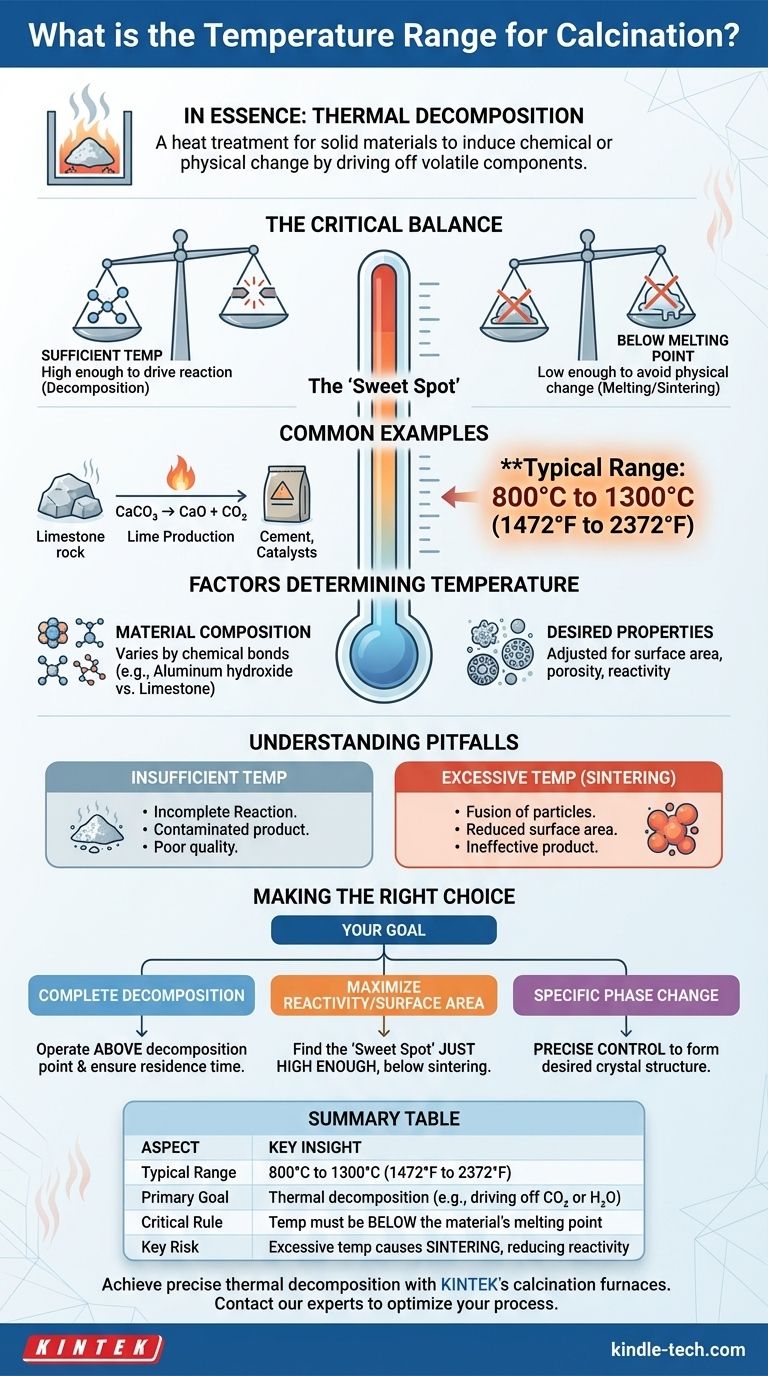
In essence, calcination is a process of thermal decomposition. This is a heat treatment applied to a solid material to bring about a chemical or physical change, typically by driving off volatile components. The required temperature varies significantly by application, but calcination furnaces generally operate in a range from 800°C to 1300°C (1472°F to 2372°F).

The specific temperature for calcination is not a single fixed value but a critical process parameter. It is carefully chosen to be high enough to drive a desired chemical reaction but remain below the material's melting point to avoid unwanted physical changes.
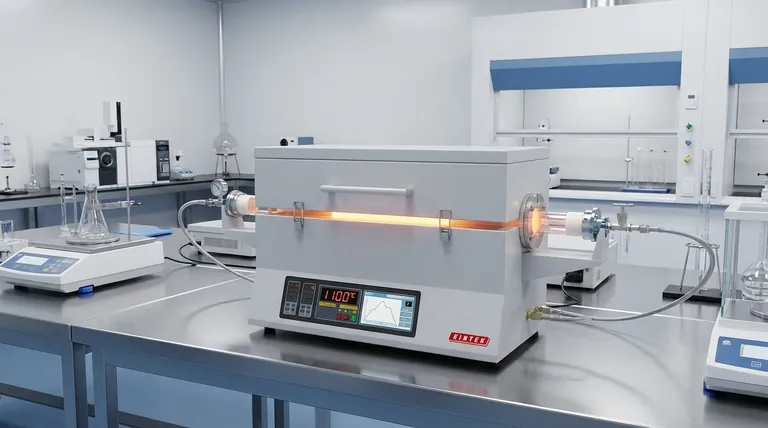
What is the temperature range for calcination? Master the 800°C to 1300°C Process

What is Calcination and Why is Temperature Critical?

Calcination is a foundational process in materials science and industry. Understanding why temperature is the primary lever of control is key to achieving the desired outcome.

The Goal: Driving Chemical and Physical Change

The fundamental purpose of calcination is to transform a material. This is often done to remove chemically bound components, like water (dehydration) or carbon dioxide (decarboxylation).

It can also be used to trigger a phase transition, changing the material's crystal structure from one form to another.

The Principle: Decomposition Without Melting

The success of calcination hinges on a simple principle: the temperature must be high enough to break chemical bonds but low enough to avoid melting the material.

Heating a substance to its calcination temperature provides the energy needed for decomposition reactions to occur.

Common Examples of Calcination

One of the most common examples is the production of lime from limestone. Calcium carbonate (CaCO₃) is heated to drive off carbon dioxide (CO₂), leaving behind calcium oxide (CaO), or quicklime.

Other major applications include the production of cement, the removal of water from hydrated minerals to create anhydrous versions, and the preparation of catalysts.

Factors That Determine the Calcination Temperature

The broad 800°C to 1300°C range exists because the precise temperature depends entirely on the material being processed and the desired properties of the final product.

Material Composition

Different chemical compounds have different decomposition temperatures. The bonds holding a molecule together dictate how much thermal energy is needed to break them apart.

For example, the decomposition of aluminum hydroxide requires a different temperature than the decomposition of limestone.

Desired End-Product Properties

Even for the same material, the temperature can be adjusted to fine-tune the final properties.

Slight variations in calcination temperature can significantly alter a product's surface area, porosity, and reactivity, which is especially critical in manufacturing catalysts and absorbents.

Understanding the Trade-offs and Pitfalls

Selecting the wrong temperature can lead to an inefficient process or a useless final product. Understanding the potential issues is crucial for process control.

Insufficient Temperature

If the temperature is too low, the decomposition reaction will be incomplete. The final product will be contaminated with the original, unreacted starting material.

This results in poor quality and requires either reprocessing or disposal, both of which are costly.

Excessive Temperature (Sintering)

If the temperature is too high—even if it's still below the melting point—it can cause an unwanted effect called sintering.

Sintering is the fusion of particles, which drastically reduces the material's surface area and reactivity. For applications like catalysts, where high surface area is essential, sintering renders the product ineffective.

Making the Right Choice for Your Application

The optimal calcination temperature is always a function of your end goal. Use these principles to guide your decision-making.

  • If your primary focus is complete decomposition: You must operate above the material's specific decomposition point and provide sufficient residence time for the reaction to finish.
  • If your primary focus is maximizing surface area or reactivity: You need to find the "sweet spot"—a temperature just high enough for full decomposition but safely below the onset of sintering.
  • If your primary focus is inducing a specific phase change: The temperature must be controlled with high precision to form the desired crystal structure without overshooting into an unwanted phase or causing sintering.

Ultimately, mastering calcination is about using temperature as a precise tool to engineer the final properties of your material.

Summary Table:

Aspect Key Insight
Typical Range 800°C to 1300°C (1472°F to 2372°F)
Primary Goal Thermal decomposition (e.g., driving off CO₂ or H₂O)
Critical Rule Temperature must be below the material's melting point
Key Risk Excessive temperature causes sintering, reducing reactivity
Main Factor Material composition and desired end-product properties

Achieve precise thermal decomposition with KINTEK's calcination furnaces.

Selecting the correct temperature is critical for your material's success. Whether you are producing lime, cement, or catalysts, our lab furnaces offer the precise temperature control and uniform heating you need to avoid incomplete reactions or damaging sintering.

KINTEK specializes in lab equipment for researchers and industrial professionals who require reliable thermal processing. Let us help you optimize your calcination process for maximum yield and desired material properties.

Contact our thermal experts today to discuss your specific application and furnace requirements.

Visual Guide
What is the temperature range for calcination? Master the 800°C to 1300°C Process Visual Guide

Related Products

People Also Ask

Related Products

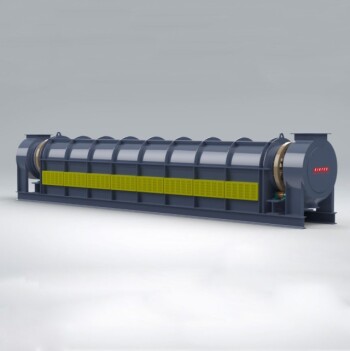
Electric Rotary Kiln Pyrolysis Furnace Plant Machine Calciner Small Rotary Kiln Rotating Furnace

Electric Rotary Kiln Pyrolysis Furnace Plant Machine Calciner Small Rotary Kiln Rotating Furnace

Electric rotary kiln - precisely controlled, it's ideal for calcination and drying of materials like lithium cobalate, rare earths, and non-ferrous metals.

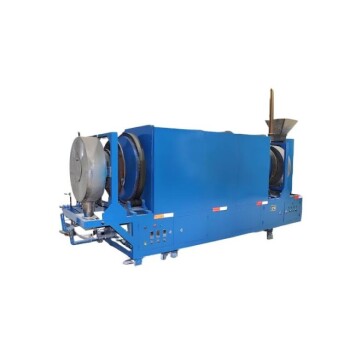
Electric Rotary Kiln Continuous Working Small Rotary Furnace Heating Pyrolysis Plant

Electric Rotary Kiln Continuous Working Small Rotary Furnace Heating Pyrolysis Plant

Efficiently calcine and dry bulk powder and lump fluid materials with an electric heating rotary furnace. Ideal for processing lithium ion battery materials and more.

Vertical High Temperature Graphite Vacuum Graphitization Furnace

Vertical High Temperature Graphite Vacuum Graphitization Furnace

Vertical high temperature graphitization furnace for carbonization and graphitization of carbon materials up to 3100℃.Suitable for shaped graphitization of carbon fiber filaments and other materials sintered in a carbon environment.Applications in metallurgy, electronics, and aerospace for producing high-quality graphite products like electrodes and crucibles.

Graphite Vacuum Furnace High Thermal Conductivity Film Graphitization Furnace

Graphite Vacuum Furnace High Thermal Conductivity Film Graphitization Furnace

The high thermal conductivity film graphitization furnace has uniform temperature, low energy consumption and can operate continuously.

Ultra-High Temperature Graphite Vacuum Graphitization Furnace

Ultra-High Temperature Graphite Vacuum Graphitization Furnace

The ultra-high temperature graphitization furnace utilizes medium frequency induction heating in a vacuum or inert gas environment. The induction coil generates an alternating magnetic field, inducing eddy currents in the graphite crucible, which heats up and radiates heat to the workpiece, bringing it to the desired temperature. This furnace is primarily used for graphitization and sintering of carbon materials, carbon fiber materials, and other composite materials.

High Temperature Muffle Oven Furnace for Laboratory Debinding and Pre Sintering

High Temperature Muffle Oven Furnace for Laboratory Debinding and Pre Sintering

KT-MD High temperature debinding and pre-sintering furnace for ceramic materials with various molding processes. Ideal for electronic components such as MLCC and NFC.

Large Vertical Graphite Vacuum Graphitization Furnace

Large Vertical Graphite Vacuum Graphitization Furnace

A large vertical high-temperature graphitization furnace is a type of industrial furnace used for the graphitization of carbon materials, such as carbon fiber and carbon black. It is a high-temperature furnace that can reach temperatures of up to 3100°C.

Graphite Vacuum Furnace Bottom Discharge Graphitization Furnace for Carbon Materials

Graphite Vacuum Furnace Bottom Discharge Graphitization Furnace for Carbon Materials

Bottom-out graphitization furnace for carbon materials, ultra-high temperature furnace up to 3100°C, suitable for graphitization and sintering of carbon rods and carbon blocks. Vertical design, bottom discharging, convenient feeding and discharging, high temperature uniformity, low energy consumption, good stability, hydraulic lifting system, convenient loading and unloading.

Graphite Vacuum Continuous Graphitization Furnace

Graphite Vacuum Continuous Graphitization Furnace

High-temperature graphitization furnace is a professional equipment for graphitization treatment of carbon materials. It is a key equipment for the production of high-quality graphite products. It has high temperature, high efficiency and uniform heating. It is suitable for various high-temperature treatments and graphitization treatments. It is widely used in metallurgy, electronics, aerospace, etc. industry.

Horizontal High Temperature Graphite Vacuum Graphitization Furnace

Horizontal High Temperature Graphite Vacuum Graphitization Furnace

Horizontal Graphitization Furnace: This type of furnace is designed with the heating elements placed horizontally, allowing for uniform heating of the sample. It's well-suited for graphitizing large or bulky samples that require precise temperature control and uniformity.

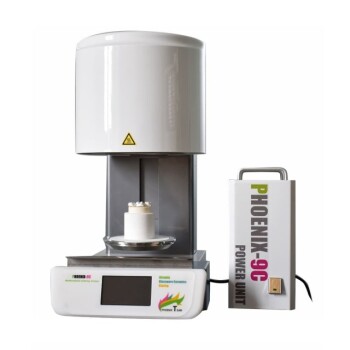
Dental Porcelain Zirconia Sintering Ceramic Furnace Chairside with Transformer

Dental Porcelain Zirconia Sintering Ceramic Furnace Chairside with Transformer

Experience top-notch sintering with Chairside Sintering Furnace with Transformer. Easy to operate, noise-free pallet, and automatic temperature calibration. Order now!

Dental Porcelain Zirconia Sintering Ceramic Vacuum Press Furnace

Dental Porcelain Zirconia Sintering Ceramic Vacuum Press Furnace

Get precise dental results with Dental Vacuum Press Furnace. Automatic temperature calibration, low noise tray, and touch screen operation. Order now!

1200℃ Split Tube Furnace with Quartz Tube Laboratory Tubular Furnace

1200℃ Split Tube Furnace with Quartz Tube Laboratory Tubular Furnace

KT-TF12 split tube furnace: high-purity insulation, embedded heating wire coils, and max. 1200C. Widely used for new materials and chemical vapour deposition.

Vacuum Arc Induction Melting Furnace

Vacuum Arc Induction Melting Furnace

Discover the power of Vacuum Arc Furnace for melting active & refractory metals. High-speed, remarkable degassing effect, and free of contamination. Learn more now!

Laboratory Muffle Oven Furnace Bottom Lifting Muffle Furnace

Laboratory Muffle Oven Furnace Bottom Lifting Muffle Furnace

Efficiently produce batches with excellent temperature uniformity using our Bottom Lifting Furnace. Features two electric lifting stages and advanced temperature control up to 1600℃.

Vacuum Heat Treat and Pressure Sintering Furnace for High Temperature Applications

Vacuum Heat Treat and Pressure Sintering Furnace for High Temperature Applications

Vacuum pressure sintering furnaces are designed for high temperature hot pressing applications in metal and ceramic sintering. Its advanced features ensure precise temperature control, reliable pressure maintenance, and a robust design for seamless operation.

Mesh belt controlled atmosphere furnace

Mesh belt controlled atmosphere furnace

Discover our KT-MB mesh belt sintering furnace - perfect for high-temperature sintering of electronic components & glass insulators. Available for open air or controlled atmosphere environments.

Vertical Laboratory Tube Furnace

Vertical Laboratory Tube Furnace

Elevate your experiments with our Vertical Tube Furnace. Versatile design allows for operation under various environments and heat treatment applications. Order now for precise results!

Non Consumable Vacuum Arc Induction Melting Furnace

Non Consumable Vacuum Arc Induction Melting Furnace

Explore the benefits of Non-Consumable Vacuum Arc Furnace with high melting point electrodes. Small, easy to operate & eco-friendly. Ideal for laboratory research on refractory metals & carbides.

Electric Rotary Kiln Small Rotary Furnace for Activated Carbon Regeneration

Electric Rotary Kiln Small Rotary Furnace for Activated Carbon Regeneration

Revitalize your activated carbon with KinTek's Electric Regeneration Furnace. Achieve efficient and cost-effective regeneration with our highly automated rotary kiln and intelligent thermal controller.


Leave Your Message