Knowledge What is the temperature sintering of alumina? Unlock Superior Performance with 1500°C to 1700°C
Author avatar

Tech Team · Kintek Solution

Updated 1 week ago

What is the temperature sintering of alumina? Unlock Superior Performance with 1500°C to 1700°C


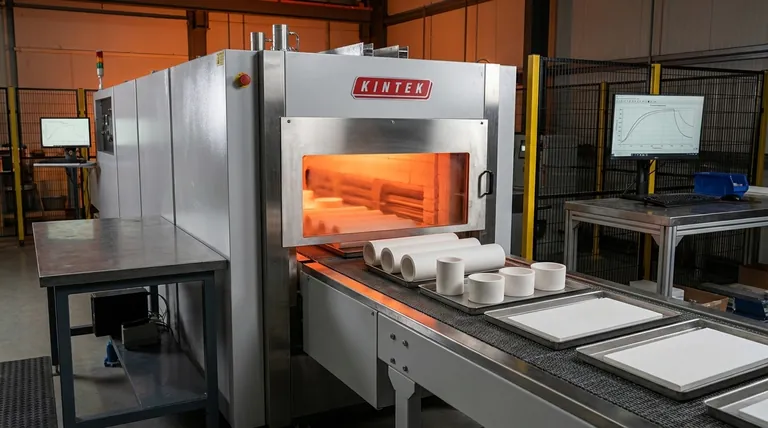
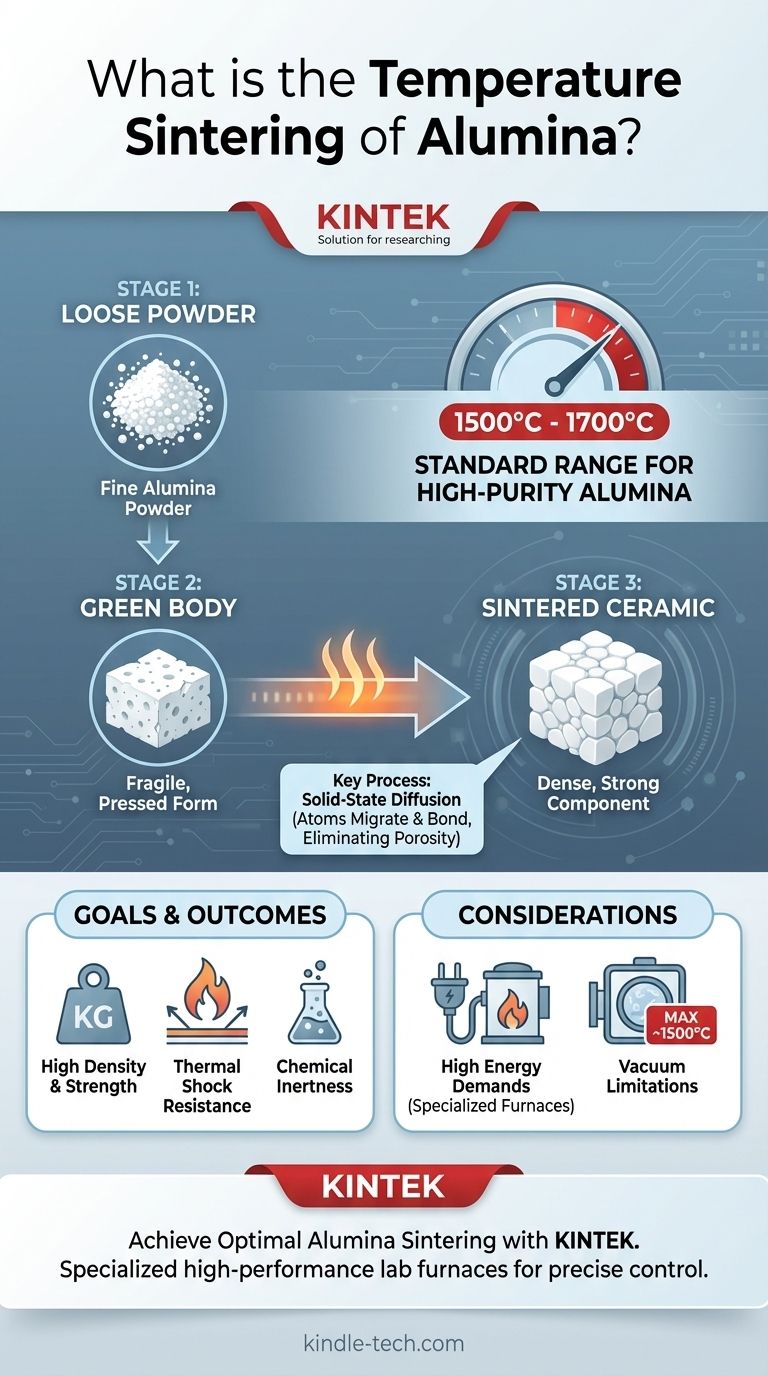
In standard practice, the sintering temperature for high-purity alumina typically falls within the range of 1500°C to 1700°C. This high-temperature process is essential for transforming loose alumina powder into a dense, strong ceramic component with the exceptional properties it is known for.

Sintering is not about melting; it's a thermal treatment that uses high heat to fuse ceramic particles together, eliminating porosity and creating a solid, durable material. For alumina, achieving this transformation requires extremely high temperatures, which directly dictates both its manufacturing complexity and its superior performance in demanding environments.
What is the temperature sintering of alumina? Unlock Superior Performance with 1500°C to 1700°C

The Purpose of Sintering Alumina

Sintering is the fundamental process that gives alumina ceramics their strength and stability. Without it, you simply have a compressed powder with no structural integrity.

From Powder to Solid

The starting point for an alumina component is a fine powder. This powder is shaped, often by pressing, into a "green body" which is chalky and fragile. Sintering is the critical step that converts this green body into a hard, dense ceramic.

The Role of High Temperature

Heat provides the energy for atoms to migrate between the individual alumina particles. This process, known as solid-state diffusion, causes the particles to bond and grow together, gradually closing the gaps and pores between them.

The Goal: Full Densification

The primary objective of sintering is to achieve maximum density. A fully sintered alumina part has minimal internal porosity, which is what gives it high mechanical strength, chemical resistance, and thermal stability.

Defining the Sintering Temperature Range

The specific temperature required depends on several factors, but a well-established range exists for high-purity materials.

The Standard Range: 1500°C to 1700°C

For most high-purity alumina applications, holding the material within this temperature window is necessary to achieve full densification. This process occurs well below alumina's melting point of over 2000°C.

The Connection to Final Use

The high sintering temperature is directly related to the high service temperature of the final product. Components like alumina furnace tubes, which are sintered in this range, can then reliably operate at temperatures up to 1800°C.

Impact on Material Properties

Properly sintering alumina within this range is what unlocks its key characteristics:

  • High Density and Strength: Minimizes weak points.
  • Excellent Thermal Shock Resistance: Allows it to withstand rapid temperature changes.
  • Acid and Alkali Resistance: Creates a non-porous surface that resists chemical attack.

Practical Considerations and Trade-offs

The high temperature required for sintering alumina has significant practical implications that must be considered.

Energy and Equipment Demands

Reaching and maintaining temperatures between 1500°C and 1700°C requires specialized, high-temperature furnaces. This makes the manufacturing process energy-intensive and costly compared to materials that can be processed at lower temperatures.

Vacuum Limitations

As noted in furnace specifications, the maximum operating temperature for alumina components is often lower under vacuum (around 1500°C). This is a critical consideration for applications involving vacuum furnaces, as it affects the usable life and integrity of the ceramic.

Applying This to Your Goal

Your approach depends on whether you are producing alumina parts or using them in a high-temperature application.

  • If your primary focus is manufacturing alumina parts: You must use a furnace capable of precise control within the 1500°C to 1700°C range to ensure full densification and optimal material properties.
  • If your primary focus is using alumina components: Recognize that their impressive service temperature (up to 1800°C) is a direct result of this demanding sintering process, which is why they are trusted for high-tech and industrial furnace applications.

Understanding the sintering process is key to appreciating both the challenges of producing alumina and the exceptional performance it delivers.

Summary Table:

Key Factor Details for Alumina Sintering
Standard Temperature Range 1500°C to 1700°C
Primary Goal Full densification via solid-state diffusion
Key Outcome High mechanical strength, thermal shock resistance, chemical inertness
Critical Consideration Requires specialized high-temperature furnaces; lower max temp (~1500°C) under vacuum.

Achieve optimal alumina sintering results with KINTEK.

Whether you are manufacturing robust alumina components or require reliable alumina parts for your high-temperature applications, the right equipment is critical. KINTEK specializes in high-performance lab furnaces and consumables, providing the precise temperature control needed for sintering success.

Contact our experts today to discuss how our solutions can enhance your lab's capabilities and ensure the superior material properties you demand.

Visual Guide
What is the temperature sintering of alumina? Unlock Superior Performance with 1500°C to 1700°C Visual Guide

Related Products

People Also Ask

Related Products

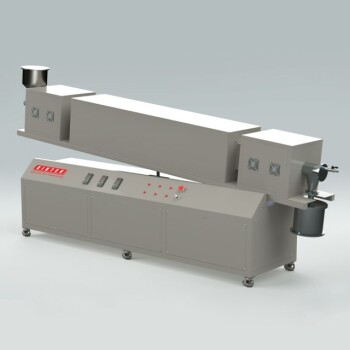
Mesh belt controlled atmosphere furnace

Mesh belt controlled atmosphere furnace

Discover our KT-MB mesh belt sintering furnace - perfect for high-temperature sintering of electronic components & glass insulators. Available for open air or controlled atmosphere environments.

1400℃ Muffle Oven Furnace for Laboratory

1400℃ Muffle Oven Furnace for Laboratory

Get precise high-temperature control up to 1500℃ with KT-14M Muffle furnace. Equipped with a smart touch screen controller and advanced insulation materials.

Vacuum Heat Treat and Pressure Sintering Furnace for High Temperature Applications

Vacuum Heat Treat and Pressure Sintering Furnace for High Temperature Applications

Vacuum pressure sintering furnaces are designed for high temperature hot pressing applications in metal and ceramic sintering. Its advanced features ensure precise temperature control, reliable pressure maintenance, and a robust design for seamless operation.

Vacuum Sealed Continuous Working Rotary Tube Furnace Rotating Tube Furnace

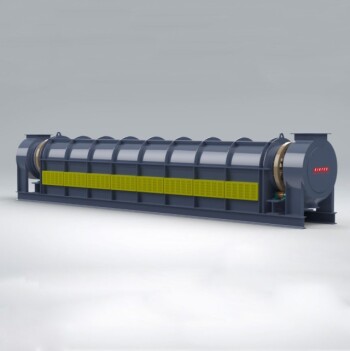
Vacuum Sealed Continuous Working Rotary Tube Furnace Rotating Tube Furnace

Experience efficient material processing with our vacuum-sealed rotary tube furnace. Perfect for experiments or industrial production, equipped with optional features for controlled feeding and optimized results. Order now.

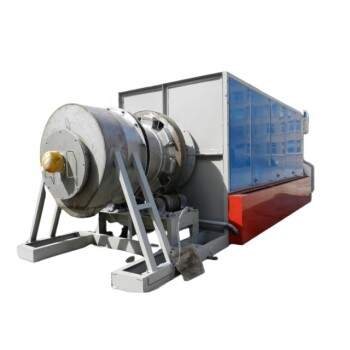
Electric Rotary Kiln Pyrolysis Furnace Plant Machine Calciner Small Rotary Kiln Rotating Furnace

Electric Rotary Kiln Pyrolysis Furnace Plant Machine Calciner Small Rotary Kiln Rotating Furnace

Electric rotary kiln - precisely controlled, it's ideal for calcination and drying of materials like lithium cobalate, rare earths, and non-ferrous metals.

Graphite Vacuum Furnace Bottom Discharge Graphitization Furnace for Carbon Materials

Graphite Vacuum Furnace Bottom Discharge Graphitization Furnace for Carbon Materials

Bottom-out graphitization furnace for carbon materials, ultra-high temperature furnace up to 3100°C, suitable for graphitization and sintering of carbon rods and carbon blocks. Vertical design, bottom discharging, convenient feeding and discharging, high temperature uniformity, low energy consumption, good stability, hydraulic lifting system, convenient loading and unloading.

Electric Rotary Kiln Continuous Working Small Rotary Furnace Heating Pyrolysis Plant

Electric Rotary Kiln Continuous Working Small Rotary Furnace Heating Pyrolysis Plant

Efficiently calcine and dry bulk powder and lump fluid materials with an electric heating rotary furnace. Ideal for processing lithium ion battery materials and more.

Electric Rotary Kiln Small Rotary Furnace for Activated Carbon Regeneration

Electric Rotary Kiln Small Rotary Furnace for Activated Carbon Regeneration

Revitalize your activated carbon with KinTek's Electric Regeneration Furnace. Achieve efficient and cost-effective regeneration with our highly automated rotary kiln and intelligent thermal controller.

Vacuum Hot Press Furnace Machine for Lamination and Heating

Vacuum Hot Press Furnace Machine for Lamination and Heating

Experience clean and precise lamination with Vacuum Lamination Press. Perfect for wafer bonding, thin-film transformations, and LCP lamination. Order now!

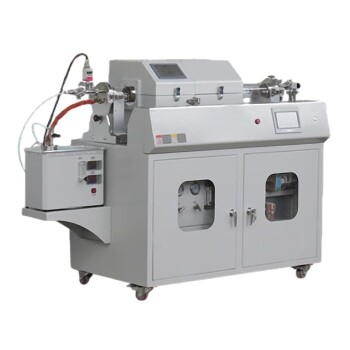
Chemical Vapor Deposition CVD Equipment System Chamber Slide PECVD Tube Furnace with Liquid Gasifier PECVD Machine

Chemical Vapor Deposition CVD Equipment System Chamber Slide PECVD Tube Furnace with Liquid Gasifier PECVD Machine

KT-PE12 Slide PECVD System: Wide power range, programmable temp control, fast heating/cooling with sliding system, MFC mass flow control & vacuum pump.

Metal Disc Electrode Electrochemical Electrode

Metal Disc Electrode Electrochemical Electrode

Elevate your experiments with our Metal Disk Electrode. High-quality, acid and alkali resistant, and customizable to fit your specific needs. Discover our complete models today.

High Performance Laboratory Freeze Dryer

High Performance Laboratory Freeze Dryer

Advanced lab freeze dryer for lyophilization, preserving biological & chemical samples efficiently. Ideal for biopharma, food, and research.

Manual Cold Isostatic Pressing Machine CIP Pellet Press

Manual Cold Isostatic Pressing Machine CIP Pellet Press

Lab Manual Isostatic Press is a high-efficient equipment for sample preparation widely used in material research, pharmacy, ceramics, and electronic industries. It allows for precision control of the pressing process and can work in a vacuum environment.

Graphite Disc Rod and Sheet Electrode Electrochemical Graphite Electrode

Graphite Disc Rod and Sheet Electrode Electrochemical Graphite Electrode

High-quality graphite electrodes for electrochemical experiments. Complete models with acid and alkali resistance, safety, durability, and customization options.

Glassy Carbon Electrochemical Electrode

Glassy Carbon Electrochemical Electrode

Upgrade your experiments with our Glassy Carbon Electrode. Safe, durable, and customizable to fit your specific needs. Discover our complete models today.

Rotating Platinum Disk Electrode for Electrochemical Applications

Rotating Platinum Disk Electrode for Electrochemical Applications

Upgrade your electrochemical experiments with our Platinum Disc Electrode. High-quality and reliable for accurate results.

Laboratory Vibratory Sieve Shaker Machine Slap Vibrating Sieve

Laboratory Vibratory Sieve Shaker Machine Slap Vibrating Sieve

KT-T200TAP is a slapping and oscillating sieving instrument for laboratory desktop use, with 300 rpm horizontal circular motion and 300 vertical slapping motions to simulate manual sieving to help sample particles pass through better.

Automatic Laboratory Heat Press Machine

Automatic Laboratory Heat Press Machine

Precision automatic heat press machines for labs—ideal for material testing, composites, and R&D. Customizable, safe, and efficient. Contact KINTEK today!

Metallographic Specimen Mounting Machine for Laboratory Materials and Analysis

Metallographic Specimen Mounting Machine for Laboratory Materials and Analysis

Precision metallographic mounting machines for labs—automated, versatile, and efficient. Ideal for sample prep in research and quality control. Contact KINTEK today!

VHP Sterilization Equipment Hydrogen Peroxide H2O2 Space Sterilizer

VHP Sterilization Equipment Hydrogen Peroxide H2O2 Space Sterilizer

A hydrogen peroxide space sterilizer is a device that uses vaporized hydrogen peroxide to decontaminate enclosed spaces. It kills microorganisms by damaging their cellular components and genetic material.


Leave Your Message