Knowledge What machine is used to make lab-grown diamonds? Discover the HPHT & CVD Technologies
Author avatar

Tech Team · Kintek Solution

Updated 5 days ago

What machine is used to make lab-grown diamonds? Discover the HPHT & CVD Technologies


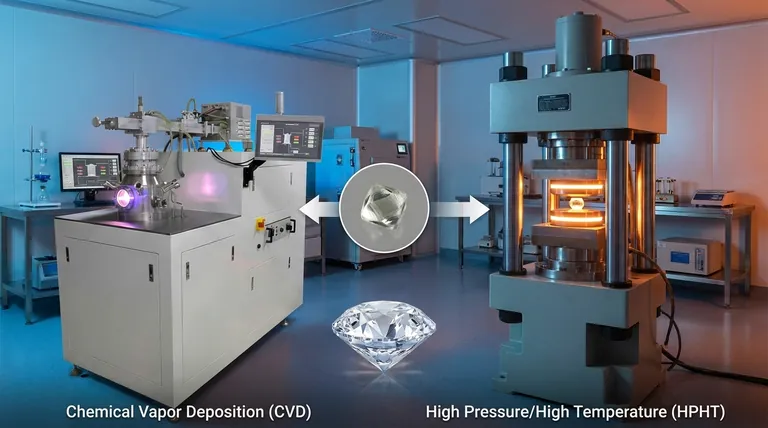
To be precise, there is no single machine used to make lab-grown diamonds. Instead, they are created through two primary technological processes, each using highly specialized equipment: High Pressure/High Temperature (HPHT) and Chemical Vapor Deposition (CVD). These methods create diamonds that are chemically, physically, and optically identical to those mined from the earth.

The core concept isn't about a specific "diamond-making machine" but about two distinct laboratory environments. One replicates the brute force of the Earth's mantle, while the other meticulously builds a diamond atom by atom.
What machine is used to make lab-grown diamonds? Discover the HPHT & CVD Technologies

The Two Primary Diamond-Growing Technologies

Understanding the creation of lab-grown diamonds means understanding the two foundational methods. Both begin with a tiny, pre-existing diamond sliver known as a "seed."

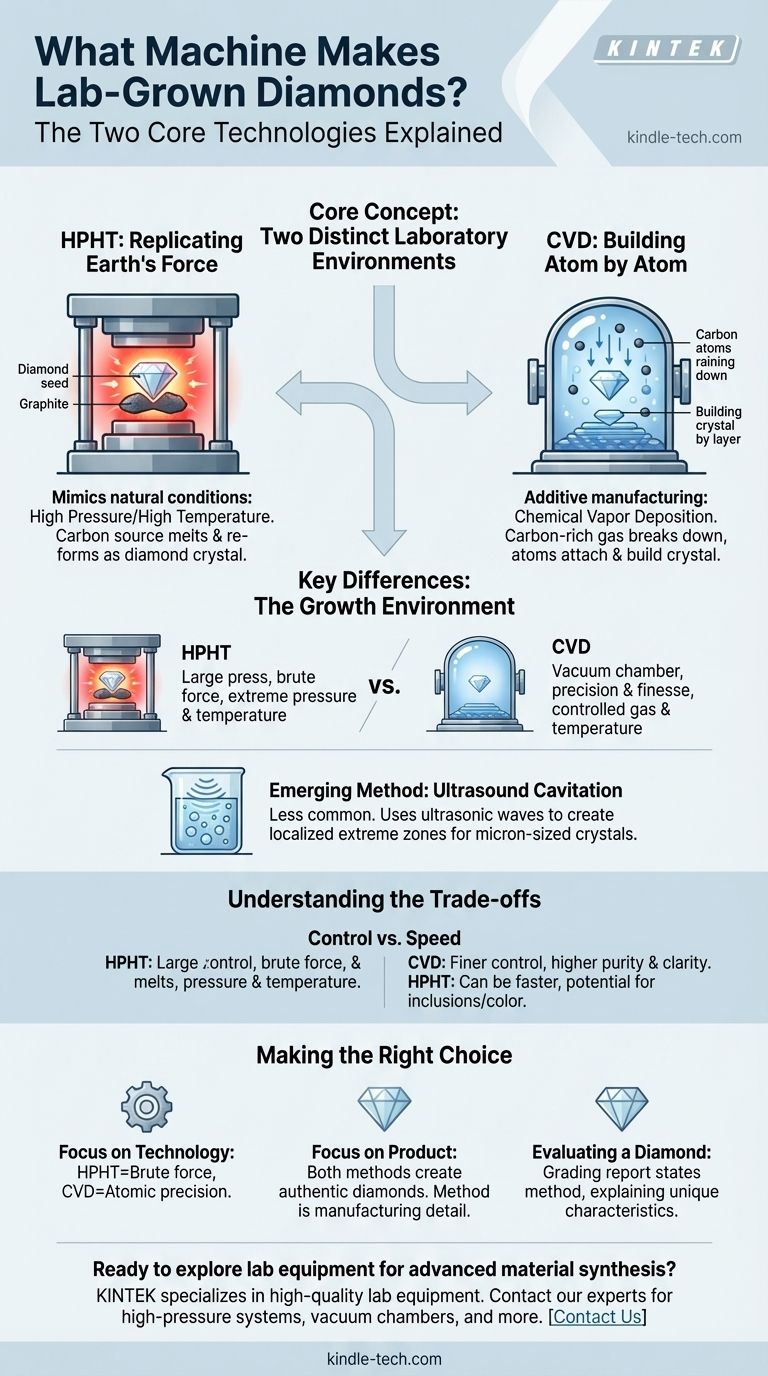
HPHT: Replicating the Earth's Force

The High Pressure/High Temperature (HPHT) method directly mimics the natural conditions under which diamonds form deep within the Earth.

A carbon source, like graphite, is placed in a large mechanical press along with the diamond seed. This press subjects the carbon to immense pressure and extremely high temperatures.

This intense environment causes the carbon source to melt and re-form as a diamond crystal, building upon the original seed.

CVD: Building Diamonds Atom by Atom

Chemical Vapor Deposition (CVD) is a fundamentally different approach, more akin to an additive manufacturing process.

The diamond seed is placed inside a sealed vacuum chamber. The chamber is then filled with a mixture of carbon-rich hydrocarbon gases.

These gases are heated, causing them to break apart and allowing carbon atoms to "rain down" and attach to the diamond seed, building up the crystal layer by layer. This method allows for a high degree of control over the diamond's final properties.

Key Differences in the Process

While both HPHT and CVD produce real diamonds, the equipment and environments are completely distinct.

The Growth Environment

HPHT relies on a powerful press to create a small, high-pressure, high-temperature environment. The equipment is designed for immense force.

CVD uses a lower-pressure vacuum chamber where the environment is controlled by managing gas composition and temperature. The equipment is designed for precision and finesse.

An Emerging Method: Ultrasound Cavitation

A third, less common method involves using ultrasonic cavitation. In this process, a suspension of graphite in an organic liquid is exposed to powerful ultrasonic waves.

This creates tiny bubbles that collapse violently, generating localized zones of extreme temperature and pressure that can convert the graphite into micron-sized diamond crystals at room temperature.

Understanding the Trade-offs

The choice between HPHT and CVD is driven by a balance of cost, desired outcome, and production efficiency. Each method presents a different set of advantages and challenges.

Control vs. Speed

The CVD process generally offers finer control over the diamond's chemical purity and ultimate clarity. The layer-by-layer growth allows for precise management of the process.

The HPHT process can sometimes be faster but may introduce different types of inclusions or color characteristics depending on the specific setup and materials used.

The Resulting Diamond

Historically, the growth method left subtle clues in the final diamond. However, advancements in both technologies have made it increasingly difficult to distinguish between them without specialized gemological equipment.

Both methods are capable of producing flawless, high-quality gemstones that are indistinguishable from natural diamonds to the naked eye.

Making the Right Choice for Your Goal

Whether you are studying, buying, or simply curious about lab-grown diamonds, understanding the origin technology provides crucial context.

  • If your primary focus is on the technology: Understand that HPHT mimics nature with brute force, while CVD builds a diamond with atomic precision from a gas.
  • If your primary focus is on the final product: Recognize that both methods produce authentic diamonds, and the choice of method is a manufacturing detail, not an indicator of the final quality.
  • If you are evaluating a specific diamond: Review its grading report, as it will often state whether it was created via HPHT or CVD, helping to explain its unique crystal characteristics.

Ultimately, these advanced technologies simply offer a different path to the same extraordinary material.

Summary Table:

Method Core Process Key Equipment
HPHT Replicates Earth's mantle conditions Large mechanical press for high pressure & temperature
CVD Builds diamond atom by atom from gas Sealed vacuum chamber for precise gas & temperature control
Ultrasound Cavitation Uses sound waves to create extreme conditions Ultrasonic reactor (less common, for micron-sized crystals)

Ready to explore lab equipment for advanced material synthesis? KINTEK specializes in providing high-quality laboratory equipment and consumables. Whether your research involves high-pressure systems, vacuum chambers, or precision heating, our solutions are designed to meet the rigorous demands of modern labs. Contact our experts today to find the perfect equipment for your diamond growth or other material science projects!

Visual Guide
What machine is used to make lab-grown diamonds? Discover the HPHT & CVD Technologies Visual Guide

Related Products

People Also Ask

Related Products

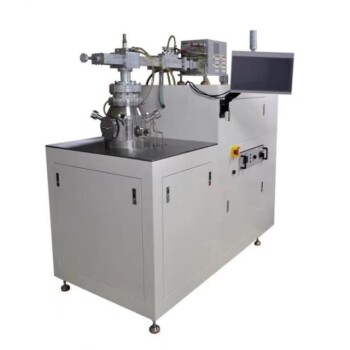
Cylindrical Resonator MPCVD Machine System Reactor for Microwave Plasma Chemical Vapor Deposition and Lab Diamond Growth

Cylindrical Resonator MPCVD Machine System Reactor for Microwave Plasma Chemical Vapor Deposition and Lab Diamond Growth

Learn about Cylindrical Resonator MPCVD Machine, the microwave plasma chemical vapor deposition method used for growing diamond gemstones and films in the jewelry and semi-conductor industries. Discover its cost-effective advantages over traditional HPHT methods.

915MHz MPCVD Diamond Machine Microwave Plasma Chemical Vapor Deposition System Reactor

915MHz MPCVD Diamond Machine Microwave Plasma Chemical Vapor Deposition System Reactor

915MHz MPCVD Diamond Machine and its multi-crystal effective growth, the maximum area can reach 8 inches, the maximum effective growth area of single crystal can reach 5 inches. This equipment is mainly used for the production of large-size polycrystalline diamond films, the growth of long single crystal diamonds, the low-temperature growth of high-quality graphene, and other materials that require energy provided by microwave plasma for growth.

HFCVD Machine System Equipment for Drawing Die Nano-Diamond Coating

HFCVD Machine System Equipment for Drawing Die Nano-Diamond Coating

The nano-diamond composite coating drawing die uses cemented carbide (WC-Co) as the substrate, and uses the chemical vapor phase method ( CVD method for short ) to coat the conventional diamond and nano-diamond composite coating on the surface of the inner hole of the mold.

Split Chamber CVD Tube Furnace with Vacuum Station Chemical Vapor Deposition System Equipment Machine

Split Chamber CVD Tube Furnace with Vacuum Station Chemical Vapor Deposition System Equipment Machine

Efficient split chamber CVD furnace with vacuum station for intuitive sample checking and quick cooling. Up to 1200℃ max temperature with accurate MFC mass flowmeter control.

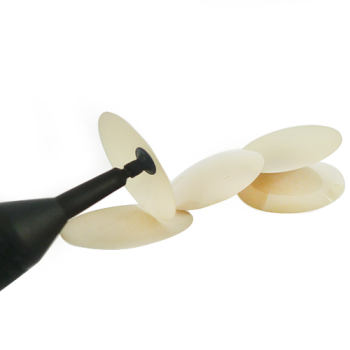
CVD Diamond Domes for Industrial and Scientific Applications

CVD Diamond Domes for Industrial and Scientific Applications

Discover CVD diamond domes, the ultimate solution for high-performance loudspeakers. Made with DC Arc Plasma Jet technology, these domes deliver exceptional sound quality, durability, and power handling.

1200℃ Split Tube Furnace with Quartz Tube Laboratory Tubular Furnace

1200℃ Split Tube Furnace with Quartz Tube Laboratory Tubular Furnace

KT-TF12 split tube furnace: high-purity insulation, embedded heating wire coils, and max. 1200C. Widely used for new materials and chemical vapour deposition.

CVD Diamond Cutting Tool Blanks for Precision Machining

CVD Diamond Cutting Tool Blanks for Precision Machining

CVD Diamond Cutting Tools: Superior Wear Resistance, Low Friction, High Thermal Conductivity for Non-Ferrous Materials, Ceramics, Composites Machining

Laboratory CVD Boron Doped Diamond Materials

Laboratory CVD Boron Doped Diamond Materials

CVD boron-doped diamond: A versatile material enabling tailored electrical conductivity, optical transparency, and exceptional thermal properties for applications in electronics, optics, sensing, and quantum technologies.

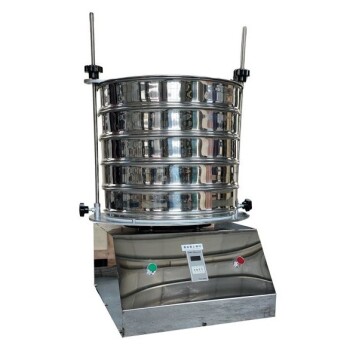
Laboratory Test Sieves and Sieving Machines

Laboratory Test Sieves and Sieving Machines

Precision lab test sieves & sieving machines for accurate particle analysis. Stainless steel, ISO-compliant, 20μm-125mm range. Request specs now!

Small Vacuum Heat Treat and Tungsten Wire Sintering Furnace

Small Vacuum Heat Treat and Tungsten Wire Sintering Furnace

The small vacuum tungsten wire sintering furnace is a compact experimental vacuum furnace specially designed for universities and scientific research institutes. The furnace features a CNC welded shell and vacuum piping to ensure leak-free operation. Quick-connect electrical connections facilitate relocation and debugging, and the standard electrical control cabinet is safe and convenient to operate.

Vacuum Dental Porcelain Sintering Furnace

Vacuum Dental Porcelain Sintering Furnace

Get precise and reliable results with KinTek's Vacuum Porcelain Furnace. Suitable for all porcelain powders, it features hyperbolic ceramic furnace function, voice prompt, and automatic temperature calibration.

Lab-Scale Vacuum Induction Melting Furnace

Lab-Scale Vacuum Induction Melting Furnace

Get precise alloy composition with our Vacuum Induction Melting Furnace. Ideal for aerospace, nuclear energy, and electronic industries. Order now for effective smelting and casting of metals and alloys.

Vacuum Heat Treat and Molybdenum Wire Sintering Furnace for Vacuum Sintering

Vacuum Heat Treat and Molybdenum Wire Sintering Furnace for Vacuum Sintering

A vacuum molybdenum wire sintering furnace is a vertical or bedroom structure, which is suitable for withdrawal, brazing, sintering and degassing of metal materials under high vacuum and high temperature conditions. It is also suitable for dehydroxylation treatment of quartz materials.

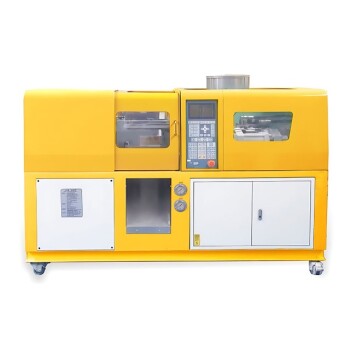
Small Injection Molding Machine for Lab Use

Small Injection Molding Machine for Lab Use

The small injection molding machinehas fast and stable movements; good controllability and repeatability, super energy saving; the product can be automatically dropped and formed; the machine body is low, convenient for feeding, easy to maintain, and no height restrictions on the installation site.

Laboratory Ten-Body Horizontal Jar Mill for Lab Use

Laboratory Ten-Body Horizontal Jar Mill for Lab Use

The Ten-body horizontal jar mill is for 10 ball mill pots (3000ml or less). It has frequency conversion control, rubber roller movement, and PE protective cover.

Laboratory Vibratory Sieve Shaker Machine Slap Vibrating Sieve

Laboratory Vibratory Sieve Shaker Machine Slap Vibrating Sieve

KT-T200TAP is a slapping and oscillating sieving instrument for laboratory desktop use, with 300 rpm horizontal circular motion and 300 vertical slapping motions to simulate manual sieving to help sample particles pass through better.

Anti-Cracking Press Mold for Lab Use

Anti-Cracking Press Mold for Lab Use

The anti-cracking press mold is a specialized equipment designed for molding various shapes and sizes of film using high pressure and electric heating.

Laboratory Sterilizer Lab Autoclave Pulse Vacuum Lifting Sterilizer

Laboratory Sterilizer Lab Autoclave Pulse Vacuum Lifting Sterilizer

The pulse vacuum lifting sterilizer is a state-of-the-art equipment for efficient and precise sterilization. It uses pulsating vacuum technology, customizable cycles, and a user-friendly design for easy operation and safety.

Laboratory Sterilizer Lab Autoclave Vertical Pressure Steam Sterilizer for Liquid Crystal Display Automatic Type

Laboratory Sterilizer Lab Autoclave Vertical Pressure Steam Sterilizer for Liquid Crystal Display Automatic Type

Liquid crystal display automatic vertical sterilizer is a safe, reliable and automatic control sterilization equipment, which is composed of heating system, microcomputer control system and overheating and overvoltage protection system.

High Energy Vibratory Laboratory Ball Mill Grinding Mill Single Tank Type

High Energy Vibratory Laboratory Ball Mill Grinding Mill Single Tank Type

High-energy vibration ball mill is a small desktop laboratory grinding instrument.It can be ball-milled or mixed with different particle sizes and materials by dry and wet methods.


Leave Your Message