Knowledge Vacuum Furnace What materials are used in high temperature brazing? Joining Superalloys, Ceramics & More
Author avatar

Tech Team · Kintek Solution

Updated 3 months ago

What materials are used in high temperature brazing? Joining Superalloys, Ceramics & More


In high-temperature brazing, an exceptionally wide range of materials can be successfully joined, including advanced superalloys, refractory metals, and even ceramics. The process is not limited by the base materials themselves, but rather by the ability of a filler metal (the braze alloy) to "wet" and bond to their surfaces in a controlled, oxide-free environment.

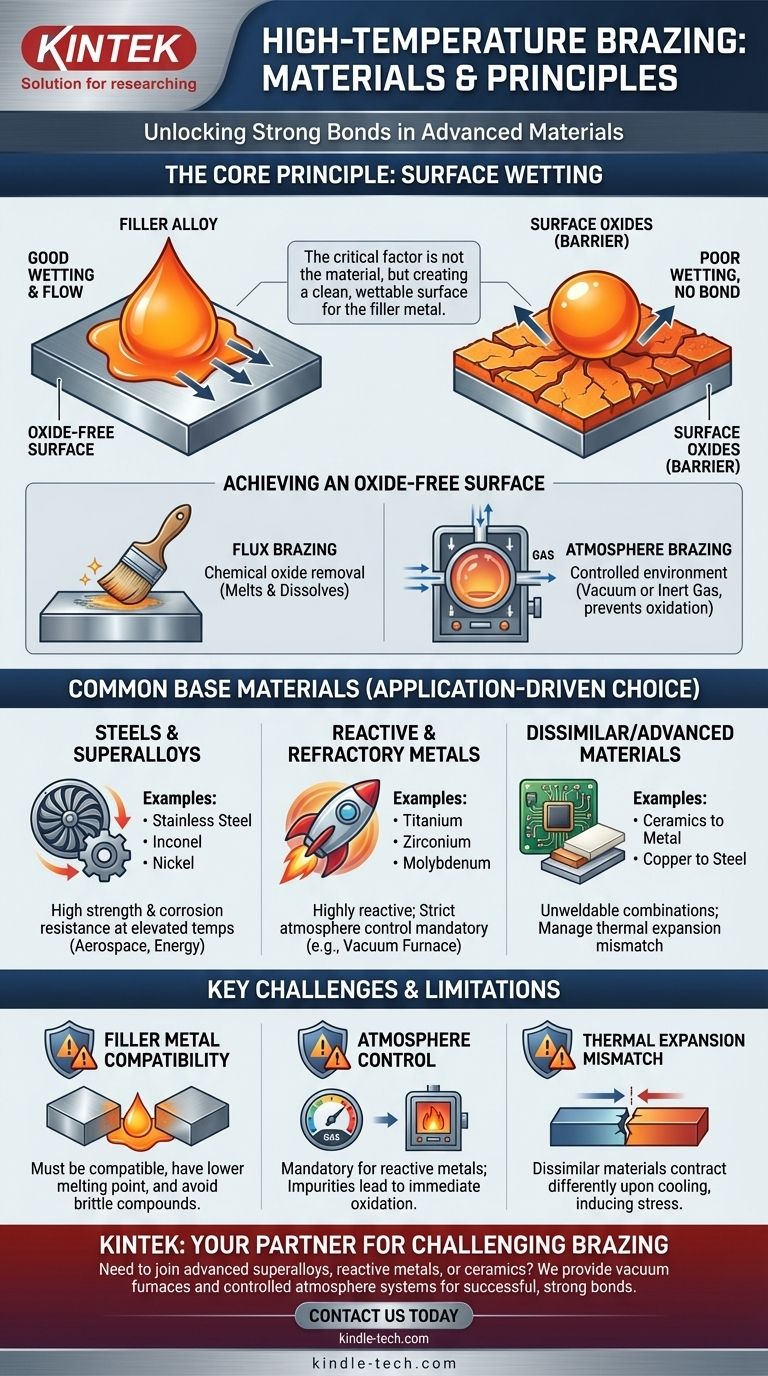
The critical factor for successful high-temperature brazing is not the specific material being joined, but the creation of an oxide-free surface that allows the molten filler alloy to form a strong, metallurgical bond.
What materials are used in high temperature brazing? Joining Superalloys, Ceramics & More

The Guiding Principle: Surface Wetting

The entire brazing process is governed by a single, fundamental concept: wetting. Understanding this is key to selecting and preparing materials.

What is "Wetting"?

Wetting is the ability of the liquid braze alloy to flow over and adhere to the surfaces of the base materials. A successful braze requires excellent wetting to ensure the filler metal is drawn into the joint via capillary action, creating a continuous, strong bond upon cooling.

The Obstacle: Surface Oxides

Nearly all metals form a thin layer of oxide on their surface when exposed to air. This oxide layer acts as a barrier, preventing the molten filler alloy from making direct contact with the base metal, thus inhibiting wetting and blocking the formation of a bond.

Achieving an Oxide-Free Surface

The primary challenge in brazing is removing this oxide layer and preventing it from re-forming. This is typically accomplished in two ways:

  • Flux Brazing: A chemical compound called flux is applied to the joint. When heated, the flux melts and dissolves the oxides, protecting the surface until the braze alloy flows.
  • Atmosphere Brazing: The process is conducted inside a furnace with a controlled atmosphere, such as a vacuum or inert gas. This environment either removes the oxygen (preventing oxidation) or contains active elements that reduce existing oxides.

Common Base Materials for High-Temperature Applications

High-temperature brazing is essential for joining materials that must perform in demanding environments. The choice of material is driven entirely by the final application's requirements.

Steels and Nickel-Based Superalloys

Materials like stainless steel, alloy steels, nickel, and Inconel are frequently brazed for high-performance applications in aerospace and energy. Their inherent strength and corrosion resistance at elevated temperatures make them ideal candidates for this joining method.

Reactive and Refractory Metals

Brazing is often the preferred method for joining titanium, zirconium, niobium, and molybdenum. These materials are highly reactive with oxygen at high temperatures, making controlled-atmosphere furnace brazing the only viable option to ensure a clean, strong joint.

Advanced and Dissimilar Materials

One of the greatest strengths of brazing is its ability to join materials that cannot be welded. This includes joining metals to ceramics, or joining metals with vastly different melting points, like copper to steel.

Understanding the Trade-offs and Limitations

While versatile, high-temperature brazing requires careful engineering consideration to avoid potential failures.

Filler Metal Compatibility

The chosen braze alloy is as critical as the base materials. It must have a melting point lower than the base materials but be capable of withstanding the final service conditions. Its chemistry must also be compatible to ensure a proper metallurgical bond without creating brittle intermetallic compounds.

The Importance of Atmosphere Control

For reactive metals like titanium or superalloys containing aluminum, atmosphere control is not optional—it is mandatory. An inadequate vacuum or impure inert gas will result in a failed joint due to the immediate formation of oxides at brazing temperatures.

Thermal Expansion Mismatch

When joining dissimilar materials, such as a metal to a ceramic, their different rates of thermal expansion must be managed. As the assembly cools from the brazing temperature, mismatched contraction rates can induce stress, potentially cracking the joint or the materials themselves.

Making the Right Choice for Your Goal

Selecting the correct materials and process is a matter of aligning them with your primary engineering objective.

  • If your primary focus is structural strength at high temperatures: Nickel-based superalloys (like Inconel) and high-strength stainless steels are your best candidates, typically joined in a vacuum furnace.
  • If your primary focus is joining dissimilar materials (like steel to ceramic): Brazing is an ideal choice, but you must carefully design the joint and select a ductile filler metal to accommodate thermal expansion stresses.
  • If your primary focus is lightweighting with reactive metals: Titanium and aluminum alloys can be reliably joined with brazing, but this requires an impeccably clean process and a tightly controlled furnace atmosphere.

Ultimately, successful high-temperature brazing depends on a holistic understanding of the base materials, the filler alloy, and the precise control of the processing environment.

Summary Table:

Base Material Category Common Examples Key Considerations
Steels & Superalloys Stainless Steel, Inconel, Nickel High strength & corrosion resistance at temperature.
Reactive & Refractory Metals Titanium, Zirconium, Molybdenum Requires strict atmosphere control (e.g., vacuum).
Dissimilar/Advanced Materials Ceramics, Copper to Steel Ideal for unweldable combinations; manage thermal stress.

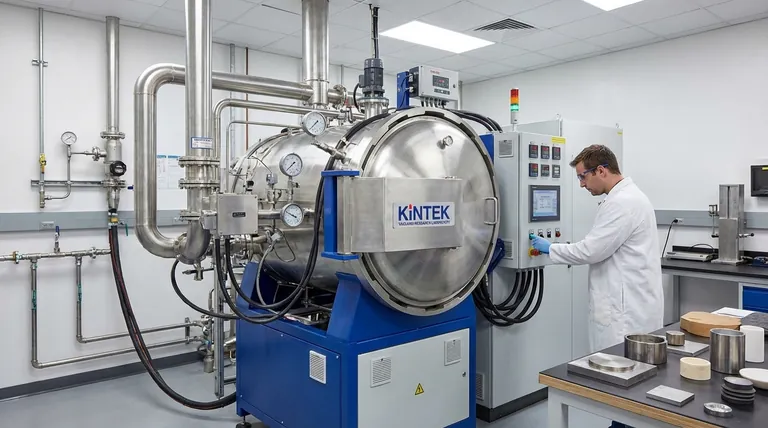
Need to braze challenging materials for a high-performance application? KINTEK specializes in providing the advanced lab equipment and expert support needed for successful high-temperature brazing. Our vacuum furnaces and controlled atmosphere systems are designed to meet the stringent requirements for joining superalloys, reactive metals, and ceramics. Let our team help you achieve strong, reliable bonds for your most demanding projects.

Contact KINTEK today to discuss your specific brazing needs and explore our solutions.

Visual Guide
What materials are used in high temperature brazing? Joining Superalloys, Ceramics & More Visual Guide

Related Products

People Also Ask

Related Products

High Temperature Resistant Optical Quartz Glass Sheet

High Temperature Resistant Optical Quartz Glass Sheet

Discover the power of optical glass sheets for precise light manipulation in telecommunications, astronomy, and beyond. Unlock advancements in optical technology with exceptional clarity and tailored refractive properties.

Electron Beam Evaporation Coating Tungsten Crucible and Molybdenum Crucible for High Temperature Applications

Electron Beam Evaporation Coating Tungsten Crucible and Molybdenum Crucible for High Temperature Applications

Tungsten and molybdenum crucibles are commonly used in electron beam evaporation processes due to their excellent thermal and mechanical properties.

Thermally Evaporated Tungsten Wire for High Temperature Applications

Thermally Evaporated Tungsten Wire for High Temperature Applications

It has a high melting point, thermal and electrical conductivity, and corrosion resistance. It is a valuable material for high temperature, vacuum and other industries.

High Quality Alumina Ceramic Screw for Engineering Advanced Fine Ceramics with High Temperature Resistance and Insulation

High Quality Alumina Ceramic Screw for Engineering Advanced Fine Ceramics with High Temperature Resistance and Insulation

Alumina ceramic screws are fastening components made of 99.5% alumina, ideal for extreme applications requiring excellent thermal resistance, electrical insulation and chemical resistance.

Advanced Engineering Fine Ceramics Alumina Ceramic Saggar for Fine Corundum

Advanced Engineering Fine Ceramics Alumina Ceramic Saggar for Fine Corundum

Alumina sagger products have the characteristics of high temperature resistance, good thermal shock stability, small expansion coefficient, anti-stripping, and good anti-powdering performance.

High Purity Pure Graphite Crucible for Evaporation

High Purity Pure Graphite Crucible for Evaporation

Vessels for high temperature applications, where materials are kept at extremely high temperatures to evaporate, allowing thin films to be deposited on substrates.

Zirconia Ceramic Gasket Insulating Engineering Advanced Fine Ceramics

Zirconia Ceramic Gasket Insulating Engineering Advanced Fine Ceramics

Zirconia insulating ceramic gasket has high melting point, high resistivity, low thermal expansion coefficient and other properties, making it an important high temperature resistant material, ceramic insulating material and ceramic sunscreen material.

Vertical High Temperature Graphite Vacuum Graphitization Furnace

Vertical High Temperature Graphite Vacuum Graphitization Furnace

Vertical high temperature graphitization furnace for carbonization and graphitization of carbon materials up to 3100℃.Suitable for shaped graphitization of carbon fiber filaments and other materials sintered in a carbon environment.Applications in metallurgy, electronics, and aerospace for producing high-quality graphite products like electrodes and crucibles.

Ultra-High Temperature Graphite Vacuum Graphitization Furnace

Ultra-High Temperature Graphite Vacuum Graphitization Furnace

The ultra-high temperature graphitization furnace utilizes medium frequency induction heating in a vacuum or inert gas environment. The induction coil generates an alternating magnetic field, inducing eddy currents in the graphite crucible, which heats up and radiates heat to the workpiece, bringing it to the desired temperature. This furnace is primarily used for graphitization and sintering of carbon materials, carbon fiber materials, and other composite materials.

Vacuum Heat Treat Sintering Brazing Furnace

Vacuum Heat Treat Sintering Brazing Furnace

A vacuum brazing furnace is a type of industrial furnace used for brazing, a metalworking process that joins two pieces of metal using a filler metal that melts at a lower temperature than the base metals. Vacuum brazing furnaces are typically used for high-quality applications where a strong, clean joint is required.

High Temperature Muffle Oven Furnace for Laboratory Debinding and Pre Sintering

High Temperature Muffle Oven Furnace for Laboratory Debinding and Pre Sintering

KT-MD High temperature debinding and pre-sintering furnace for ceramic materials with various molding processes. Ideal for electronic components such as MLCC and NFC.

Vacuum Heat Treat and Pressure Sintering Furnace for High Temperature Applications

Vacuum Heat Treat and Pressure Sintering Furnace for High Temperature Applications

Vacuum pressure sintering furnaces are designed for high temperature hot pressing applications in metal and ceramic sintering. Its advanced features ensure precise temperature control, reliable pressure maintenance, and a robust design for seamless operation.

Carbon Graphite Boat -Laboratory Tube Furnace with Cover

Carbon Graphite Boat -Laboratory Tube Furnace with Cover

Covered Carbon Graphite Boat Laboratory Tube Furnaces are specialized vessels or vessels made of graphite material designed to withstand extreme high temperatures and chemically aggressive environments.

High Temperature Constant Temperature Heating Circulator Water Bath Chiller Circulator for Reaction Bath

High Temperature Constant Temperature Heating Circulator Water Bath Chiller Circulator for Reaction Bath

Efficient and reliable, KinTek KHB Heating Circulator is perfect for your lab needs. With a max. heating temperature of up to 300℃, it features accurate temperature control and fast heating.

1700℃ Laboratory High Temperature Tube Furnace with Alumina Tube

1700℃ Laboratory High Temperature Tube Furnace with Alumina Tube

Looking for a high-temperature tube furnace? Check out our 1700℃ Tube Furnace with Alumina Tube. Perfect for research and industrial applications up to 1700C.

Automatic High Temperature Heated Hydraulic Press Machine with Heated Plates for Lab

Automatic High Temperature Heated Hydraulic Press Machine with Heated Plates for Lab

The High Temperature Hot Press is a machine specifically designed for pressing, sintering and processing materials in a high temperature environment. It is capable of operating in the range of hundreds of degrees Celsius to thousands of degrees Celsius for a variety of high temperature process requirements.

Manual High Temperature Heated Hydraulic Press Machine with Heated Plates for Lab

Manual High Temperature Heated Hydraulic Press Machine with Heated Plates for Lab

The High Temperature Hot Press is a machine specifically designed for pressing, sintering and processing materials in a high temperature environment. It is capable of operating in the range of hundreds of degrees Celsius to thousands of degrees Celsius for a variety of high temperature process requirements.

1400℃ Laboratory High Temperature Tube Furnace with Alumina Tube

1400℃ Laboratory High Temperature Tube Furnace with Alumina Tube

Looking for a tube furnace for high-temperature applications? Our 1400℃ Tube Furnace with Alumina Tube is perfect for research and industrial use.

2200 ℃ Graphite Vacuum Heat Treat Furnace

2200 ℃ Graphite Vacuum Heat Treat Furnace

Discover the power of the KT-VG Graphite Vacuum Furnace - with a maximum working temperature of 2200℃, it's perfect for vacuum sintering of various materials. Learn more now.

1700℃ Muffle Oven Furnace for Laboratory

1700℃ Muffle Oven Furnace for Laboratory

Get superior heat control with our 1700℃ Muffle Furnace. Equipped with intelligent temperature microprocessor, TFT touch screen controller & advanced insulation materials for precise heating up to 1700C. Order now!


Leave Your Message