Knowledge What conditions does a vacuum annealing furnace provide for Ti41.5Zr41.5Ni17 films? Optimize Quasicrystal Stability
Author avatar

Tech Team · Kintek Solution

Updated 3 days ago

What conditions does a vacuum annealing furnace provide for Ti41.5Zr41.5Ni17 films? Optimize Quasicrystal Stability


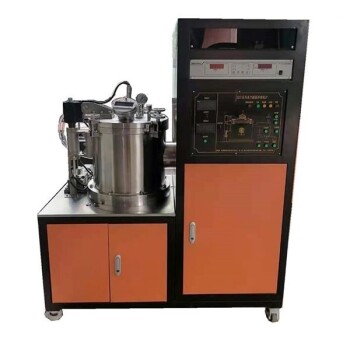
To effectively study the phase transition stability of Ti41.5Zr41.5Ni17 thin films, a vacuum annealing furnace must provide a precise, high-temperature isothermal environment strictly devoid of oxygen. Specifically, maintaining a temperature of approximately 550°C for a one-hour duration is necessary to supply the thermal energy required to drive diffusion mechanisms without chemical interference.

The vacuum furnace serves as a controlled reactor that supplies the stable thermal energy needed to convert the W-approximant phase into a quasicrystalline phase. By simultaneously excluding oxygen, it ensures that the observed phase transitions are driven solely by diffusion, significantly increasing the material's overall quasicrystal content.

The Role of Controlled Thermal Energy

Precise Isothermal Regulation

The furnace must maintain a stable, high-temperature environment, typically around 550°C.

This specific temperature is not arbitrary; it is the thermodynamic threshold required to initiate specific changes within the material. The environment must be isothermal, meaning the temperature remains constant throughout the annealing process to ensure uniform transformation across the film.

Driving Diffusion Mechanisms

The primary function of this thermal energy is to activate diffusion phase transition mechanisms.

At ambient temperatures, the atoms in the Ti-Zr-Ni alloy lack the energy to rearrange themselves. The steady heat provided by the furnace increases atomic mobility, allowing the internal structure to reorganize from one phase to another.

Promoting Phase Conversion

The ultimate goal of this thermal application is the conversion of the W-approximant phase.

Through the one-hour annealing process, the stable heat drives this intermediate phase to transform into a quasicrystalline phase. This conversion is critical for increasing the total quasicrystal content within the thin film.

The Necessity of an Oxygen-Free Environment

Excluding Chemical Interference

The "vacuum" aspect of the furnace is just as critical as the heat.

Titanium and Zirconium are highly reactive metals that readily oxidize at high temperatures. The furnace must create a vacuum to strictly exclude oxygen from the chamber.

Preserving Material Integrity

If oxygen were present, it would react with the thin film surface, altering its chemical composition.

By removing oxygen, the furnace prevents the formation of oxides that would otherwise obscure the study of the metallic phase transition. This ensures the researcher is observing the intrinsic stability of the Ti41.5Zr41.5Ni17 alloy, rather than the behavior of a contaminated oxide layer.

Understanding the Trade-offs

Time vs. Transition Completeness

While the typical process is one hour, deviations in time can affect the phase balance.

Insufficient time at 550°C may result in an incomplete conversion, leaving too much W-approximant phase remaining. Conversely, excessive annealing times could theoretically push the material past the desired quasicrystalline state, depending on the specific stability limits of the alloy.

Vacuum Quality vs. Surface Purity

The reliability of the results is entirely dependent on the quality of the vacuum.

Even a minor leak or insufficient pump-down pressure introduces enough oxygen to compromise the thin film. In this context, a "low-quality" vacuum doesn't just reduce efficiency; it actively destroys the sample's validity for phase transition study.

Making the Right Choice for Your Research

To achieve reliable phase transition data for Ti41.5Zr41.5Ni17, consider the following operational priorities:

  • If your primary focus is maximizing Quasicrystal Content: Ensure your furnace can hold a strict isothermal 550°C for the full hour to fully drive the W-approximant conversion.
  • If your primary focus is Material Purity: Prioritize the vacuum integrity above all else to prevent oxidation from interfering with the diffusion mechanism.

Success in this process relies on balancing sufficient thermal energy to force atomic rearrangement while maintaining a pristine environment to protect the alloy's chemical identity.

Summary Table:

Requirement Specification/Value Purpose in Research
Temperature ~550°C Thermodynamic threshold for phase conversion
Atmosphere High Vacuum Prevents oxidation of Ti and Zr reactive metals
Duration 1 Hour Supplies thermal energy for diffusion mechanisms
Environment Isothermal Ensures uniform transformation across the thin film
Key Outcome Quasicrystalline Phase Conversion from W-approximant for material study

Elevate Your Material Science Research with KINTEK

Precision is paramount when studying delicate phase transitions in alloys like Ti-Zr-Ni. KINTEK specializes in high-performance laboratory equipment designed to meet the rigorous demands of advanced metallurgy. Our comprehensive range of vacuum furnaces, atmosphere furnaces, and CVD systems provides the strict isothermal control and high-vacuum integrity required to prevent oxidation and ensure repeatable results.

From high-temperature furnaces and vacuum reactors to essential crucibles and ceramics, KINTEK delivers the tools you need for groundbreaking thin-film research.

Ready to optimize your annealing process? Contact our technical experts today to find the perfect furnace solution for your laboratory!

References

  1. S.V. Malykhin, D. Terentyev. STRUCTURAL-PHASE CHANGES IN THIN FILMS AND SURFACE LAYERS OF Ti41.5Zr41.5Ni17 ALLOY, STIMULATED BY RADIATION-THERMAL IMPACT OF HYDROGEN PLASMA. DOI: 10.46813/2019-119-083

This article is also based on technical information from Kintek Solution Knowledge Base .

Related Products

People Also Ask

Related Products

Vacuum Heat Treat Furnace with Ceramic Fiber Liner

Vacuum Heat Treat Furnace with Ceramic Fiber Liner

Vacuum furnace with polycrystalline ceramic fiber insulation liner for excellent heat insulation and uniform temperature field. Choose from 1200℃ or 1700℃ max. working temperature with high vacuum performance and precise temperature control.

Vacuum Heat Treat Sintering Brazing Furnace

Vacuum Heat Treat Sintering Brazing Furnace

A vacuum brazing furnace is a type of industrial furnace used for brazing, a metalworking process that joins two pieces of metal using a filler metal that melts at a lower temperature than the base metals. Vacuum brazing furnaces are typically used for high-quality applications where a strong, clean joint is required.

Molybdenum Vacuum Heat Treat Furnace

Molybdenum Vacuum Heat Treat Furnace

Discover the benefits of a high-configuration molybdenum vacuum furnace with heat shield insulation. Ideal for high-purity, vacuum environments like sapphire crystal growth and heat treatment.

1200℃ Controlled Atmosphere Furnace Nitrogen Inert Atmosphere Furnace

1200℃ Controlled Atmosphere Furnace Nitrogen Inert Atmosphere Furnace

Discover our KT-12A Pro Controlled atmosphere furnace - high precision, heavy duty vacuum chamber, versatile smart touch screen controller, and excellent temperature uniformity up to 1200C. Ideal for both laboratory and industrial application.

2200 ℃ Tungsten Vacuum Heat Treat and Sintering Furnace

2200 ℃ Tungsten Vacuum Heat Treat and Sintering Furnace

Experience the ultimate refractory metal furnace with our Tungsten vacuum furnace. Capable of reaching 2200℃, perfect for sintering advanced ceramics and refractory metals. Order now for high-quality results.

1400℃ Controlled Atmosphere Furnace with Nitrogen and Inert Atmosphere

1400℃ Controlled Atmosphere Furnace with Nitrogen and Inert Atmosphere

Achieve precise heat treatment with KT-14A controlled atmosphere furnace. Vacuum sealed with a smart controller, it's ideal for lab and industrial use up to 1400℃.

Graphite Vacuum Furnace High Thermal Conductivity Film Graphitization Furnace

Graphite Vacuum Furnace High Thermal Conductivity Film Graphitization Furnace

The high thermal conductivity film graphitization furnace has uniform temperature, low energy consumption and can operate continuously.

2200 ℃ Graphite Vacuum Heat Treat Furnace

2200 ℃ Graphite Vacuum Heat Treat Furnace

Discover the power of the KT-VG Graphite Vacuum Furnace - with a maximum working temperature of 2200℃, it's perfect for vacuum sintering of various materials. Learn more now.

Vacuum Heat Treat and Molybdenum Wire Sintering Furnace for Vacuum Sintering

Vacuum Heat Treat and Molybdenum Wire Sintering Furnace for Vacuum Sintering

A vacuum molybdenum wire sintering furnace is a vertical or bedroom structure, which is suitable for withdrawal, brazing, sintering and degassing of metal materials under high vacuum and high temperature conditions. It is also suitable for dehydroxylation treatment of quartz materials.

Vacuum Heat Treat and Sintering Furnace with 9MPa Air Pressure

Vacuum Heat Treat and Sintering Furnace with 9MPa Air Pressure

The air pressure sintering furnace is a high-tech equipment commonly used for the sintering of advanced ceramic materials. It combines vacuum sintering and pressure sintering techniques to achieve high-density and high-strength ceramics.

Laboratory Vacuum Tilt Rotary Tube Furnace Rotating Tube Furnace

Laboratory Vacuum Tilt Rotary Tube Furnace Rotating Tube Furnace

Discover the versatility of Laboratory Rotary Furnace: Ideal for calcination, drying, sintering, and high-temperature reactions. Adjustable rotating and tilting functions for optimal heating. Suitable for vacuum and controlled atmosphere environments. Learn more now!

Controlled Nitrogen Inert Hydrogen Atmosphere Furnace

Controlled Nitrogen Inert Hydrogen Atmosphere Furnace

KT-AH Hydrogen atmosphere furnace - induction gas furnace for sintering/annealing with built-in safety features, dual housing design, and energy-saving efficiency. Ideal for lab and industrial use.

Graphite Vacuum Furnace Bottom Discharge Graphitization Furnace for Carbon Materials

Graphite Vacuum Furnace Bottom Discharge Graphitization Furnace for Carbon Materials

Bottom-out graphitization furnace for carbon materials, ultra-high temperature furnace up to 3100°C, suitable for graphitization and sintering of carbon rods and carbon blocks. Vertical design, bottom discharging, convenient feeding and discharging, high temperature uniformity, low energy consumption, good stability, hydraulic lifting system, convenient loading and unloading.

Vacuum Dental Porcelain Sintering Furnace

Vacuum Dental Porcelain Sintering Furnace

Get precise and reliable results with KinTek's Vacuum Porcelain Furnace. Suitable for all porcelain powders, it features hyperbolic ceramic furnace function, voice prompt, and automatic temperature calibration.

Horizontal High Temperature Graphite Vacuum Graphitization Furnace

Horizontal High Temperature Graphite Vacuum Graphitization Furnace

Horizontal Graphitization Furnace: This type of furnace is designed with the heating elements placed horizontally, allowing for uniform heating of the sample. It's well-suited for graphitizing large or bulky samples that require precise temperature control and uniformity.

Graphite Vacuum Furnace IGBT Experimental Graphitization Furnace

Graphite Vacuum Furnace IGBT Experimental Graphitization Furnace

IGBT experimental graphitization furnace, a tailored solution for universities and research institutions, with high heating efficiency, user-friendliness, and precise temperature control.

Vacuum Hot Press Furnace Heated Vacuum Press Machine Tube Furnace

Vacuum Hot Press Furnace Heated Vacuum Press Machine Tube Furnace

Reduce forming pressure & shorten sintering time with Vacuum Tube Hot Press Furnace for high-density, fine-grain materials. Ideal for refractory metals.

Laboratory Rapid Thermal Processing (RTP) Quartz Tube Furnace

Laboratory Rapid Thermal Processing (RTP) Quartz Tube Furnace

Get lightning-fast heating with our RTP Rapid Heating Tube Furnace. Designed for precise, high-speed heating and cooling with convenient sliding rail and TFT touch screen controller. Order now for ideal thermal processing!

Ultra-High Temperature Graphite Vacuum Graphitization Furnace

Ultra-High Temperature Graphite Vacuum Graphitization Furnace

The ultra-high temperature graphitization furnace utilizes medium frequency induction heating in a vacuum or inert gas environment. The induction coil generates an alternating magnetic field, inducing eddy currents in the graphite crucible, which heats up and radiates heat to the workpiece, bringing it to the desired temperature. This furnace is primarily used for graphitization and sintering of carbon materials, carbon fiber materials, and other composite materials.

Mesh belt controlled atmosphere furnace

Mesh belt controlled atmosphere furnace

Discover our KT-MB mesh belt sintering furnace - perfect for high-temperature sintering of electronic components & glass insulators. Available for open air or controlled atmosphere environments.


Leave Your Message