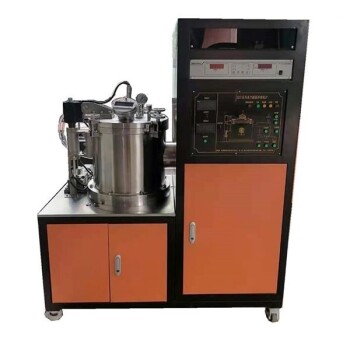
A high vacuum annealing furnace facilitates the desorption of non-bonded sulfur atoms by significantly lowering their sublimation point through ultra-low pressure. This specialized environment, typically maintained at pressures below 10⁻⁶ mbar, allows for the removal of sulfur that is physically adsorbed via weak Van der Waals forces. By applying moderate heat (approximately 100 °C), the furnace utilizes vacuum kinetics to strip away these surface contaminants without disrupting the chemically bonded sulfur within the molybdenum disulfide (MoS2) crystal lattice.
The high vacuum annealing furnace acts as a precision purification tool, using extreme pressure reduction to selectively remove weakly bonded surface contaminants while preserving the structural integrity of the MoS2 crystal. This process is essential for achieving a pristine surface required for high-performance electronic and optoelectronic applications.
The Mechanism of Physical Desorption
Lowering the Sublimation Point
In a standard atmospheric environment, sulfur requires significant thermal energy to transition from a solid to a vapor. A high vacuum furnace reduces the ambient pressure to less than 10⁻⁶ mbar, which drastically lowers the sublimation point of sulfur molecules.
Utilizing Vacuum Kinetics
Once the sublimation point is lowered, even moderate temperatures (around 100 °C) provide enough energy for physically adsorbed sulfur to detach from the surface. The vacuum environment then facilitates the rapid transport of these liberated molecules away from the MoS2 sample, preventing re-adsorption.
Overcoming Van der Waals Forces
Residual sulfur atoms left over from passivation are often held to the monolayer MoS2 surface by weak Van der Waals forces rather than chemical bonds. The combination of low pressure and controlled heating is specifically tuned to overcome these weak attractions without providing enough energy to break the strong covalent Mo-S bonds in the lattice.
Preserving the MoS2 Crystal Lattice
Selectivity Through Moderate Heating
Unlike high-temperature synthesis (which can exceed 1000 °C), this specific annealing step uses moderate temperatures (100 °C to 200 °C). This precision ensures that the thermal energy is high enough to remove "junk" sulfur but low enough to avoid creating unwanted sulfur vacancies in the material.
Maintaining Chemical Bond Integrity
The primary role of this furnace in the post-passivation phase is purification, not modification. By operating within a specific vacuum-temperature window, the furnace ensures that the sulfur atoms successfully incorporated into the lattice during passivation remain chemically locked in place.
Cleaning the Interface
Beyond removing sulfur, high vacuum annealing at slightly higher temperatures (up to 200 °C) can also eliminate residual organic matter and photoresist residues. This results in a cleaner interface between the MoS2 channel, the gate dielectric, and the metal electrodes.
Understanding the Trade-offs and Risks
The Risk of Over-Annealing
While vacuum annealing is effective for cleaning, excessive temperatures or prolonged exposure can lead to the unintentional desorption of lattice sulfur. This creates vacancies that may degrade the material's electronic properties or alter its photoluminescence response.
Pressure Consistency
Maintaining a vacuum level strictly below 10⁻⁶ mbar is critical; if the pressure fluctuates, the sublimation rate of the adsorbed sulfur becomes inconsistent. This can lead to non-uniform surface chemistry, which negatively impacts the reliability of the resulting semiconductor devices.
Balancing Throughput and Purity
Achieving ultra-high vacuum levels is a time-consuming process that limits high-volume production. Engineers must balance the need for extreme surface purity against the practical constraints of processing time and equipment wear.
How to Apply This to Your Project
When integrating a high vacuum annealing step into your MoS2 fabrication workflow, your parameters should shift based on your specific device requirements.
- If your primary focus is surface cleanliness for monolayer flakes: Use a moderate temperature of 100 °C and prioritize reaching a vacuum of 10⁻⁶ mbar to remove adsorbed sulfur without affecting the lattice.
- If your primary focus is improving electrical contact resistance: Increase the annealing temperature to approximately 200 °C to ensure the removal of both sulfur and organic residues at the metal-semiconductor interface.
- If your primary focus is tuning electronic structures via vacancies: Opt for higher temperatures or a reducing atmosphere (like Ar/H2) in a tube furnace to intentionally break Mo-S bonds.
A high vacuum annealing furnace is the definitive solution for transforming a passivated, "dirty" MoS2 surface into a high-purity semiconductor layer ready for precision device integration.
Summary Table:
| Feature | Specification / Impact |
|---|---|
| Primary Mechanism | Physical desorption via lowered sublimation points |
| Required Pressure | < 10⁻⁶ mbar (Ultra-high vacuum) |
| Optimal Temperature | 100°C (Cleaning) to 200°C (Interface optimization) |
| Key Objective | Overcoming Van der Waals forces without breaking Mo-S bonds |
| Material Benefit | Pristine surface for high-performance electronics |
Elevate Your Material Research with KINTEK Precision
Achieving the perfect MoS2 surface requires more than just heat—it requires a controlled environment where vacuum kinetics and thermal stability meet. KINTEK specializes in high-performance laboratory equipment, offering an industry-leading range of high-vacuum, tube, and CVD furnaces designed to protect your crystal lattice while eliminating contaminants.
From our precision high-temperature reactors to essential PTFE and ceramic consumables, we provide the tools researchers need for consistent, high-purity results. Whether you are optimizing semiconductor interfaces or exploring advanced 2D materials, our expert team is ready to support your workflow.
Contact KINTEK today to find the ideal thermal solution for your lab!
References
- Yiru Zhu, Manish Chhowalla. Room-Temperature Photoluminescence Mediated by Sulfur Vacancies in 2D Molybdenum Disulfide. DOI: 10.1021/acsnano.3c02103
This article is also based on technical information from Kintek Solution Knowledge Base .
Related Products
- Vacuum Heat Treat Furnace with Ceramic Fiber Liner
- Laboratory High Pressure Vacuum Tube Furnace
- Vacuum Heat Treat and Pressure Sintering Furnace for High Temperature Applications
- Ultra-High Temperature Graphite Vacuum Graphitization Furnace
- 2200 ℃ Tungsten Vacuum Heat Treat and Sintering Furnace
People Also Ask
- What is a vacuum heat treatment furnace? The Ultimate Guide to Controlled Atmosphere Processing
- What is the temperature of vacuum heat treatment? Achieve Superior Material Properties & Pristine Finishes
- How does a vacuum heat treatment work? Achieve Superior Material Properties in a Pristine Environment
- What is a vacuum heat treatment furnace? Achieve Unmatched Purity and Control
- What is vacuum heat treatment process? Achieve Superior Control, Cleanliness, and Quality