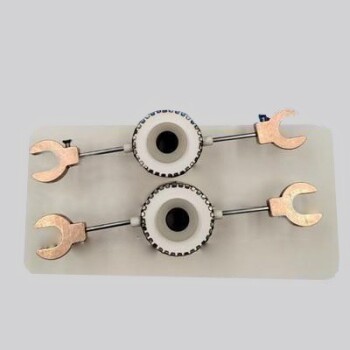
A specialized ceramic heating holder functions as the primary temperature regulation system within a vacuum irradiation chamber. Its specific role is to maintain precise, high-temperature conditions—typically between 700 K and 1000 K—while materials undergo ion injection to simulate nuclear reactor environments.
The validity of a nuclear simulation depends on accurately replicating the thermal environment of a reactor core. The ceramic heating holder provides the necessary thermal stability over long durations, allowing researchers to observe how helium atoms migrate and aggregate within materials like silicon carbide under realistic operating stresses.
Simulating the Reactor Core Environment
Replicating Extreme Temperatures
To test how materials will behave inside a nuclear reactor, they must be subjected to intense heat. The ceramic heating holder is designed to reach and sustain temperatures ranging from 700 K to 1000 K. This specific range mimics the thermal stress found in actual reactor cores.
Sustaining Long-Duration Experiments
Simulations are rarely instantaneous; they often require ion injection processes that last for several hours. The holder's role is to ensure the temperature does not fluctuate during this extended period. Consistency is vital for valid data collection over time.
The Mechanism of Control
Precise Thermal Feedback
The device relies on thermal feedback control to maintain stability. This system actively monitors the temperature and adjusts the heating output in real-time. This prevents thermal drift, ensuring the environment remains constant throughout the experiment.
Operation in a Vacuum
These heating holders are specifically engineered to function within a vacuum irradiation chamber. Generating and controlling heat in a vacuum presents unique challenges regarding heat transfer. The ceramic construction is optimized to manage these conditions effectively while holding the sample in place.
Critical Research Applications
Analyzing Silicon Carbide Lattices
The primary reference application for this technology is the study of silicon carbide (SiC). Researchers use the heating holder to maintain the material's temperature while injecting ions. This allows for a detailed examination of how the crystal lattice structure responds to radiation.
Tracking Helium Atom Behavior
The ultimate goal of using this specialized holder is to study helium migration and aggregation. Heat significantly affects how helium atoms move through a material. By stabilizing the temperature, researchers can isolate the effects of thermal energy on atomic movement and defect formation.
Understanding the Trade-offs
Complexity of Setup
Implementing a heating stage inside a vacuum chamber adds significant complexity to the experimental setup. The need for precise feedback loops means that any failure in the sensor or control logic can ruin an hours-long experiment.
Thermal Stability vs. Duration
While the device is designed for stability, maintaining high temperatures (up to 1000 K) for extended periods places stress on the heating element itself. Researchers must balance the need for long exposure times with the operational limits of the ceramic heater to avoid equipment failure during critical data collection.
Making the Right Choice for Your Experiment
To maximize the effectiveness of your simulation, align your equipment use with your specific research goals.
- If your primary focus is studying atomic migration: Prioritize the precision of the thermal feedback control to ensure temperature fluctuations do not skew the migration data.
- If your primary focus is material durability testing: Ensure the heating holder is rated for the maximum duration of your ion injection process to prevent thermal drop-off.
Precision in temperature control is the variable that transforms a simple radiation test into a valid nuclear environment simulation.
Summary Table:
| Feature | Specification/Role |
|---|---|
| Temperature Range | 700 K to 1000 K |
| Environment | Vacuum Irradiation Chambers |
| Primary Function | Precise Thermal Feedback Control |
| Key Application | Silicon Carbide (SiC) Research |
| Research Goal | Helium Atom Migration & Aggregation Study |
| Material | Specialized Thermal-Resistant Ceramics |
Elevate Your Nuclear Materials Research with KINTEK
Precise thermal stability is the difference between a failed test and a breakthrough. KINTEK specializes in high-performance laboratory solutions designed for extreme environments. Whether you are conducting ion injection studies or testing material durability, our comprehensive range of high-temperature furnaces (vacuum, tube, and muffle), high-pressure reactors, and precision ceramic heating components ensures your simulations replicate real-world reactor stresses with absolute accuracy.
From advanced crushing and milling systems for sample preparation to specialized PTFE and ceramic consumables, KINTEK provides the reliability your lab demands.
Ready to optimize your experimental setup? Contact our technical experts today to find the perfect heating and material solution for your research goals.
References
- Kymbat M. Tynyshbayeva, Maxim V. Zdorovets. Study of The Gas-Swelling Mechanisms in Silicon Carbide Ceramics under High-Temperature Irradiation with Helium Ions. DOI: 10.3390/ma16175750
This article is also based on technical information from Kintek Solution Knowledge Base .
Related Products
- Hexagonal Boron Nitride HBN Ceramic Ring
- Ceramic Evaporation Boat Set Alumina Crucible for Laboratory Use
- Engineering Advanced Fine Ceramics Alumina Crucibles (Al2O3) for Thermal Analysis TGA DTA
- Engineering Advanced Fine Ceramics Alumina Al2O3 Crucible With Lid Cylindrical Laboratory Crucible
- Aluminized Ceramic Evaporation Boat for Thin Film Deposition
People Also Ask
- Why is a hexagonal Boron Nitride (h-BN) layer required for LATP? Protect Your Samples from Carbon Contamination
- What is the necessity of using a ceramic crucible as a carrier during BN synthesis? Ensure High-Purity Results
- Why is Boron Nitride coating used in VHP sintering? Prevent Carbon Diffusion & Ensure Clean Mold Release
- Why are Viton O-rings considered essential consumables for the high-temperature sealing interfaces of microreactors?
- Does ceramic break with heat? The Real Culprit is Thermal Shock