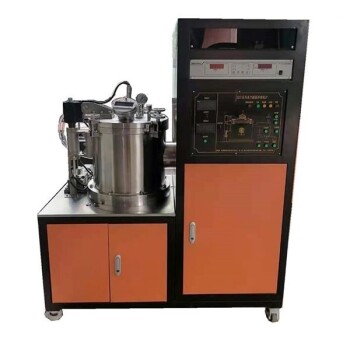
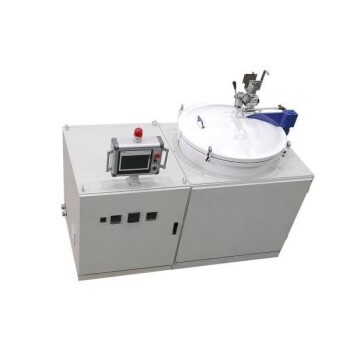
The vacuum diffusion welding furnace serves as the critical transformative environment in the fabrication of multi-layer titanium alloy laminates, converting discrete sheets into a unified, high-performance structural block.
By maintaining a controlled vacuum or inert atmosphere, the furnace applies precise heat and uniform pressure—often utilizing a flexible membrane under argon protection—to facilitate atomic diffusion across the contact interfaces of the titanium stack.
Core Takeaway The furnace functions not just as a heating element, but as a mechanism for atomic integration. It simultaneously prevents oxidation embrittlement and forces atoms to migrate across layer boundaries, resulting in a pore-free, isotropic material where the original interfaces are virtually indistinguishable.
The Mechanics of Atomic Bonding
Application of Uniform Pressure
To achieve a high-quality bond, the furnace must apply consistent pressure across the entire surface of the laminate stack.
In advanced setups, this is achieved using a flexible membrane combined with argon gas pressure. This method ensures that force is distributed evenly, accommodating minor surface irregularities and maximizing contact area.
Facilitating Atomic Diffusion
The primary role of the furnace is to elevate the material to a specific temperature where atoms become highly mobile without melting the metal.
At these elevated temperatures, atoms migrate across the interfaces of the stacked sheets. This solid-state diffusion creates strong bonds at the atomic level, effectively erasing the physical boundary between layers.
Creation of Isotropic Bonds
The ultimate goal of this process is to create "isotropic" bonds, meaning the material properties are uniform in all directions.
When the furnace operates correctly, it produces a laminated material with no visible interfaces. The layers function as a single, monolithic unit rather than a stack of glued sheets.
Critical Environmental Controls
Prevention of Oxidation
Titanium alloys are highly reactive to oxygen at high temperatures, which causes embrittlement and structural failure.
The vacuum furnace provides a high-vacuum or inert (argon) environment that inhibits the formation of oxide layers. This protection is non-negotiable for maintaining the ductility and toughness of the final laminate.
Microstructural Preservation
By controlling the atmosphere and thermal cycle, the furnace preserves the material's microstructure.
Specifically, it helps maintain uniform equiaxed alpha grains. This preservation ensures that the bonding process does not degrade the inherent properties of the titanium alloy.
Impact on Mechanical Performance
Elimination of Interfacial Pores
One of the furnace's most important roles is the elimination of voids or pores between layers.
Through the combination of heat and pressure, the furnace collapses these potential weak points. A pore-free interface is essential for preventing crack initiation and propagation under stress.
Enhancement of Toughness and Strength
The result of this controlled diffusion process is a significant boost in mechanical performance.
Laminates processed this way exhibit superior impact toughness and fracture strength. The bonding is so complete that the material effectively resists delamination even under heavy impact loads.
Understanding the Trade-offs
The Necessity of Atmosphere Integrity
The process relies entirely on the purity of the vacuum or argon environment.
Even a minor leak or failure in the vacuum system leads to rapid gas absorption and oxidation. This results in a brittle material that is structurally compromised, regardless of how well the pressure was applied.
Complexity of Pressure Systems
Using a flexible membrane for pressure application offers superior uniformity but introduces mechanical complexity.
Unlike simple mechanical rams, flexible membrane systems require precise control of gas pressure differentials. If the pressure is not balanced correctly against the temperature, the laminate may suffer from incomplete bonding or deformation.
Making the Right Choice for Your Goal
To optimize the fabrication of titanium laminates, consider which furnace parameter aligns with your specific engineering requirements:
- If your primary focus is Maximum Fracture Strength: Prioritize systems with flexible membrane pressure application to ensure the complete elimination of interfacial pores.
- If your primary focus is Material Ductility: Ensure the furnace is capable of maintaining a high-vacuum or pure argon atmosphere to absolutely prevent oxidation embrittlement.
- If your primary focus is Microstructural Uniformity: Focus on the precision of the thermal cycle control to maintain equiaxed grain structures during the diffusion window.
The vacuum diffusion welding furnace transforms a stack of parts into a single, high-strength entity by mastering the delicate balance between heat, pressure, and atmospheric purity.
Summary Table:
| Key Feature | Role in Fabrication | Benefit to Titanium Laminates |
|---|---|---|
| High-Vacuum Environment | Prevents oxidation and gas absorption | Maintains material ductility and toughness |
| Uniform Argon Pressure | Flexible membrane application | Eliminates interfacial pores and voids |
| Solid-State Diffusion | Facilitates atomic migration | Creates isotropic, monolithic structures |
| Thermal Cycle Control | Manages heat precisely | Preserves uniform equiaxed grain microstructure |
Elevate Your Material Integrity with KINTEK Precision
Unlock the full potential of your titanium alloy fabrication with KINTEK’s advanced vacuum diffusion welding solutions. Whether you are developing aerospace components or high-performance structural blocks, our specialized high-temperature vacuum and atmosphere furnaces provide the precise thermal and pressure control necessary for flawless atomic integration.
Our value to you:
- Advanced Furnace Technology: From vacuum and atmosphere furnaces to high-pressure systems, we ensure a pore-free bonding environment.
- Comprehensive Lab Portfolio: We offer crushing and milling systems, hydraulic presses, and essential consumables like ceramics and crucibles to support your entire workflow.
- Expert Engineering Support: Our tools are designed to preserve microstructural uniformity and maximize fracture strength in sensitive alloys.
Ready to eliminate delamination and achieve superior isotropic bonds?
Contact KINTEK today for a consultation
References
- Tatiana Poliakova, Alexandre M. Fedoseev. Structural regularities in double sulphates of trivalent actinides. DOI: 10.21175/rad.abstr.book.2023.38.1
This article is also based on technical information from Kintek Solution Knowledge Base .
Related Products
- Vacuum Arc Induction Melting Furnace
- Vacuum Heat Treat Furnace and Levitation Induction Melting Furnace
- Vacuum Heat Treat and Molybdenum Wire Sintering Furnace for Vacuum Sintering
- Vacuum Heat Treat Sintering Brazing Furnace
- Lab-Scale Vacuum Induction Melting Furnace
People Also Ask
- How do vacuum induction or arc melting furnaces facilitate the synthesis of U-Al-C MAX phases? Precision Heat & Purity
- What core role does a Vacuum Induction Melting furnace play in nickel-free steel production? Achieve High-Purity Alloys
- What is the primary function of a vacuum arc melting furnace in RHEA preparation? Achieving Extreme Thermal Fusion
- What is the function of vacuum arc melting equipment? Creating High-Purity Ferrochrome (CrFe) Alloys
- What is the function of a vacuum arc melting furnace? Prepare High-Purity Alx(CrFeNi)1-x High-Entropy Alloys