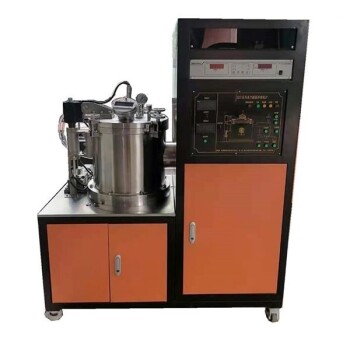
The vacuum tube furnace is the primary reactor for synthesizing T-RGO/TiO2 composites.
It provides a strictly controlled, oxygen-free environment—typically under high vacuum or inert gas—that facilitates the thermal reduction of graphene oxide while simultaneously regulating the crystallization and phase stability of titanium dioxide. This dual-purpose thermal processing is essential for restoring the material's electrical conductivity and ensuring a stable structural interface between the two components.
Core Takeaway: A vacuum tube furnace enables the precise, steady-state thermal reduction required to transform insulating graphene oxide into a conductive framework without damaging its structure, while simultaneously controlling the crystal growth of titanium dioxide.
Facilitating Controlled Reduction of Graphene Oxide
Restoration of Electrical Conductivity
The furnace provides a high-temperature environment (typically ranging from 400°C to 900°C) that effectively eliminates oxygen-containing functional groups from the surface of graphene oxide. This process repairs the $sp^2$ aromatic network, converting an insulating precursor into a highly conductive reduced graphene oxide (RGO) carrier.
Prevention of Oxidative Damage
By maintaining an inert atmosphere (such as Argon) or a high vacuum (often less than $10^{-6}$ mbar), the tube furnace prevents the carbon framework from burning away. This allows for long-term, steady-state heating that ensures gradual deoxidation while preserving the structural integrity of the graphene.
Thermal Exfoliation and Morphology
Rapid heating within the tube furnace can facilitate the thermal exfoliation of graphene oxide. This creates nano-fillers characterized by a high-porosity, wrinkled structure, which increases the surface area available for titanium dioxide deposition.
Regulating the Titanium Dioxide Phase and Interface
Phase Stability and Crystal Growth
The precise temperature control system of the tube furnace ensures phase stability during film growth, such as favoring the formation of anatase $TiO_2$ crystals. This is vital for the development of photocatalytic devices, as specific crystal orientations significantly impact catalytic activity.
Formation of the Schottky Junction
After growth is complete, the furnace allows for controlled natural cooling under vacuum, which acts as a quenching process. This prevents over-oxidation and promotes a stable transition layer between the graphene and the metallic components, maintaining the integrity of the Schottky junction.
Uniform Vapor Deposition
In vapor deposition processes, the tube furnace provides the necessary temperature gradients to ensure precursor vapors deposit uniformly onto a substrate. This results in a cohesive composite where $TiO_2$ nanoparticles are evenly distributed across the graphene surface.
Understanding the Trade-offs and Critical Parameters
The Temperature Paradox
While higher temperatures generally improve the reduction of graphene oxide, exceeding 1000°C can lead to a decline in quality. Excessive heat increases the activation energy on the surface, which can actually hinder the graphitization process and reduce the material's overall catalytic effectiveness.
Atmospheric Sensitivity
The choice of atmosphere—whether high vacuum, argon, or nitrogen—radically changes the final product's characteristics. For example, using a nitrogen-protected environment during calcination is essential for regulating oxygen vacancies, which are critical for electrocatalytic performance but can be lost in an improperly controlled environment.
Achieving Optimal Synthesis for Your Application
How to Apply This to Your Project
To maximize the performance of your T-RGO/TiO2 composite, you must calibrate your furnace settings based on your specific performance requirements.
- If your primary focus is maximum electrical conductivity: Prioritize a high-vacuum environment ($10^{-6}$ mbar) at temperatures near 800°C to ensure the complete repair of the $sp^2$ network.
- If your primary focus is photocatalytic activity: Focus on precise temperature regulation (typically around 400°C–500°C) to ensure the growth of the anatase phase and the creation of oxygen vacancies.
- If your primary focus is structural surface area: Use a rapid heating profile to 1000°C to encourage thermal exfoliation and a wrinkled, high-porosity morphology.
By mastering the thermal and atmospheric variables of the vacuum tube furnace, you can precisely engineer the interface and conductivity of your composite materials.
Summary Table:
| Process Step | Role of Vacuum Tube Furnace | Key Outcome |
|---|---|---|
| Thermal Reduction | Oxygen-free heating (400°C–900°C) | Restores $sp^2$ network and electrical conductivity |
| Phase Regulation | Precise temperature control | Stabilizes anatase $TiO_2$ crystals and Schottky junctions |
| Morphology Control | Rapid heating profiles | Facilitates thermal exfoliation for high-porosity RGO |
| Atmospheric Protection | High vacuum ($10^{-6}$ mbar) or inert gas | Prevents oxidative damage and regulates oxygen vacancies |
Elevate Your Material Research with KINTEK Precision
Unlock the full potential of your composite materials with KINTEK’s advanced laboratory solutions. Whether you are synthesizing T-RGO/TiO2 or developing next-gen semiconductors, our precision vacuum tube furnaces (including CVD, PECVD, and atmosphere models) provide the exact atmospheric control and thermal stability required for superior conductivity and phase purity.
Beyond thermal processing, KINTEK offers a comprehensive suite of tools for the modern lab:
- Sample Preparation: High-pressure reactors, autoclaves, and hydraulic presses (pellet, hot, isostatic).
- Material Processing: Crushing, milling, and sieving systems.
- Electrochemistry: Specialized electrolytic cells, electrodes, and battery research consumables.
- Thermal Management: Cooling solutions, freeze dryers, and high-performance crucibles.
Ready to achieve high-performance results? Contact our experts today to find the perfect equipment for your specific application.
References
- Tomasz Kędzierski, Ewa Mijowska. Towards Promotion of Graphene/Titania‐Based Electrode via Ultrafast and Self‐Expansion Reduction for Li‐ion Battery. DOI: 10.1002/celc.202201068
This article is also based on technical information from Kintek Solution Knowledge Base .
Related Products
- Vacuum Sealed Continuous Working Rotary Tube Furnace Rotating Tube Furnace
- Laboratory High Pressure Vacuum Tube Furnace
- Laboratory Vacuum Tilt Rotary Tube Furnace Rotating Tube Furnace
- Split Chamber CVD Tube Furnace with Vacuum Station Chemical Vapor Deposition System Equipment Machine
- 1200℃ Controlled Atmosphere Furnace Nitrogen Inert Atmosphere Furnace
People Also Ask
- What are the advantages of using a rotary tube furnace for MoVOx catalysts? Elevate Uniformity and Crystallinity
- What are the process advantages of using a rotary tube furnace for WS2 powder? Achieve Superior Material Crystallinity
- Why is a vacuum tube furnace with argon protection required for RGO/Cu? Ensure Conductivity and Material Purity
- Why is a rotary tube furnace preferred over a fixed tube furnace for the carbonization of asphaltenes? Superior Quality
- What is a rotary tube furnace? Achieve Superior Uniformity for Powders and Granules