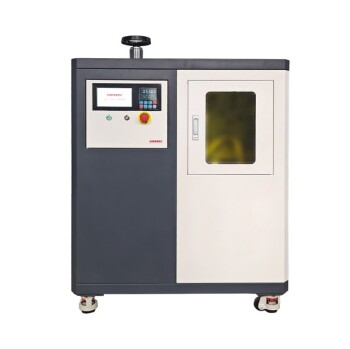
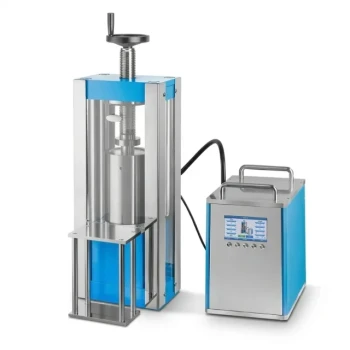
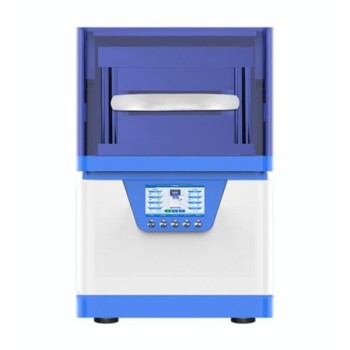
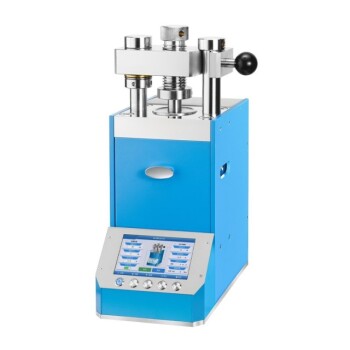
An industrial Hot Isostatic Pressing (HIP) system serves as the primary mechanism for transforming loose powder into solid, high-performance Oxide Dispersion Strengthened (ODS) steel. By utilizing an inert gas to apply high pressure (typically 196 MPa) at elevated temperatures (around 1423 K), the system forces the material to undergo plastic flow and diffusion creep.
The HIP process is essential for achieving full densification by eliminating internal voids within the material. Simultaneously, it drives atomic-level diffusion to create a seamless, mechanically stable bond between the ODS core and its protective stainless steel canister.
The Mechanics of Consolidation
Achieving Full Densification
The primary function of the HIP system is to eliminate porosity. Through the application of inert gas as a pressure medium, the system exerts uniform force on the powders contained within a canister.
This isostatic pressure triggers plastic flow and diffusion creep within the powder particles. These mechanisms collapse internal voids, resulting in a fully dense, solid material.
The Role of Extreme Parameters
Success in this process relies on reaching specific thresholds. The reference process utilizes a pressure of 196 MPa combined with a temperature of 1423 K.
These extreme conditions are necessary to soften the material sufficiently for plastic deformation while simultaneously forcing particles together to remove microscopic gaps.
Interface and Coating Integrity
Atomic-Level Diffusion
Beyond consolidating the core, the HIP system is critical for bonding the ODS steel to its enclosure. The system's uniform pressure environment facilitates atomic diffusion at the boundary layers.
This occurs between the ODS steel core and the stainless steel canister, which effectively acts as the corrosion-resistant cladding or coating for the final component.
Ensuring Mechanical Stability
The result of this high-pressure diffusion is a continuous metallurgical bond. By merging the atoms of the canister and the core, the system ensures the mechanical stability of the interface.
This prevents delamination and ensures that the protective stainless steel layer remains integral to the structural ODS core under stress.
Critical Process Requirements
Necessity of Isostatic Conditions
It is vital to understand that "isostatic" pressure—equal pressure from all sides—is non-negotiable for this application. Unbalanced pressure would lead to distortion of the component rather than uniform densification.
Parameter Sensitivity
The process is highly sensitive to the specific pressure and temperature set points (e.g., 196 MPa / 1423 K). Failure to maintain these specific high-energy conditions will result in incomplete diffusion creep, leaving voids in the material or a weak interface bond.
Making the Right Choice for Your Goal
To maximize the effectiveness of an industrial HIP system for ODS steel, align your process controls with your specific material objectives:
- If your primary focus is Core Integrity: Ensure pressure parameters reach levels sufficient (e.g., 196 MPa) to induce plastic flow and completely eliminate internal voids.
- If your primary focus is Interface Bonding: Prioritize temperature stability to facilitate the atomic-level diffusion necessary for fusing the stainless steel canister to the ODS core.
Successful consolidation relies on the precise synchronization of heat and pressure to force distinct materials into a single, unified entity.
Summary Table:
| Feature | Process Parameter/Mechanism | Benefit for ODS Steel |
|---|---|---|
| Pressure Medium | Inert Gas (Isostatic) | Uniform force distribution without component distortion |
| Operating Pressure | 196 MPa | Triggers plastic flow and diffusion creep to eliminate voids |
| Operating Temp | 1423 K | Softens material for deformation and facilitates atomic diffusion |
| Interface Bonding | Metallurgical Diffusion | Seamless, stable bond between ODS core and stainless cladding |
| Final State | Full Densification | High-performance, solid material with zero internal porosity |
Elevate Your Material Performance with KINTEK HIP Solutions
Precision matters when consolidating high-performance materials like ODS steel. KINTEK specializes in advanced laboratory and industrial equipment, including state-of-the-art Hot Isostatic Pressing (HIP) systems and isostatic presses designed to meet the rigorous demands of material science.
Our comprehensive portfolio—ranging from high-temperature furnaces and crushing systems to high-pressure reactors and hydraulic presses—empowers researchers and manufacturers to achieve full densification and superior mechanical stability.
Ready to optimize your consolidation process? Contact KINTEK today to discover how our expert-engineered solutions can drive your next breakthrough in material integrity and corrosion resistance.
References
- Hideo Sakasegawa, Masami Ando. Corrosion-resistant coating technique for oxide-dispersion-strengthened ferritic/martensitic steel. DOI: 10.1080/00223131.2014.894950
This article is also based on technical information from Kintek Solution Knowledge Base .
Related Products
- Warm Isostatic Press for Solid State Battery Research
- 600T Vacuum Induction Hot Press Furnace for Heat Treat and Sintering
- Isostatic Molding Pressing Molds for Lab
- Automatic High Temperature Heated Hydraulic Press Machine with Heated Plates for Lab
- Electric Split Lab Cold Isostatic Press CIP Machine for Cold Isostatic Pressing
People Also Ask
- What is the temperature of a warm isostatic press? Achieve Optimal Densification for Your Materials
- What is the function of a Warm Isostatic Press (WIP) in all-solid-state pouch cells? Optimize Battery Density
- Why are Warm Isostatic Presses (WIP) necessary for solid-state batteries? Achieve Atomic-Level Contact
- What advantages does a warm isostatic press offer over a traditional uniaxial press for Li6PS5Cl electrolyte sheets?
- How do warm isostatic presses improve dry electrode performance? Enhance ASSB Conductivity with Heat & Pressure