Knowledge Resources Which is better upflow or downflow furnace? The right choice depends on your home's layout.
Author avatar

Tech Team · Kintek Solution

Updated 2 months ago

Which is better upflow or downflow furnace? The right choice depends on your home's layout.


Ultimately, neither an upflow nor a downflow furnace is inherently better. The right choice is determined entirely by its installation location within your home. Upflow furnaces are the most common type in the U.S. simply because many homes are built with basements, the ideal location for an upflow design that leverages the natural tendency of heat to rise.

The "upflow vs. downflow" debate isn't about which technology is superior, but which configuration correctly matches your home's ductwork and layout. Choosing the wrong one for your location will lead to significant inefficiency, regardless of the furnace's quality.
Which is better upflow or downflow furnace? The right choice depends on your home's layout.

The Fundamental Difference: Airflow Direction

The name of each furnace type describes the direction it moves air. Understanding this simple principle is the key to selecting the correct unit for your home.

How an Upflow Furnace Works

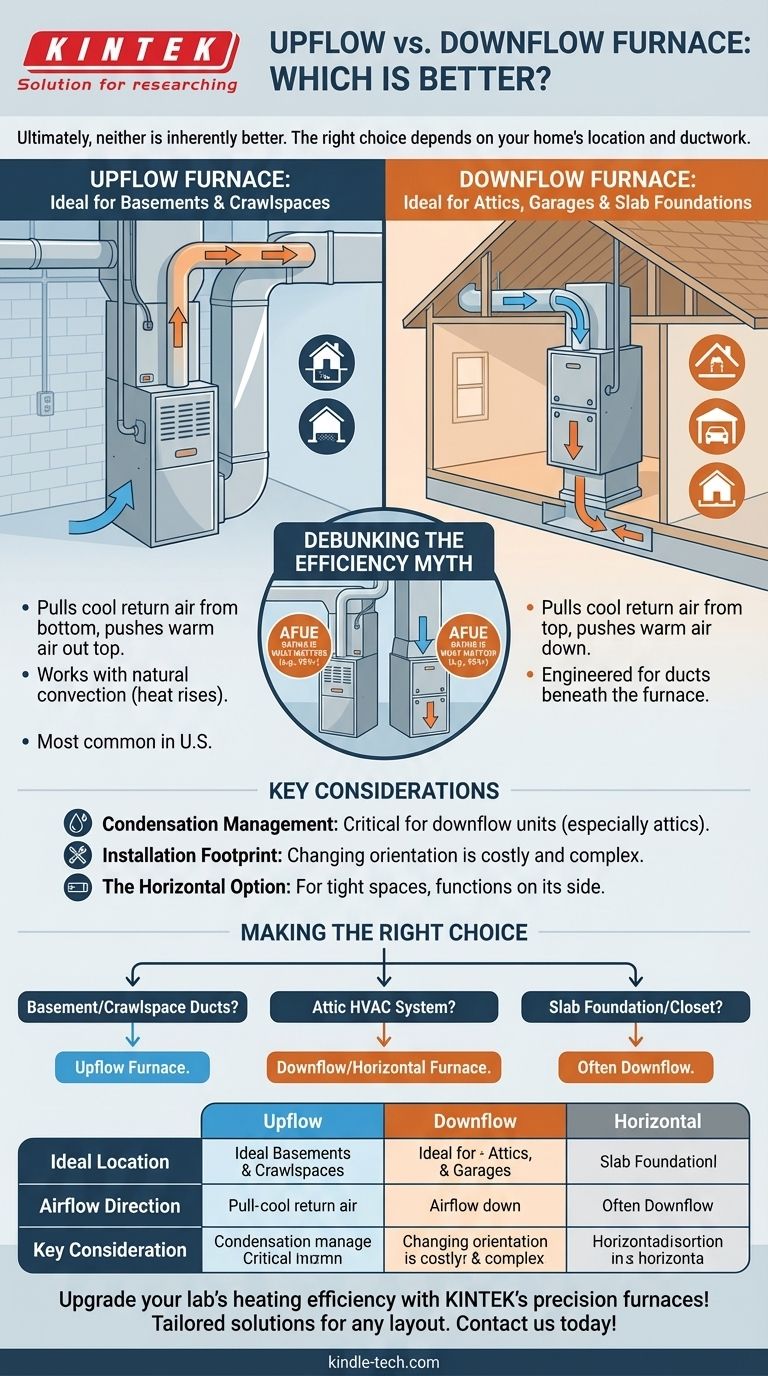
An upflow furnace pulls cool return air in through the bottom of the unit. It then heats the air and pushes the warm, conditioned air out of the top, where it is distributed into your home's ductwork.

This design works with physics, not against it. Since hot air naturally rises, this configuration is highly effective when the furnace is placed in the lowest level of a home.

Ideal Location for Upflow

The ideal and most common location for an upflow furnace is a basement or a crawlspace. The furnace sits on the floor and pushes heat upwards into the living spaces above.

How a Downflow Furnace Works

A downflow furnace, sometimes called a counterflow furnace, does the exact opposite. It pulls cool return air in from the top, heats it, and then pushes the warm air down into the ductwork below.

This design is specifically engineered for situations where the ductwork is located beneath the furnace, such as in the floor or a crawlspace, but the furnace itself is not in a basement.

Ideal Location for Downflow

Downflow furnaces are necessary for installations in attics, garages, or first-floor utility closets in homes built on a slab foundation. In these cases, the furnace is above the ductwork it needs to feed.

Debunking the Efficiency Myth

A common point of confusion is whether one furnace type is more energy-efficient than the other. The answer is tied to proper application, not the technology itself.

Configuration vs. Inherent Efficiency

While an upflow furnace in a basement takes advantage of natural convection (rising heat), the actual energy efficiency of a modern furnace is determined by its AFUE rating, not its airflow direction.

AFUE Rating Is What Matters

AFUE (Annual Fuel Utilization Efficiency) measures how much fuel a furnace converts into usable heat. A furnace with a 95% AFUE rating converts 95 cents of every dollar of fuel into warmth for your home.

Both upflow and downflow models are available in high-efficiency ratings of 95% or higher. A high-efficiency downflow unit is far superior to a low-efficiency upflow unit.

The Real Source of Inefficiency

The biggest efficiency losses occur when the wrong type of furnace is installed in the wrong location. Trying to force an upflow furnace to work in an attic would require convoluted, inefficient ducting that negates any potential benefits. Proper installation is paramount.

Understanding the Trade-offs

While both types can be highly effective when installed correctly, there are a few practical considerations to keep in mind.

Condensation Management in Downflow Units

High-efficiency furnaces produce condensation as a byproduct of combustion. In a downflow unit, particularly one in a cold attic, managing this condensate is critical to prevent water damage and operational issues. The drainage system must be installed perfectly.

Installation Footprint and Ductwork

In most cases, you are replacing an existing furnace with one of the same orientation. Changing from an upflow to a downflow configuration (or vice-versa) is a major project that requires significant and costly ductwork modifications.

The Horizontal Option

For very tight spaces like narrow attics or constricted crawlspaces, a horizontal furnace is also an option. It functions similarly but lies on its side, pulling air from one end and pushing it out the other, making it a versatile problem-solver for unique layouts.

Making the Right Choice for Your Home

Forget asking which furnace is "better" and instead ask which one your home's layout requires.

  • If your home has a basement or main-floor furnace room with crawlspace ducting: You will almost certainly need an upflow furnace.
  • If your HVAC system is located in the attic: You will need a downflow or horizontal furnace to properly distribute heat to the floors below.
  • If your home is on a slab foundation with the furnace in a closet: The correct choice depends on where the ducts run, but it is often a downflow configuration.

Focus on matching the furnace's orientation to your ductwork, then select the unit with the highest AFUE rating your budget allows.

Summary Table:

Furnace Type Ideal Location Airflow Direction Key Consideration
Upflow Furnace Basement, Crawlspace Pulls air from bottom, pushes heated air out top Leverages natural heat rise; most common in homes with basements
Downflow Furnace Attic, Garage, Slab Foundation Pulls air from top, pushes heated air down Requires precise condensate management; ideal for attic installations
Horizontal Furnace Tight spaces (e.g., narrow attics) Airflow from one side to the other Solves unique layout challenges; versatile for constrained areas

Upgrade your lab's heating efficiency with KINTEK's precision furnaces!
Whether your laboratory requires a compact horizontal design for tight spaces or a high-performance upflow/downflow configuration, KINTEK delivers reliable, energy-efficient solutions tailored to your specific layout and workflow. Our furnaces are engineered for precise temperature control, durability, and seamless integration with your existing setup.

Contact us today to discuss your lab's heating needs and discover how KINTEK can enhance your research and testing capabilities. Get in touch now!

Visual Guide
Which is better upflow or downflow furnace? The right choice depends on your home's layout. Visual Guide

Related Products

People Also Ask

Related Products

Graphite Vacuum Furnace High Thermal Conductivity Film Graphitization Furnace

Graphite Vacuum Furnace High Thermal Conductivity Film Graphitization Furnace

The high thermal conductivity film graphitization furnace has uniform temperature, low energy consumption and can operate continuously.

Rotary Tube Furnace Split Multi Heating Zone Rotating Tube Furnace

Rotary Tube Furnace Split Multi Heating Zone Rotating Tube Furnace

Multi zone rotary furnace for high-precision temperature control with 2-8 independent heating zones. Ideal for lithium ion battery electrode materials and high-temperature reactions. Can work under vacuum and controlled atmosphere.

High Temperature Muffle Oven Furnace for Laboratory Debinding and Pre Sintering

High Temperature Muffle Oven Furnace for Laboratory Debinding and Pre Sintering

KT-MD High temperature debinding and pre-sintering furnace for ceramic materials with various molding processes. Ideal for electronic components such as MLCC and NFC.

1700℃ Controlled Atmosphere Furnace Nitrogen Inert Atmosphere Furnace

1700℃ Controlled Atmosphere Furnace Nitrogen Inert Atmosphere Furnace

KT-17A Controlled atmosphere furnace: 1700℃ heating, vacuum sealing technology, PID temperature control, and versatile TFT smart touch screen controller for laboratory and industrial use.

1400℃ Controlled Atmosphere Furnace with Nitrogen and Inert Atmosphere

1400℃ Controlled Atmosphere Furnace with Nitrogen and Inert Atmosphere

Achieve precise heat treatment with KT-14A controlled atmosphere furnace. Vacuum sealed with a smart controller, it's ideal for lab and industrial use up to 1400℃.

1200℃ Split Tube Furnace with Quartz Tube Laboratory Tubular Furnace

1200℃ Split Tube Furnace with Quartz Tube Laboratory Tubular Furnace

KT-TF12 split tube furnace: high-purity insulation, embedded heating wire coils, and max. 1200C. Widely used for new materials and chemical vapour deposition.

Vertical High Temperature Graphite Vacuum Graphitization Furnace

Vertical High Temperature Graphite Vacuum Graphitization Furnace

Vertical high temperature graphitization furnace for carbonization and graphitization of carbon materials up to 3100℃.Suitable for shaped graphitization of carbon fiber filaments and other materials sintered in a carbon environment.Applications in metallurgy, electronics, and aerospace for producing high-quality graphite products like electrodes and crucibles.

Controlled Nitrogen Inert Hydrogen Atmosphere Furnace

Controlled Nitrogen Inert Hydrogen Atmosphere Furnace

KT-AH Hydrogen atmosphere furnace - induction gas furnace for sintering/annealing with built-in safety features, dual housing design, and energy-saving efficiency. Ideal for lab and industrial use.

Ultra-High Temperature Graphite Vacuum Graphitization Furnace

Ultra-High Temperature Graphite Vacuum Graphitization Furnace

The ultra-high temperature graphitization furnace utilizes medium frequency induction heating in a vacuum or inert gas environment. The induction coil generates an alternating magnetic field, inducing eddy currents in the graphite crucible, which heats up and radiates heat to the workpiece, bringing it to the desired temperature. This furnace is primarily used for graphitization and sintering of carbon materials, carbon fiber materials, and other composite materials.

Graphite Vacuum Furnace Bottom Discharge Graphitization Furnace for Carbon Materials

Graphite Vacuum Furnace Bottom Discharge Graphitization Furnace for Carbon Materials

Bottom-out graphitization furnace for carbon materials, ultra-high temperature furnace up to 3100°C, suitable for graphitization and sintering of carbon rods and carbon blocks. Vertical design, bottom discharging, convenient feeding and discharging, high temperature uniformity, low energy consumption, good stability, hydraulic lifting system, convenient loading and unloading.

600T Vacuum Induction Hot Press Furnace for Heat Treat and Sintering

600T Vacuum Induction Hot Press Furnace for Heat Treat and Sintering

Discover the 600T Vacuum Induction Hot Press Furnace, designed for high-temperature sintering experiments in vacuum or protected atmospheres. Its precise temperature and pressure control, adjustable working pressure, and advanced safety features make it ideal for nonmetal materials, carbon composites, ceramics, and metal powders.

Horizontal High Temperature Graphite Vacuum Graphitization Furnace

Horizontal High Temperature Graphite Vacuum Graphitization Furnace

Horizontal Graphitization Furnace: This type of furnace is designed with the heating elements placed horizontally, allowing for uniform heating of the sample. It's well-suited for graphitizing large or bulky samples that require precise temperature control and uniformity.

Laboratory Muffle Oven Furnace Bottom Lifting Muffle Furnace

Laboratory Muffle Oven Furnace Bottom Lifting Muffle Furnace

Efficiently produce batches with excellent temperature uniformity using our Bottom Lifting Furnace. Features two electric lifting stages and advanced temperature control up to 1600℃.

2200 ℃ Graphite Vacuum Heat Treat Furnace

2200 ℃ Graphite Vacuum Heat Treat Furnace

Discover the power of the KT-VG Graphite Vacuum Furnace - with a maximum working temperature of 2200℃, it's perfect for vacuum sintering of various materials. Learn more now.

Vacuum Heat Treat and Pressure Sintering Furnace for High Temperature Applications

Vacuum Heat Treat and Pressure Sintering Furnace for High Temperature Applications

Vacuum pressure sintering furnaces are designed for high temperature hot pressing applications in metal and ceramic sintering. Its advanced features ensure precise temperature control, reliable pressure maintenance, and a robust design for seamless operation.

Vacuum Sealed Continuous Working Rotary Tube Furnace Rotating Tube Furnace

Vacuum Sealed Continuous Working Rotary Tube Furnace Rotating Tube Furnace

Experience efficient material processing with our vacuum-sealed rotary tube furnace. Perfect for experiments or industrial production, equipped with optional features for controlled feeding and optimized results. Order now.

Molybdenum Vacuum Heat Treat Furnace

Molybdenum Vacuum Heat Treat Furnace

Discover the benefits of a high-configuration molybdenum vacuum furnace with heat shield insulation. Ideal for high-purity, vacuum environments like sapphire crystal growth and heat treatment.

Vacuum Hot Press Furnace Machine Heated Vacuum Press

Vacuum Hot Press Furnace Machine Heated Vacuum Press

Discover the advantages of Vacuum Hot Press Furnace! Manufacture dense refractory metals & compounds, ceramics, and composites under high temp and pressure.

Vacuum Heat Treat and Molybdenum Wire Sintering Furnace for Vacuum Sintering

Vacuum Heat Treat and Molybdenum Wire Sintering Furnace for Vacuum Sintering

A vacuum molybdenum wire sintering furnace is a vertical or bedroom structure, which is suitable for withdrawal, brazing, sintering and degassing of metal materials under high vacuum and high temperature conditions. It is also suitable for dehydroxylation treatment of quartz materials.

Laboratory Rapid Thermal Processing (RTP) Quartz Tube Furnace

Laboratory Rapid Thermal Processing (RTP) Quartz Tube Furnace

Get lightning-fast heating with our RTP Rapid Heating Tube Furnace. Designed for precise, high-speed heating and cooling with convenient sliding rail and TFT touch screen controller. Order now for ideal thermal processing!


Leave Your Message



















