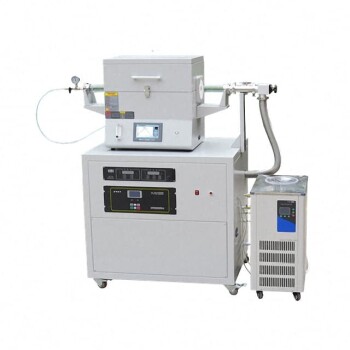
Post-treatment of 3D printed MoS2/TiS2 electrodes in a vacuum tube furnace is primarily performed to eliminate non-conductive printing additives and to precisely regulate the material’s crystal phase. By subjecting the printed structures to controlled thermal cycles—often around 470 °C—manufacturers can remove organic binders like Pluronic F127 while inducing specific phase transitions, such as the reversion from the 1T' phase back to the stable 2H phase.
Vacuum annealing transforms a raw, additive-heavy printed structure into a functional, high-purity electrode. This process is essential for achieving the chemical stability and structural orientation required for high-performance electrochemical applications.
Eliminating Organic Impurities
Removal of Printing Binders
Additive manufacturing requires rheological modifiers, such as Pluronic F127 polymers, to make the ink flowable and stable. These polymers are non-conductive and act as "dead weight" that blocks active electrochemical sites once the printing is complete.
Restoration of Active Surface Area
The high-temperature environment of the vacuum furnace thermally decomposes these organic additives. This "burn-out" process clears the pathways for ions to interact with the MoS2/TiS2 nanosheets, significantly increasing the electrode's effective surface area.
Structural and Phase Regulation
Controlling Phase Transitions
Transition metal dichalcogenides (TMDs) often exist in multiple crystalline phases, such as the metallic 1T/1T' phase and the semiconducting 2H phase. Post-treatment allows researchers to precisely control these transitions to study their impact on the electrochemical performance of micro-supercapacitors.
Eliminating Material Defects
Thermal energy provided by the furnace helps heal intrinsic defects within the MoS2 nanosheets. This reorganization of the lattice structure ensures that the material is stable enough to withstand repeated charging and discharging cycles.
Enhancing Electrical and Interfacial Bonding
Improving Carrier Injection
Vacuum annealing at specific temperatures (ranging from 200 °C to 470 °C) helps eliminate residue that hinders electrical flow. This process optimizes the interface between the active material and the substrate, reducing the Schottky barrier and enhancing carrier injection efficiency.
Strengthening Interfacial Contact
The heat treatment promotes better mechanical and electrical adhesion between the printed TMDs and their underlying current collectors. This improved bonding is critical for reducing internal resistance and ensuring high-speed charge transport.
Understanding the Trade-offs
Thermal Budget and Material Integrity
While high temperatures are necessary to remove binders, excessive heat can lead to the aggregation of nanosheets, which reduces the active surface area. Finding the "sweet spot" temperature is critical to prevent degrading the very structures created during the 3D printing process.
Atmospheric Control vs. Complexity
Utilizing a vacuum or inert atmosphere (like Nitrogen) is mandatory to prevent the oxidation of MoS2 and TiS2. However, this increases the complexity and cost of the manufacturing setup compared to open-air annealing, requiring specialized tube furnace equipment.
Optimizing Your Post-Treatment Strategy
How to Apply This to Your Project
- If your primary focus is maximizing conductivity: Target higher temperatures in a reducing or inert atmosphere to ensure the complete removal of oxygen-containing functional groups and organic residues.
- If your primary focus is studying phase-dependent behavior: Use precise temperature ramping (e.g., 2°C/min) to capture the specific transition point between the 1T' and 2H phases.
- If your primary focus is interface stability: Focus on vacuum annealing at lower ranges (near 200 °C–300 °C) to improve bonding without risking the structural deformation of delicate printed architectures.
Correctly calibrated vacuum post-treatment is the bridge that turns a 3D-printed shape into a highly efficient energy storage device.
Summary Table:
| Objective | Key Benefit | Process Detail |
|---|---|---|
| Binder Removal | Eliminates non-conductive polymers (e.g., Pluronic F127) | Thermal decomposition (burn-out) |
| Phase Regulation | Induces 1T' to 2H phase transition | Controlled thermal cycles (~470 °C) |
| Surface Optimization | Increases active surface area for ion interaction | Removal of "dead weight" additives |
| Electrical Enhancement | Reduces internal resistance & Schottky barriers | Improved interfacial bonding in vacuum |
| Atmospheric Control | Prevents material oxidation | Vacuum or inert gas (N2) environment |
Elevate Your Materials Research with KINTEK Precision
Achieving the perfect crystalline phase and purity in 3D-printed electrodes requires uncompromising thermal control. KINTEK specializes in high-performance laboratory equipment, providing the advanced vacuum tube furnaces, atmosphere furnaces, and CVD systems essential for precise post-treatment of TMDs and battery materials.
Our comprehensive portfolio supports every stage of your workflow, from hydraulic pellet presses and crushing systems for material preparation to high-temperature high-pressure reactors and battery research consumables. Whether you are optimizing carrier injection or scaling micro-supercapacitor production, KINTEK delivers the reliability and technical support you need to succeed.
Ready to optimize your thermal processing? Contact our laboratory specialists today to find the ideal solution for your specific research requirements.
References
- Apostolos Panagiotopoulos, Cecilia Mattevi. 3D printed inks of two-dimensional semimetallic MoS<sub>2</sub>/TiS<sub>2</sub> nanosheets for conductive-additive-free symmetric supercapacitors. DOI: 10.1039/d3ta02508j
This article is also based on technical information from Kintek Solution Knowledge Base .
Related Products
- Vacuum Sealed Continuous Working Rotary Tube Furnace Rotating Tube Furnace
- Laboratory High Pressure Vacuum Tube Furnace
- Laboratory Vacuum Tilt Rotary Tube Furnace Rotating Tube Furnace
- Split Chamber CVD Tube Furnace with Vacuum Station Chemical Vapor Deposition System Equipment Machine
- 1200℃ Controlled Atmosphere Furnace Nitrogen Inert Atmosphere Furnace
People Also Ask
- What are the process advantages of using a rotary tube furnace for WS2 powder? Achieve Superior Material Crystallinity
- What are the advantages of using a rotary tube furnace for MoVOx catalysts? Elevate Uniformity and Crystallinity
- Why is a vacuum tube furnace with argon protection required for RGO/Cu? Ensure Conductivity and Material Purity
- Why is a rotary tube furnace preferred over a fixed tube furnace for the carbonization of asphaltenes? Superior Quality
- What is a rotary tube furnace? Achieve Superior Uniformity for Powders and Granules