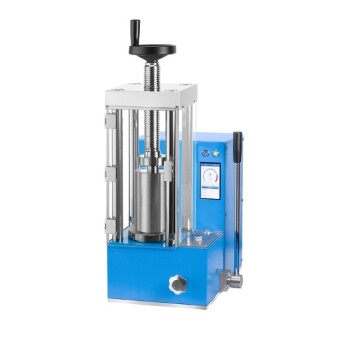
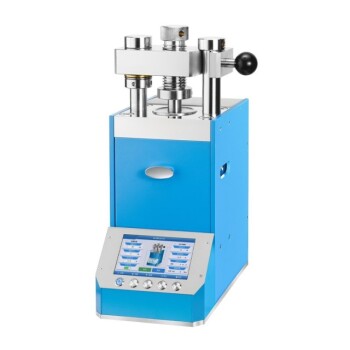
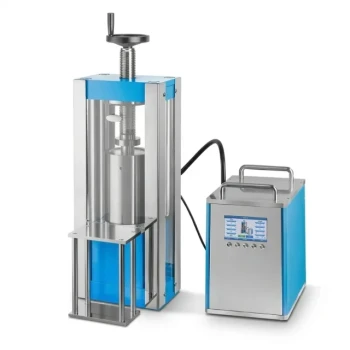
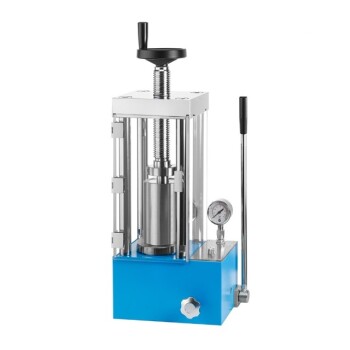
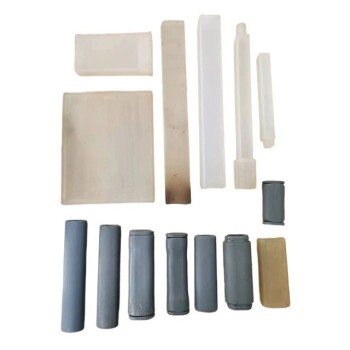
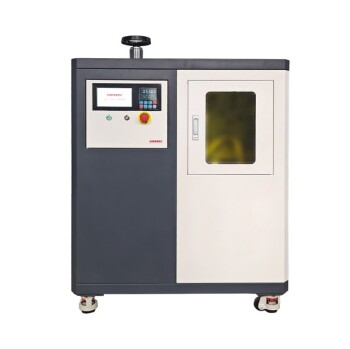
A Cold Isostatic Press (CIP) is required to correct the internal structural flaws left behind by initial uniaxial pressing. While the initial press forms the shape, the CIP applies isotropic high pressure (approximately 360 kgf/cm²) through a liquid medium to effectively eliminate density gradients. This secondary stage is critical for maximizing the packing density and uniformity of the LLZTBO green bodies, ensuring the final material can withstand high-temperature sintering.
Core Insight: Uniaxial pressing creates the shape, but Cold Isostatic Pressing creates the structure. By applying pressure evenly from every direction, CIP transforms a chemically promising material into a physically viable one, directly enabling high relative densities (95%) and the low interfacial resistance required for top-tier performance.
The Limitations of Uniaxial Pressing
The Creation of Density Gradients
Uniaxial pressing applies force from a single direction (or two opposing directions).
This unidirectional force inevitably creates density gradients within the compacted granule. The material closer to the punch becomes denser than the material in the center or at the edges, creating a "green body" (unfired ceramic) with uneven internal stress.
The Risk to Integrity
If these gradients are left unaddressed, the material will shrink unevenly during the sintering process.
This leads to warping, cracking, or internal voids in the final LLZTBO component, compromising its mechanical stability and electrochemical performance.
The Mechanics of Isostatic Correction
Applying Isotropic Pressure
Unlike uniaxial pressing, a CIP uses a liquid medium to transmit pressure.
This ensures that the force is applied isotropically, meaning it hits the material with equal intensity from every single direction simultaneously.
Eliminating the Gradients
Because the pressure is uniform (specifically around 360 kgf/cm² for this application), the material is compacted evenly toward its center.
This process removes the density variations caused by the initial press, resulting in a green body that is homogenous throughout its entire volume.
Impact on Final Performance
Achieving High Relative Density
The primary goal of processing LLZTBO is to achieve a high relative density, typically targeting 95% or higher.
CIP increases the overall packing density of the green body before it ever enters the furnace. A denser green body significantly lowers the barrier to achieving full densification during the final high-temperature sintering.
Lowering Interfacial Resistance
For LLZTBO composites, electrical performance is paramount.
By ensuring high density and uniformity, CIP minimizes internal porosity. This reduction in voids is essential for achieving low interfacial resistance, which directly dictates the efficiency and conductivity of the final composite.
Understanding the Trade-offs
Increased Process Complexity
Introducing a CIP stage adds a discrete step to the manufacturing workflow.
This increases the total cycle time per part compared to simple uniaxial pressing. It requires transferring parts between distinct pieces of equipment, which introduces handling risks for fragile green bodies.
Equipment and Maintenance Costs
CIP equipment is generally more complex to maintain than standard mechanical presses.
The use of high-pressure liquid media requires robust seals, pumps, and safety protocols, representing a higher capital investment and operational overhead.
Making the Right Choice for Your Goal
To maximize the performance of your LLZTBO composites, align your processing steps with your specific performance targets:
- If your primary focus is electrochemical performance: Prioritize the CIP stage to ensure the density required for low interfacial resistance, even if it slows production.
- If your primary focus is structural reliability: Use CIP to eliminate density gradients, which is the single most effective way to prevent cracking and warping during sintering.
Ultimate success in LLZTBO fabrication relies not just on the chemistry of the granules, but on the physical uniformity achieved through isostatic pressure.
Summary Table:
| Feature | Uniaxial Pressing | Cold Isostatic Pressing (CIP) |
|---|---|---|
| Pressure Direction | Unidirectional (Single/Dual Axis) | Isotropic (Uniform from all sides) |
| Internal Structure | Creates density gradients | Eliminates gradients; homogenous |
| Material Density | Lower packing density | Maximum packing density (up to 95%+) |
| Sintering Result | High risk of warping/cracking | Uniform shrinkage; high integrity |
| Primary Goal | Initial shaping of the component | Structural refinement and densification |
Elevate Your Materials Research with KINTEK Precision
Don't let internal structural flaws compromise your LLZTBO composite performance. KINTEK specializes in advanced laboratory solutions, offering high-performance Cold Isostatic Presses (CIP) and hydraulic pellet presses designed to eliminate density gradients and maximize material conductivity.
Our comprehensive portfolio supports every stage of your workflow—from crushing and milling systems for powder preparation to high-temperature muffle and vacuum furnaces for final sintering. Whether you are developing next-generation batteries or advanced ceramics, our team provides the technical expertise and robust equipment needed to achieve low interfacial resistance and superior mechanical stability.
Ready to achieve 95%+ relative density in your green bodies? Contact KINTEK today to discuss your application!
Related Products
- Electric Lab Cold Isostatic Press CIP Machine for Cold Isostatic Pressing
- Automatic Lab Cold Isostatic Press CIP Machine Cold Isostatic Pressing
- Electric Split Lab Cold Isostatic Press CIP Machine for Cold Isostatic Pressing
- Manual Cold Isostatic Pressing Machine CIP Pellet Press
- Isostatic Molding Pressing Molds for Lab
People Also Ask
- What role does cold isostatic pressing play in the formation of feed rods for single crystal growth? Ensure Stability.
- What is isostatic pressing method for ceramics? Achieve Uniform Density for Complex Parts
- In what ways does Cold Isostatic Pressing (CIP) enhance LiFePO4 battery performance? Boost Density and Conductivity
- How does Cold Isostatic Pressing (CIP) benefit SiC ceramic reactors? Achieve Flawless Material Integrity
- Why is a cold isostatic press advantageous for Argyrodite sulfide solid-state batteries? Achieve Optimal Densification