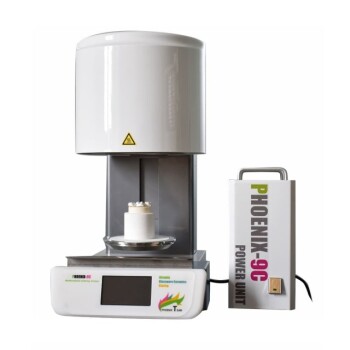
Maintaining precise chemical control and hardware integrity is the primary reason for using a graphite resistance furnace with an inert gas atmosphere when melting fayalite slag. This configuration creates a stable, high-temperature environment (1200°C–1400°C) while preventing the oxidation of the iron crucible and ensuring the slag’s chemical composition remains unchanged by atmospheric oxygen.
Core Takeaway: This specialized setup isolates the melting process from the surrounding air, using inert gases like argon or nitrogen to preserve the reductive state necessary for fayalite slag stability and to protect critical furnace components from degradation.
Achieving Thermal Stability and Homogenization
The Role of Graphite Resistance Heating
A graphite resistance furnace is selected because it provides the stable and uniform high-temperature environment required for the melting process. This uniformity is critical for the thorough melting and homogenization of chemical reagent mixtures.
Precision at High Temperatures
Fayalite slag processing typically occurs between 1200°C and 1400°C. Graphite heating elements can easily reach and maintain these temperatures with high precision, allowing researchers to control the viscosity and phase distribution of the slag.
The Critical Function of the Inert Atmosphere
Displacing Atmospheric Oxygen
Inert gases, such as high-purity argon or nitrogen, are injected into the furnace through gas lances to displace oxygen. Because these gases do not react with the materials at processing temperatures, they create a protective barrier around the sample.
Protecting the Iron Crucible
Fayalite slag is often melted within an iron crucible, which is highly susceptible to atmospheric oxidation at elevated temperatures. The inert atmosphere prevents the crucible from reacting with oxygen, which would otherwise weaken the vessel and contaminate the melt.
Maintaining a Reductive Environment
Fayalite ($Fe_2SiO_4$) requires a specific reductive environment to remain stable. The presence of oxygen would trigger unintended chemical changes, potentially converting the iron within the slag to different oxidation states and altering the experimental results.
Understanding the Trade-offs and Limitations
Gas Selection and Temperature Limits
While nitrogen is an effective inert shield, it is only classified as truly inert below 1800°C. If the process exceeds this temperature, nitrogen may begin to react with certain furnace components or samples, making argon the preferred (though more expensive) choice for ultra-high-temp applications.
Purity and Contamination Risks
The effectiveness of this system depends entirely on the purity of the gas. Even trace amounts of oxygen or moisture in the argon or nitrogen supply can lead to the gradual oxidation of the graphite elements or the slag sample, potentially skewing data.
Applying This Setup to Your Process
Recommendations Based on Your Objectives
- If your primary focus is cost-efficiency at standard temperatures: Use high-purity nitrogen as your inert gas, provided your process stays well below the 1800°C threshold.
- If your primary focus is maximum chemical purity and stability: Utilize high-purity argon and ensure gas lances are positioned to provide a continuous, direct flow over the iron crucible.
- If your primary focus is furnace longevity: Regularly inspect graphite elements for signs of thinning, which indicates oxygen ingress and a failure in the inert atmosphere seal.
By strictly controlling the atmosphere and temperature, you ensure that the final slag product is a true reflection of your intended chemical proportions.
Summary Table:
| Component | Role in Fayalite Slag Melting | Key Benefit |
|---|---|---|
| Graphite Heating | Provides uniform heat (1200°C–1400°C) | Ensures thorough melting and homogenization |
| Inert Gas (Ar/N2) | Displaces atmospheric oxygen | Prevents oxidation of samples and furnace parts |
| Iron Crucible | Holds the reagent mixture | Protected from degradation by the inert shield |
| Reductive State | Maintains $Fe_2SiO_4$ stability | Prevents unintended chemical/oxidation changes |
Elevate Your High-Temperature Research with KINTEK
Precision is the backbone of successful metallurgical and material science research. At KINTEK, we understand that maintaining a stable reductive environment and hardware integrity is non-negotiable for processes like fayalite slag melting.
We specialize in providing high-performance atmosphere and vacuum furnaces, alongside a comprehensive range of high-purity ceramics, crucibles, and graphite components designed to withstand extreme conditions without compromising your data. Whether you need a custom furnace setup for precise chemical control or reliable consumables for your daily lab operations, our team is ready to support your technical goals.
Ready to optimize your thermal processing? Contact our experts today to find the perfect high-temperature solution for your laboratory.
References
- Anton Andersson, Fredrik Engström. A Method for Synthesizing Iron Silicate Slags to Evaluate Their Performance as Supplementary Cementitious Materials. DOI: 10.3390/app13148357
This article is also based on technical information from Kintek Solution Knowledge Base .
Related Products
- Graphite Vacuum Furnace Negative Material Graphitization Furnace
- Graphite Vacuum Furnace IGBT Experimental Graphitization Furnace
- Graphite Vacuum Furnace High Thermal Conductivity Film Graphitization Furnace
- Ultra-High Temperature Graphite Vacuum Graphitization Furnace
- Vertical High Temperature Graphite Vacuum Graphitization Furnace
People Also Ask
- What is the use of graphite furnace? Achieve Extreme-Temperature Processing for Advanced Materials
- What is the disadvantage of graphite furnace? Managing Reactivity and Contamination Risks
- What is the purpose of a graphite furnace? Achieve Extreme Temperatures for Advanced Materials
- What is the application of graphite furnace? Essential for High-Temp Material Processing & Synthesis
- What are the disadvantages of graphite furnace? Key Limitations and Operational Costs