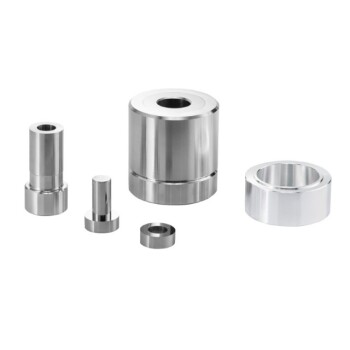
The high-pressure pellet press acts as the critical bridge between raw waste and usable energy. Its primary function is to apply intense mechanical pressure to loose Municipal Solid Waste (MSW), compacting it into pellets or briquettes with high density, specific geometric shapes, and significant mechanical strength.
Core Takeaway By transforming variable waste into a standardized fuel form, the high-pressure press solves two fundamental problems: it drastically improves logistics through higher volumetric energy density and ensures the operational stability required for efficient gasification or incineration.
The Transformation of Feedstock
Creating Mechanical Strength
Loose MSW is inherently inconsistent and fragile. A high-pressure press forces this material into a solid state, creating pellets with high mechanical strength.
This strength is vital for durability. It ensures the fuel does not disintegrate back into loose waste during handling or processing.
Defining Geometric Consistency
The press does not just squash the material; it shapes it. It produces pellets or briquettes with specific geometric shapes.
This uniformity is impossible to achieve with loose waste. It turns a heterogeneous pile of trash into a homogenous product.
Solving Logistical Challenges
Increasing Volumetric Energy Density
One of the biggest hurdles in using MSW is its low density. The pellet press substantially increases the volumetric energy density of the fuel.
This means you can pack significantly more potential energy into the same amount of space.
Optimizing Transportation and Storage
Because the density is higher, the fuel becomes far more economical to manage.
Pelletization facilitates easier transportation and storage. You effectively reduce the physical footprint of your fuel inventory, lowering the costs associated with moving and housing the material.
Ensuring Downstream Process Stability
Guaranteeing Physical Consistency
Industrial energy converters, such as gasifiers and incinerators, rely on predictable inputs. The pellet press ensures the physical consistency of the feedstock.
Without this step, the variable nature of loose MSW would cause fluctuations in the system, leading to inefficiencies.
Maintaining Steady-State Operation
Consistency in the fuel leads to consistency in the reaction. Using pellets allows for steady-state operation during complex thermochemical processes like pyrolysis or gasification.
This stability helps operators maintain optimal temperatures and reaction rates, preventing system upsets caused by inconsistent fuel quality.
Understanding the Trade-offs
Energy Investment vs. Fuel Quality
While essential for quality, high-pressure pelletization is an energy-intensive process. You are effectively "investing" mechanical energy into the waste to upgrade its physical properties.
Equipment Complexity
Introducing a high-pressure system adds a layer of mechanical complexity to the RDF production line. This requires robust maintenance protocols to manage the wear and tear associated with compressing abrasive waste materials.
Making the Right Choice for Your Goal
To determine how to best integrate a pellet press into your workflow, consider your primary operational targets:
- If your primary focus is logistics and distribution: Prioritize maximum compaction density to minimize transportation costs and storage footprint.
- If your primary focus is process efficiency: Prioritize geometric uniformity to ensure steady-state reactions in your gasifier or incinerator.
The pellet press is not just a compactor; it is a standardization tool that turns waste liability into a reliable energy asset.
Summary Table:
| Feature | Impact of High-Pressure Press | Benefit for RDF Production |
|---|---|---|
| Physical Form | Loose MSW to Rigid Pellets | High mechanical strength; prevents disintegration during handling |
| Geometry | Uniform shapes & sizes | Consistent feedstock for stable gasification and incineration |
| Density | Increased Volumetric Energy Density | Significantly reduces storage space and transportation costs |
| Process Stability | Homogenous Fuel Input | Maintains steady-state operation and optimal reaction rates |
Elevate Your Waste-to-Energy Efficiency with KINTEK
Maximize the potential of your Refuse Derived Fuel (RDF) production with KINTEK’s precision-engineered hydraulic presses and crushing systems. Our robust equipment is designed to handle the toughest Municipal Solid Waste, transforming inconsistent feedstock into high-density, high-strength pellets that optimize your downstream gasification and storage logistics.
Whether you need advanced pellet presses, milling systems, or specialized lab equipment for battery and material research, KINTEK provides the reliability and technical expertise required for high-performance operations.
Ready to standardize your fuel quality and lower logistical costs? Contact our experts today to find the perfect solution for your lab or production line!
References
- Izabela S. Pieta, Ewa M. Serwicka. Waste into Fuel—Catalyst and Process Development for MSW Valorisation. DOI: 10.3390/catal8030113
This article is also based on technical information from Kintek Solution Knowledge Base .
Related Products
- kbr pellet press 2t
- Automatic Laboratory Hydraulic Press for XRF & KBR Pellet Press
- Laboratory Hydraulic Press Lab Pellet Press Machine for Glove Box
- Laboratory Hydraulic Pellet Press for XRF KBR FTIR Lab Applications
- Automatic Laboratory Hydraulic Pellet Press Machine for Lab Use
People Also Ask
- How do you prepare samples for IR spectroscopy? A Step-by-Step Guide for Solids, Liquids, and Gases
- What measurement methods are commonly used for powder samples in infrared spectroscopy? Optimize Your FTIR Analysis
- Why KBr is used in IR spectrophotometry? A Key to Transparent Sample Analysis
- How are a KBr pellet press and mortar utilized in FTIR analysis of activated carbon? Expert Sample Prep Guide
- How do you prepare KBr pellets for FTIR analysis? Master the Technique for High-Quality IR Spectra