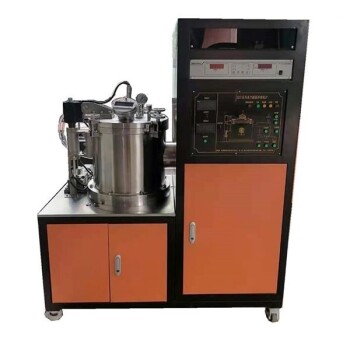
A high vacuum annealing furnace is the critical standard for heat-treating irradiated material samples because it eliminates environmental interference. By maintaining extremely low residual gas levels, it prevents surface oxidation and hydrogen absorption, ensuring that the sample's chemical composition remains unaltered during high-temperature exposure.
Core Insight: In the study of irradiated materials, experimental isolation is paramount. A high vacuum environment guarantees that any observed microstructural changes—specifically the growth of defects like helium bubbles—are driven purely by thermal dynamics, rather than by chemical reactions with the surrounding atmosphere.
The Necessity of Environmental Control
Eliminating Surface Oxidation
When materials are heated to high temperatures (such as 500°C or higher), they become highly reactive to oxygen.
Without a vacuum, oxygen in the air reacts with the sample surface.
This oxidation obscures surface features and can alter the material properties, making it impossible to accurately observe the intrinsic effects of irradiation.
Preventing Hydrogen Absorption
Beyond simple oxidation, irradiated samples are susceptible to absorbing hydrogen from the environment.
Hydrogen absorption is a critical variable that must be controlled, as hydrogen can drastically change the microstructure and mechanical properties of the material.
A high vacuum furnace effectively removes these gases, preventing them from infiltrating the sample lattice.
Ensuring Data Integrity
Isolating Thermal Effects
The primary goal of annealing irradiated samples is often to observe how radiation-induced defects evolve under heat.
Researchers specifically look for phenomena such as the nucleation and growth of helium bubbles.
By removing environmental variables, you ensure these changes are caused solely by the thermal energy applied, not by external chemical triggers.
Validating Defect Evolution
To build accurate predictive models of material behavior, the cause-and-effect relationship must be clear.
If a sample reacts with air or water vapor during heating, the resulting microstructure is a hybrid of irradiation damage and corrosion.
High vacuum processing ensures the "baseline" remains pure, allowing for precise observation of defect evolution.
Understanding the Trade-offs
High Vacuum vs. Controlled Atmosphere
While a high vacuum is ideal for studying surface defects and preventing hydrogen uptake, it is resource-intensive.
Controlled atmosphere furnaces (using inert gases like Argon) are often used for general annealing of alloys like 304 stainless steel to prevent decarburization.
However, for irradiated samples where specific defect tracking (like helium bubbles) is the goal, an inert gas atmosphere may not provide the extreme purity required to rule out all microscopic surface interactions.
Process Complexity
Achieving and maintaining a high vacuum adds complexity to the experimental setup compared to standard atmospheric furnaces.
It requires rigorous seal integrity and sophisticated pumping systems.
Despite the added effort, this complexity is a necessary "cost" for obtaining valid, publication-grade data on irradiation effects.
Making the Right Choice for Your Research
If you are designing an experiment involving heat treatment, select your furnace environment based on your specific analytical needs:
- If your primary focus is observing micro-defects (e.g., Helium bubbles): You must use a high vacuum furnace to ensure changes are driven solely by thermal effects without chemical interference.
- If your primary focus is bulk standardization (e.g., 304 SS base structure): A controlled atmosphere furnace (Argon) may suffice to prevent general oxidation and decarburization.
Ultimately, the high vacuum environment acts as a shield, preserving the scientific validity of your irradiation data against the chaos of atmospheric chemistry.
Summary Table:
| Feature | High Vacuum Annealing | Controlled Atmosphere (Inert Gas) |
|---|---|---|
| Primary Goal | Isolate thermal effects & observe micro-defects | General bulk standardization & prevent scaling |
| Surface Protection | Eliminates oxidation & gas absorption | Minimizes surface oxidation and decarburization |
| Ideal For | Helium bubble growth, defect evolution | Alloy tempering, stress relieving 304 SS |
| Data Validity | Highest: eliminates chemical interference | Moderate: potential for trace gas interactions |
| System Complexity | High: Requires specialized pumping & seals | Moderate: Requires gas flow & pressure control |
Advance Your Irradiation Research with KINTEK Precision
When studying the evolution of micro-defects and helium bubbles, your experimental integrity depends on a contamination-free environment. KINTEK specializes in high-performance laboratory equipment, providing the advanced high-temperature vacuum furnaces and high-pressure reactors necessary to eliminate atmospheric interference and isolate pure thermal dynamics.
From precise muffle and tube furnaces to specialized CVD systems and crushing equipment, we offer a comprehensive range of solutions for materials science and battery research. Our team understands the critical nature of irradiation data—let us help you maintain a pure scientific baseline.
Ready to elevate your research results? Contact KINTEK today to discuss your furnace specifications and find the perfect heating solution for your lab.
References
- А.S. Kalchenko, G.D. Tolstolutskaya. COMPARATIVE STUDY OF HELIUM BUBBLE FORMATION IN Cr-Fe-Ni-Mn HIGH-ENTROPY ALLOY AND 18Cr10NiTi STEELAFTER IRRADIATION AND POST-IRRADIATION ANNEALING. DOI: 10.46813/2019-123-025
This article is also based on technical information from Kintek Solution Knowledge Base .
Related Products
- Vacuum Heat Treat Furnace with Ceramic Fiber Liner
- Laboratory High Pressure Vacuum Tube Furnace
- Vacuum Heat Treat and Pressure Sintering Furnace for High Temperature Applications
- Ultra-High Temperature Graphite Vacuum Graphitization Furnace
- 2200 ℃ Tungsten Vacuum Heat Treat and Sintering Furnace
People Also Ask
- What is a vacuum heat treatment furnace? The Ultimate Guide to Controlled Atmosphere Processing
- What is a vacuum heat treatment furnace? Achieve Unmatched Purity and Control
- What is vacuum heat treatment process? Achieve Superior Control, Cleanliness, and Quality
- How does a vacuum heat treatment work? Achieve Superior Material Properties in a Pristine Environment
- What is the temperature of vacuum heat treatment? Achieve Superior Material Properties & Pristine Finishes