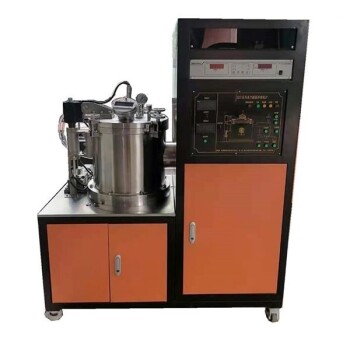
High vacuum is essential for preserving the chemical integrity of the material surface. To conduct valid annealing experiments on ferritic alloys (such as FeCrAl and 14YWT) at 1100°C, you must utilize a high vacuum furnace capable of maintaining a pressure better than 2 x 10^-4 mbar. This ultra-low oxygen environment is the only reliable way to prevent severe oxidation and decarburization during long-duration heat treatments.
Core Takeaway The scientific validity of these experiments relies on isolating internal microstructural changes from external environmental attacks. A high vacuum ensures that observed grain growth is dictated strictly by internal factors, such as nano-oxide pinning, rather than by surface degradation caused by atmospheric exposure.
Preserving Material Chemistry
Preventing Oxidation and Decarburization
At 1100°C, ferritic alloys are highly reactive to trace elements in the atmosphere. Without a controlled environment, oxygen and carbon react with the alloy surface, leading to severe oxidation and decarburization.
The Threshold for Purity
Standard annealing environments are insufficient for this level of heat. The furnace must achieve a vacuum better than 2 x 10^-4 mbar to sufficiently lower the oxygen partial pressure.
Protecting Alloy Composition
Specific alloys, such as FeCrAl and 14YWT, rely on precise chemical balances to function. High vacuum prevents the depletion of alloying elements that would occur if surface reactions were allowed to proceed unchecked.
Ensuring Data Validity
Isolating Internal Mechanisms
The goal of these experiments is often to study how internal features, specifically nano-oxides, pin grain boundaries and control growth. If the surface oxidizes, it introduces external variables that obscure these internal effects.
Accurate Texture Evolution
Microstructural evolution and texture development must be driven by thermodynamic equilibrium within the alloy. A high vacuum eliminates "environmental noise," ensuring the resulting data reflects the material's intrinsic properties.
Eliminating Processing Stress
Beyond surface protection, the vacuum environment promotes the diffusion of alloying elements and helps eliminate internal stresses generated during prior processing. This results in a "cleaner" baseline for studying mechanical properties and elongation.
Understanding the Trade-offs
Vacuum vs. Inert Gas
While high-temperature atmosphere furnaces using Argon protection can prevent oxidation for some applications, they may not offer the same level of purity as a high vacuum for sensitive ferritic alloys. The vacuum actively encourages degassing, whereas inert gas simply displaces reactive air.
The Cost of Complexity
Achieving and maintaining a vacuum of 2 x 10^-4 mbar at 1100°C requires specialized equipment and rigorous maintenance. It is a more resource-intensive process than standard atmospheric annealing but is non-negotiable for high-fidelity surface studies.
Making the Right Choice for Your Goal
To ensure your annealing experiments yield publication-grade data, align your furnace choice with your specific research objectives.
- If your primary focus is surface chemistry analysis: Prioritize a vacuum better than 2 x 10^-4 mbar to guarantee that no oxidation or decarburization skews your surface measurements.
- If your primary focus is studying internal grain kinetics: Use high vacuum to ensure that grain growth is restricted only by internal pinning forces, not by a rigid oxide shell formed during heating.
By controlling the atmosphere, you transform the furnace from a simple heater into a precision instrument for isolating microstructural physics.
Summary Table:
| Feature | Requirement for Ferritic Alloys (1100°C) | Benefit |
|---|---|---|
| Vacuum Level | Better than 2 x 10^-4 mbar | Prevents oxidation and decarburization |
| Surface Integrity | Ultra-low oxygen environment | Protects alloy composition and chemical balance |
| Data Validity | Isolate internal microstructural kinetics | Accurate mapping of nano-oxide pinning effects |
| Environment | High Vacuum vs. Inert Gas | Vacuum promotes degassing and removes trace impurities |
Elevate Your Material Research with KINTEK Precision
Don't let surface oxidation compromise your microstructural data. KINTEK specializes in high-performance laboratory equipment, providing the high-temperature vacuum furnaces and CVD systems necessary to achieve the ultra-low pressures required for sensitive ferritic alloy experiments.
Whether you need reliable muffle and tube furnaces, advanced isostatic hydraulic presses, or precision ceramics and crucibles, our solutions are designed to deliver the chemical integrity your research demands.
Ready to isolate your microstructural physics from environmental noise? Contact our laboratory experts today to find the perfect vacuum system for your 1100°C+ applications.
References
- Eda Aydogan, S.A. Maloy. Effect of High-Density Nanoparticles on Recrystallization and Texture Evolution in Ferritic Alloys. DOI: 10.3390/cryst9030172
This article is also based on technical information from Kintek Solution Knowledge Base .
Related Products
- Laboratory High Pressure Vacuum Tube Furnace
- Ultra-High Temperature Graphite Vacuum Graphitization Furnace
- 2200 ℃ Graphite Vacuum Heat Treat Furnace
- 2200 ℃ Tungsten Vacuum Heat Treat and Sintering Furnace
- Horizontal High Temperature Graphite Vacuum Graphitization Furnace
People Also Ask
- What is the role of a high-vacuum tube furnace in preparing Co3S4@NiS2/C composite materials? Expert Synthesis Insights
- What role does a high-vacuum tube furnace play in synthesizing manganese nitride? Achieve Precise Phase & Stoichiometry.
- What is the primary function of a high-vacuum tube furnace in CVD synthesis of Sb-doped Bi2Se3? Precision Growth Control
- Role of High-Pressure Tube Furnace in Ru/OMC Synthesis: Achieve Precise Reduction & Nanostructure Control
- What is the primary function of a high-pressure tube furnace in the preparation of Laver biochar? Expert Pyrolysis Guide