Knowledge Why is a high vacuum furnace used for the homogenization of 3D-printed alloy libraries before corrosion testing? - FAQ
Author avatar

Tech Team · Kintek Solution

Updated 2 days ago

Why is a high vacuum furnace used for the homogenization of 3D-printed alloy libraries before corrosion testing? - FAQ


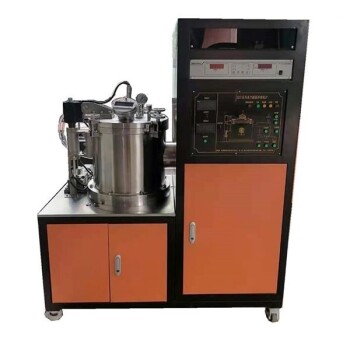
A high vacuum furnace is essential for processing 3D-printed alloy libraries because it allows for high-temperature homogenization while preventing surface oxidation. By creating a low-pressure environment (down to 10⁻⁶ torr) at temperatures around 1000 °C, it effectively eliminates the structural defects inherent to 3D printing without chemically altering the material's surface.

The core purpose of using high vacuum is to achieve a stable, single-phase microstructure free of printing defects. This ensures that subsequent corrosion tests measure the true properties of the alloy composition, rather than artifacts caused by segregation, stress, or heat-induced oxidation.

The Challenge of 3D-Printed Microstructures

Eliminating Dendritic Segregation

3D printing, or additive manufacturing, involves rapid cooling that often results in dendritic segregation. This is a microscopic separation of elements within the alloy.

To fix this, the material must be heated to high temperatures (e.g., 1000 °C). This allows the internal distribution of alloy elements to diffuse and reach a thermodynamic equilibrium state.

Relieving Residual Stresses

The additive manufacturing process creates significant internal tension known as residual stress. These stresses can skew experimental data and affect the mechanical integrity of the sample.

High-temperature treatment relaxes the material structure. This effectively resets the internal physical state of the alloy before testing begins.

Why the Vacuum Environment is Critical

Preventing Surface Oxidation

Heating a metal to 1000 °C in a standard atmosphere would cause immediate and severe surface oxidation. This oxide layer would fundamentally alter the surface chemistry of the alloy.

A high vacuum furnace removes air and contaminants, reducing pressure to 10⁻⁶ torr. This allows the necessary heat treatment to occur while keeping the surface pristine for corrosion experiments.

Ensuring Data Accuracy

Corrosion testing requires a baseline of consistency to be valid. If the sample has varying phases or surface oxides, the resulting kinetics data will be unreliable.

By ensuring a stable single-phase solid solution microstructure, the vacuum process guarantees the accuracy and repeatability of the corrosion data collected later.

Understanding the Trade-offs

Process Time and Complexity

Achieving a high vacuum of 10⁻⁶ torr adds significant time and complexity compared to standard heat treatment. The system must pump down for extended periods before heating can begin to ensure the environment is truly protective.

Equipment Sensitivity

Vacuum furnaces are sensitive to contamination. Any outgassing from the 3D-printed parts (such as binder residues or trapped pockets of gas) can degrade the vacuum level, potentially compromising the "clean" environment required for perfect homogenization.

Making the Right Choice for Your Experiment

To ensure your corrosion testing yields valid scientific data, consider the following based on your specific goals:

  • If your primary focus is microstructural uniformity: Ensure your treatment temperature is sufficient to dissolve dendritic structures and achieve a single-phase solid solution.
  • If your primary focus is surface chemistry integrity: Verify that the vacuum level is maintained at or below 10⁻⁶ torr to strictly prevent oxidation during the heating cycle.

By isolating the alloy from atmospheric interference, you transform a variable-heavy printed part into a reliable scientific sample.

Summary Table:

Feature Benefit for 3D-Printed Alloys Impact on Corrosion Testing
High Vacuum (10⁻⁶ torr) Prevents surface oxidation at 1000 °C Ensures pristine surface for accurate chemical analysis
High-Temp Diffusion Eliminates dendritic segregation Creates stable, single-phase microstructure
Thermal Relaxation Relieves internal residual stresses Removes structural artifacts that skew data
Atmosphere Control Removes air and contaminants Guarantees repeatability and data integrity

Elevate Your Materials Research with KINTEK

Achieving precise homogenization for 3D-printed alloy libraries requires the highest standards in thermal processing. KINTEK specializes in advanced laboratory equipment, offering a comprehensive range of high-temperature furnaces (vacuum, muffle, tube, and atmosphere) designed to deliver the oxidation-free environments your research demands.

From high-pressure reactors and crushing and milling systems to pellet presses and PTFE consumables, our portfolio is engineered to support every stage of your material characterization. Our solutions ensure your samples are free from printing artifacts, allowing you to measure the true properties of your alloy compositions.

Ready to transform your variable-heavy printed parts into reliable scientific samples?

Contact KINTEK Experts Today to find the perfect heating solution for your lab’s precision requirements.

References

  1. Yafei Wang, Adrien Couet. Integrated High‐Throughput and Machine Learning Methods to Accelerate Discovery of Molten Salt Corrosion‐Resistant Alloys. DOI: 10.1002/advs.202200370

This article is also based on technical information from Kintek Solution Knowledge Base .

Related Products

People Also Ask

Related Products

Vacuum Heat Treat Sintering Brazing Furnace

Vacuum Heat Treat Sintering Brazing Furnace

A vacuum brazing furnace is a type of industrial furnace used for brazing, a metalworking process that joins two pieces of metal using a filler metal that melts at a lower temperature than the base metals. Vacuum brazing furnaces are typically used for high-quality applications where a strong, clean joint is required.

Vacuum Heat Treat Furnace with Ceramic Fiber Liner

Vacuum Heat Treat Furnace with Ceramic Fiber Liner

Vacuum furnace with polycrystalline ceramic fiber insulation liner for excellent heat insulation and uniform temperature field. Choose from 1200℃ or 1700℃ max. working temperature with high vacuum performance and precise temperature control.

Molybdenum Vacuum Heat Treat Furnace

Molybdenum Vacuum Heat Treat Furnace

Discover the benefits of a high-configuration molybdenum vacuum furnace with heat shield insulation. Ideal for high-purity, vacuum environments like sapphire crystal growth and heat treatment.

2200 ℃ Tungsten Vacuum Heat Treat and Sintering Furnace

2200 ℃ Tungsten Vacuum Heat Treat and Sintering Furnace

Experience the ultimate refractory metal furnace with our Tungsten vacuum furnace. Capable of reaching 2200℃, perfect for sintering advanced ceramics and refractory metals. Order now for high-quality results.

Vacuum Heat Treat and Molybdenum Wire Sintering Furnace for Vacuum Sintering

Vacuum Heat Treat and Molybdenum Wire Sintering Furnace for Vacuum Sintering

A vacuum molybdenum wire sintering furnace is a vertical or bedroom structure, which is suitable for withdrawal, brazing, sintering and degassing of metal materials under high vacuum and high temperature conditions. It is also suitable for dehydroxylation treatment of quartz materials.

2200 ℃ Graphite Vacuum Heat Treat Furnace

2200 ℃ Graphite Vacuum Heat Treat Furnace

Discover the power of the KT-VG Graphite Vacuum Furnace - with a maximum working temperature of 2200℃, it's perfect for vacuum sintering of various materials. Learn more now.

Vacuum Heat Treat and Sintering Furnace with 9MPa Air Pressure

Vacuum Heat Treat and Sintering Furnace with 9MPa Air Pressure

The air pressure sintering furnace is a high-tech equipment commonly used for the sintering of advanced ceramic materials. It combines vacuum sintering and pressure sintering techniques to achieve high-density and high-strength ceramics.

1400℃ Controlled Atmosphere Furnace with Nitrogen and Inert Atmosphere

1400℃ Controlled Atmosphere Furnace with Nitrogen and Inert Atmosphere

Achieve precise heat treatment with KT-14A controlled atmosphere furnace. Vacuum sealed with a smart controller, it's ideal for lab and industrial use up to 1400℃.

Vacuum Hot Press Furnace Heated Vacuum Press Machine Tube Furnace

Vacuum Hot Press Furnace Heated Vacuum Press Machine Tube Furnace

Reduce forming pressure & shorten sintering time with Vacuum Tube Hot Press Furnace for high-density, fine-grain materials. Ideal for refractory metals.

Graphite Vacuum Furnace High Thermal Conductivity Film Graphitization Furnace

Graphite Vacuum Furnace High Thermal Conductivity Film Graphitization Furnace

The high thermal conductivity film graphitization furnace has uniform temperature, low energy consumption and can operate continuously.

Vacuum Dental Porcelain Sintering Furnace

Vacuum Dental Porcelain Sintering Furnace

Get precise and reliable results with KinTek's Vacuum Porcelain Furnace. Suitable for all porcelain powders, it features hyperbolic ceramic furnace function, voice prompt, and automatic temperature calibration.

600T Vacuum Induction Hot Press Furnace for Heat Treat and Sintering

600T Vacuum Induction Hot Press Furnace for Heat Treat and Sintering

Discover the 600T Vacuum Induction Hot Press Furnace, designed for high-temperature sintering experiments in vacuum or protected atmospheres. Its precise temperature and pressure control, adjustable working pressure, and advanced safety features make it ideal for nonmetal materials, carbon composites, ceramics, and metal powders.

1200℃ Controlled Atmosphere Furnace Nitrogen Inert Atmosphere Furnace

1200℃ Controlled Atmosphere Furnace Nitrogen Inert Atmosphere Furnace

Discover our KT-12A Pro Controlled atmosphere furnace - high precision, heavy duty vacuum chamber, versatile smart touch screen controller, and excellent temperature uniformity up to 1200C. Ideal for both laboratory and industrial application.

Vacuum Hot Press Furnace Machine Heated Vacuum Press

Vacuum Hot Press Furnace Machine Heated Vacuum Press

Discover the advantages of Vacuum Hot Press Furnace! Manufacture dense refractory metals & compounds, ceramics, and composites under high temp and pressure.

Laboratory Vacuum Tilt Rotary Tube Furnace Rotating Tube Furnace

Laboratory Vacuum Tilt Rotary Tube Furnace Rotating Tube Furnace

Discover the versatility of Laboratory Rotary Furnace: Ideal for calcination, drying, sintering, and high-temperature reactions. Adjustable rotating and tilting functions for optimal heating. Suitable for vacuum and controlled atmosphere environments. Learn more now!

Horizontal High Temperature Graphite Vacuum Graphitization Furnace

Horizontal High Temperature Graphite Vacuum Graphitization Furnace

Horizontal Graphitization Furnace: This type of furnace is designed with the heating elements placed horizontally, allowing for uniform heating of the sample. It's well-suited for graphitizing large or bulky samples that require precise temperature control and uniformity.

1700℃ Controlled Atmosphere Furnace Nitrogen Inert Atmosphere Furnace

1700℃ Controlled Atmosphere Furnace Nitrogen Inert Atmosphere Furnace

KT-17A Controlled atmosphere furnace: 1700℃ heating, vacuum sealing technology, PID temperature control, and versatile TFT smart touch screen controller for laboratory and industrial use.

Ultra-High Temperature Graphite Vacuum Graphitization Furnace

Ultra-High Temperature Graphite Vacuum Graphitization Furnace

The ultra-high temperature graphitization furnace utilizes medium frequency induction heating in a vacuum or inert gas environment. The induction coil generates an alternating magnetic field, inducing eddy currents in the graphite crucible, which heats up and radiates heat to the workpiece, bringing it to the desired temperature. This furnace is primarily used for graphitization and sintering of carbon materials, carbon fiber materials, and other composite materials.

Vacuum Heat Treat Furnace and Levitation Induction Melting Furnace

Vacuum Heat Treat Furnace and Levitation Induction Melting Furnace

Experience precise melting with our Vacuum Levitation Melting Furnace. Ideal for high melting point metals or alloys, with advanced technology for effective smelting. Order now for high-quality results.

Laboratory Rapid Thermal Processing (RTP) Quartz Tube Furnace

Laboratory Rapid Thermal Processing (RTP) Quartz Tube Furnace

Get lightning-fast heating with our RTP Rapid Heating Tube Furnace. Designed for precise, high-speed heating and cooling with convenient sliding rail and TFT touch screen controller. Order now for ideal thermal processing!


Leave Your Message