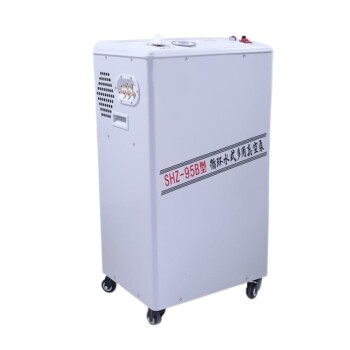
A high vacuum system is the prerequisite for obtaining valid data. It is essential for the degassing treatment applied to the absorption bulb, the crucible, and the aluminum sample itself before any testing begins. By thoroughly evacuating the system, you ensure that the testing environment is free from atmospheric contamination and residual volatiles.
The core purpose of the high vacuum is to isolate the variable of interest. It guarantees that any measured changes in pressure or volume are caused solely by the aluminum sample absorbing hydrogen, rather than by the thermal expansion or chemical reaction of background gases.
Creating a Controlled Baseline
Pre-Experiment Degassing
Before hydrogen is introduced for equilibrium testing, the entire apparatus must be "cleaned" of air and impurities.
A high vacuum pump removes residual gases not just from the chamber, but also from the walls of the absorption bulb and the crucible.
Crucially, the aluminum sample itself is degassed to ensure it starts from a neutral state.
Eliminating Signal Interference
The measurement of hydrogen solubility relies on detecting very subtle changes in the system's state.
If residual gases are present, they will expand or contract with temperature changes, creating "noise" in the data.
A high vacuum environment removes these variables, ensuring that observed pressure fluctuations correlate directly to hydrogen uptake.
Common Pitfalls to Avoid
The Risk of Partial Evacuation
Failing to achieve a sufficiently high vacuum is a primary source of experimental error.
If the system is only partially evacuated, impurity gases remain active within the test chamber.
This leads to skewed results, where the data reflects a mixture of gas behaviors rather than the true solubility characteristics of the aluminum alloy.
Ignoring Component Outgassing
It is a mistake to focus only on the sample while ignoring the hardware.
The crucible and the absorption bulb can release adsorbed gases when heated.
A high vacuum system must be used to treat these components strictly before the experiment to prevent them from contaminating the results mid-test.
Ensuring Accuracy in Your Measurements
If your primary focus is Data Purity:
- Ensure the vacuum system runs long enough to fully degas the crucible and bulb, not just the chamber air.
If your primary focus is Process Reliability:
- Monitor vacuum levels to confirm no leaks exist that could reintroduce atmospheric gases during the heating phase.
High vacuum is not merely a preparation step; it is the control mechanism that validates the entire solubility experiment.
Summary Table:
| Feature | Requirement | Impact on Measurement Accuracy |
|---|---|---|
| Pre-Test Degassing | Absorption bulb, crucible, and sample | Eliminates background volatiles that skew pressure readings. |
| Atmospheric Isolation | Removal of air and impurities | Prevents chemical reactions or thermal expansion of residual gases. |
| Signal-to-Noise Ratio | High vacuum baseline | Ensures observed pressure changes correlate solely to hydrogen uptake. |
| System Integrity | Leak-free high vacuum environment | Validates that no atmospheric gases re-enter during the heating phase. |
Elevate Your Material Research with Precision Engineering
Achieving valid data in hydrogen solubility studies requires more than just an experiment—it requires a controlled environment. KINTEK specializes in high-performance laboratory equipment designed to meet the rigorous demands of aluminum alloy research. From advanced high-temperature vacuum furnaces and rotary systems to specialized crucibles and ceramics, our solutions ensure your testing environment is free from contamination.
Whether you are refining battery research, developing aerospace alloys, or optimizing casting processes, KINTEK provides the high-vacuum technology and essential consumables you need for flawless execution.
Ready to eliminate experimental noise and achieve superior data purity? Contact KINTEK today to find the perfect vacuum system for your laboratory.
References
- P. N. Anyalebechi. Hydrogen Solubility in Liquid and Solid Pure Aluminum—Critical Review of Measurement Methodologies and Reported Values. DOI: 10.4236/msa.2022.134011
This article is also based on technical information from Kintek Solution Knowledge Base .
Related Products
- 304 316 Stainless Steel Vacuum Ball Valve Stop Valve for High Vacuum Systems
- Ultra-High Vacuum Flange Aviation Plug Glass Sintered Airtight Circular Connector for KF ISO CF
- KF/ISO/CF Ultra-High Vacuum Stainless Steel Flange Pipe/Straight Pipe/Tee/Cross
- CF Ultra-High Vacuum Observation Window Stainless Steel Flange Sapphire Glass Sight Glass
- KF Ultra-High Vacuum Observation Window Stainless Steel Flange Sapphire Glass Sight Glass
People Also Ask
- What is high vacuum used for? Essential for Particle Beams and Advanced Lab Instruments
- Why is a high vacuum system essential during the monitoring of volatiles in the graphite expansion process? Ensure Precision
- Why are Viton O-rings utilized for sealing in carbochlorination experimental setups? Ensure Safety and Seal Integrity
- Why must a laboratory vacuum pump be used to evacuate a PM-HIP capsule before it is sealed? Ensure Material Integrity
- What is the relationship between temperature and pressure in a vacuum? Mastering Thermal Control for Optimal Vacuum Performance