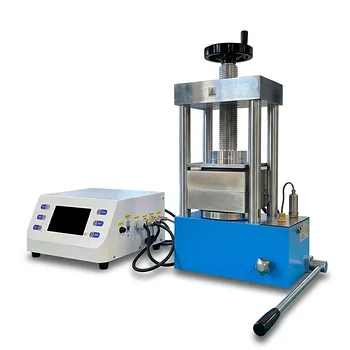
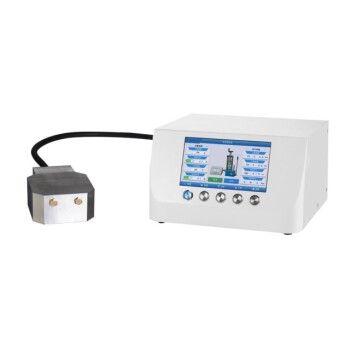
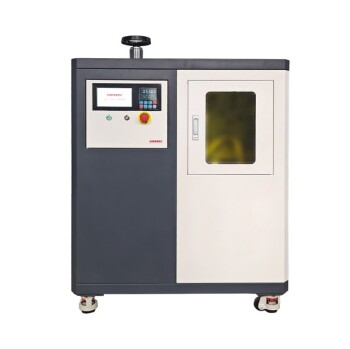
A hot press machine is the critical tool used to establish a cohesive interface between the carbon cloth electrode (coated with a manganese dioxide catalyst) and the proton exchange membrane (PEM). This thermal pressing process eliminates microscopic gaps to create a tight physical bond, ensuring the two components act as a unified system rather than separate layers.
The core function of the hot press machine is to drastically reduce contact resistance. By optimizing the physical connection, it enables efficient proton transport, directly resulting in higher power output and increased sensor sensitivity.
The Physics of Interface Bonding
Creating a Tight Physical Bond
The interface between the catalyst layer and the membrane is the most critical junction in the cathode assembly. Simply placing the carbon cloth against the PEM often results in poor surface contact. Hot pressing applies heat and force to fuse the catalyst-coated electrode directly to the membrane structure.
Reducing Contact Resistance
Electrical and ionic resistance are the enemies of efficiency in fuel cells. When the bond is loose, resistance spikes, wasting energy as heat. The thermal pressing process ensures the contact area is maximized, thereby significantly reducing contact resistance between the electrode and the membrane.
Impact on Electrochemical Performance
Facilitating Proton Transport
For a Microbial Fuel Cell (MFC) to function, protons must migrate from the anode, through the membrane, to the cathode's catalytic sites. A poor bond acts as a bottleneck for this movement. Hot pressing clears this path, improving the transport of protons across the membrane boundary.
Enhancing Power and Sensitivity
The efficiency of proton transport dictates the overall performance of the cell. By optimizing this transport, the cell can generate increased output power. Furthermore, for applications where the MFC acts as a sensor, this tight bond improves response sensitivity, allowing the device to detect changes in organic matter more accurately.
Critical Considerations
The Cost of Poor Bonding
It is important to understand that skipping this step or applying insufficient pressure leads to interface failure. Without the reduction in contact resistance provided by hot pressing, the voltage losses will be substantial. The system will suffer from sluggish proton transfer, rendering the sensor slow to react and the power output negligible.
Optimizing Your Cathode Fabrication
To ensure you are getting the most out of your MFC setup, consider your specific performance targets:
- If your primary focus is maximum power generation: Ensure the hot press parameters facilitate the lowest possible contact resistance to prevent voltage loss.
- If your primary focus is sensor accuracy: Prioritize a uniform bond to ensure rapid proton transport, which correlates directly to high response sensitivity.
By mechanically and thermally integrating these layers, you transform two separate components into a high-efficiency electrochemical interface.
Summary Table:
| Key Feature | Benefit of Hot Pressing |
|---|---|
| Interface Quality | Eliminates microscopic gaps for a tight physical bond |
| Electrical Performance | Drastically reduces contact resistance between layers |
| Ionic Conductivity | Facilitates faster and more efficient proton transport |
| System Output | Increases maximum power generation and voltage stability |
| Sensor Accuracy | Enhances response sensitivity to organic matter changes |
Elevate Your Electrochemical Research with KINTEK Precision
Achieving the perfect interface in Microbial Fuel Cell (MFC) fabrication requires the exact balance of heat and pressure. KINTEK specializes in advanced hydraulic presses (pellet, hot, and isostatic) and laboratory equipment designed to minimize contact resistance and maximize your research output.
Whether you are developing high-output power systems or ultra-sensitive biosensors, our comprehensive range of tools—from high-temperature furnaces to specialized battery research consumables—ensures your lab is equipped for success.
Ready to optimize your cathode bonding process? Contact our technical experts today to find the ideal hot press solution for your laboratory.
References
- Shailesh Kharkwal, How Yong Ng. Development and Long-Term Stability of a Novel Microbial Fuel Cell BOD Sensor with MnO2 Catalyst. DOI: 10.3390/ijms18020276
This article is also based on technical information from Kintek Solution Knowledge Base .
Related Products
- Automatic Heated Hydraulic Press Machine with Heated Plates for Laboratory Hot Press 25T 30T 50T
- 30T 40T Split Automatic Heated Hydraulic Press Machine with Heated Plates for Laboratory Hot Press
- Automatic Heated Hydraulic Press Machine with Heated Plates for Laboratory Hot Press
- Automatic High Temperature Heated Hydraulic Press Machine with Heated Plates for Lab
- 24T 30T 60T Heated Hydraulic Press Machine with Heated Plates for Laboratory Hot Press
People Also Ask
- Why is the heating function of a laboratory hydraulic press essential for MEA assembly in DEFC? Optimize Cell Bonding
- What technical conditions does a heated hydraulic press provide for PEO batteries? Optimize Solid-State Interfaces
- How is a heated hydraulic press used for Li-LLZO batteries? Optimize Interfacial Bonding with Thermal-Pressure
- What role does a heated hydraulic press play in Cold Sintering (CSP)? Enhancing LATP-Halide Densification
- What are heated hydraulic presses used for? Molding Composites, Vulcanizing Rubber, and More