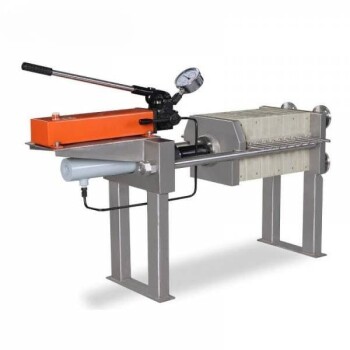
A hydraulic press is used to mechanically induce specific microstructural defects prior to heat treatment to ensure the coating retains its hardness. By applying a compression rate of 15% to 40%, the press introduces high-density dislocations into the arc-sprayed coating, which serve as the foundation for long-term thermal stability.
The primary function of pre-deformation is to create internal barriers that prevent the coating's structure from relaxing or softening when exposed to high heat.
The Mechanism of Stabilization
Introducing High-Density Dislocations
The hydraulic press exerts significant force to compress the coating material within a specific range.
This mechanical stress intentionally generates a high density of dislocations throughout the coating's structure.
Forming Barriers Against Movement
During the subsequent heat treatment, these mechanically induced dislocations serve a critical protective function.
They act as physical barriers that inhibit the movement of polygonal sub-boundaries.
By restricting this movement, the process prevents the microstructural changes that typically lead to softening.
Solving Thermal Stability Issues
Stabilizing Nano-Substructures
Standard heat treatment without pre-deformation can often degrade a coating's fine structure.
The combined process of deformation followed by heat treatment effectively stabilizes the nano-substructures.
This ensures the internal architecture of the material remains intact despite thermal stress.
Retaining Hardness at High Temperatures
This technique directly addresses the thermal stability issues common in traditional coatings.
The coating is able to maintain high hardness even when exposed to high temperatures for extended periods.
Testing confirms stability during exposures ranging from 90 to 180 minutes.
Critical Process Parameters
The Importance of the Compression Window
The effectiveness of this treatment relies strictly on adhering to the 15% to 40% compression rate.
Applying insufficient pressure will fail to generate the necessary density of dislocations to act as barriers.
Conversely, ignoring this step renders the subsequent heat treatment less effective for hardness retention.
Making the Right Choice for Your Goal
To maximize the performance of your arc-sprayed coatings, consider these specific applications:
- If your primary focus is High-Temperature Durability: Prioritize the pre-deformation step to "lock" the microstructure, ensuring hardness persists during 90-180 minute thermal cycles.
- If your primary focus is Process Consistency: Strictly calibrate your hydraulic equipment to maintain the 15% to 40% compression window, as this is the variable that dictates success.
By mechanically engineering the microstructure first, you ensure the coating survives the thermal environment that follows.
Summary Table:
| Process Step | Mechanism | Key Outcome |
|---|---|---|
| Pre-Deformation | 15% - 40% Compression rate | High-density dislocation generation |
| Microstructure | Dislocation barrier formation | Inhibits sub-boundary movement |
| Heat Treatment | Thermal exposure (90-180 min) | Stabilized nano-substructures |
| Final Result | Mechanical engineering | High hardness retention at high temps |
Maximize Material Performance with KINTEK Precision
Ensure your arc-sprayed coatings withstand the toughest thermal environments. KINTEK specializes in high-performance hydraulic presses (pellet, hot, isostatic) designed to deliver the precise compression rates required for effective pre-deformation. Whether you are stabilizing nano-substructures or seeking superior heat treatment results, our comprehensive range of laboratory equipment—from high-temperature furnaces to crushing and milling systems—is engineered to meet your exact research and production needs.
Ready to elevate your material stability? Contact KINTEK today to find the perfect hydraulic solution for your laboratory.
References
- O.V. Makhnenko, D.V. Kovalchuk. Modelling of temperature fields and stress-strain state of small 3D sample in its layer-by-layer forming. DOI: 10.15407/tpwj2017.03.02
This article is also based on technical information from Kintek Solution Knowledge Base .
Related Products
- Heated Hydraulic Press Machine with Heated Plates for Vacuum Box Laboratory Hot Press
- Automatic High Temperature Heated Hydraulic Press Machine with Heated Plates for Lab
- Manual High Temperature Heated Hydraulic Press Machine with Heated Plates for Lab
- Heated Hydraulic Press Machine with Integrated Manual Heated Plates for Lab Use
- 24T 30T 60T Heated Hydraulic Press Machine with Heated Plates for Laboratory Hot Press
People Also Ask
- Why is a heated laboratory hydraulic press necessary for composite laminates? Achieve Void-Free Structural Integrity
- What role does a heated hydraulic press play in Cold Sintering (CSP)? Enhancing LATP-Halide Densification
- What technical conditions does a heated hydraulic press provide for PEO batteries? Optimize Solid-State Interfaces
- What are heated hydraulic presses used for? Molding Composites, Vulcanizing Rubber, and More
- How is a heated hydraulic press used for Li-LLZO batteries? Optimize Interfacial Bonding with Thermal-Pressure