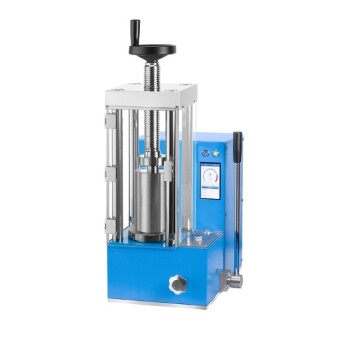
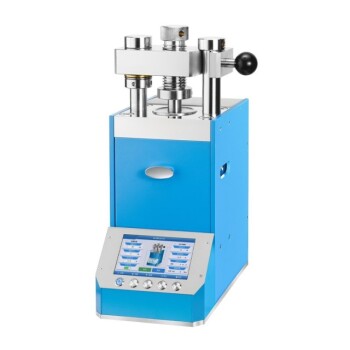
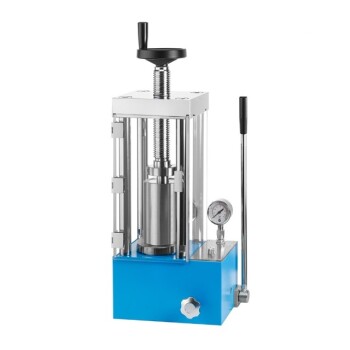
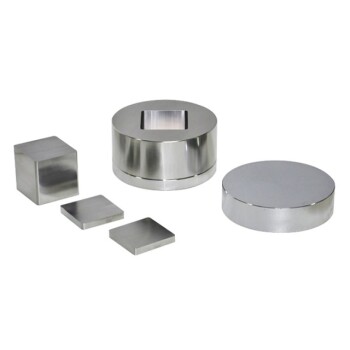
A laboratory cold press is the foundational tool used to prepare reactant materials for Self-propagating High-temperature Synthesis (SHS) by transforming loose powders into a conductive solid. Its specific purpose is to apply high uniaxial pressure to mixed powders, compressing them into cylindrical "green bodies" with a controlled density. This mechanical compression reduces the interstitial gaps between particles, creating the physical contact necessary for the reaction to function.
Core Takeaway The cold press is not just for shaping materials; it is a critical instrument for enabling thermodynamics. By compressing powders to a specific density, the press maximizes particle-to-particle contact, ensuring the heat transfer required to sustain the combustion wave and produce a stable, high-quality composite.
The Physics of Powder Compaction
Reducing Inter-Particle Gaps
The primary function of the cold press is to mechanically force powder particles closer together. In their loose state, reactant powders contain significant air gaps which act as thermal insulators.
Enhancing Contact Points
By applying high pressure, the press increases the surface area contact between individual particles. This contact is the physical bridge that allows energy to travel from one particle to the next.
Impact on Reaction Dynamics
Enabling Heat Transfer
The SHS process relies entirely on the material's ability to transfer heat ahead of the reaction front. The compressed green body created by the cold press ensures effective thermal conduction, without which the reaction would likely stall or fail to ignite.
Stabilizing the Combustion Wave
For the synthesis to be successful, a combustion wave must travel self-sustainably through the compact. The uniform density provided by the cold press ensures this wave propagates stably, rather than erratically, preventing incomplete reactions.
Forming Active Composites
Proper compression facilitates the preparation of highly active, non-equilibrium composite powders. The controlled environment of the green body allows for the precise formation of the desired chemical structure during the rapid heating phase.
Critical Process Variables
The Role of Relative Density
The press allows operators to achieve a specific relative density, often targeted around 0.5 (50% theoretical density). This specific density is a calculated variable, not a random outcome.
Defining Structure and Strength
The porosity and contact established during pressing directly influence the speed of the combustion wave. Consequently, the initial pressing parameters determine the skeletal structure and mechanical properties of the final porous ceramic product.
Understanding the Trade-offs
The Risk of Inconsistent Density
If the pressure applied is too low, the resulting green body will be too porous. This leads to poor heat transfer, causing the combustion wave to die out (extinguish) before the reaction is complete.
The Challenge of Over-Compression
While the references highlight the need for compression, precise control is vital. Deviating from the optimal density window can alter thermal conduction efficiency unpredictably, leading to non-uniform products or structural defects in the final ceramic.
Optimizing the Pre-Ignition Phase
The cold press is the control gate for the entire SHS experiment; the quality of the press determines the quality of the burn.
- If your primary focus is Reaction Stability: Ensure the cold press applies sufficient pressure to minimize gaps, guaranteeing the thermal conductivity needed for a steady combustion wave.
- If your primary focus is Product Morphology: Calibrate the press to achieve a precise relative density (e.g., 0.5), as this directly dictates the final porosity and mechanical strength of the ceramic.
Success in SHS begins before the ignition; it is determined by the precision of your powder compaction.
Summary Table:
| Factor | Role in SHS Process | Impact on Final Product |
|---|---|---|
| Particle Contact | Increases surface area contact for thermal bridge | Prevents reaction stalling or ignition failure |
| Relative Density | Targets specific density (approx. 0.5) | Determines skeletal structure and porosity |
| Inter-particle Gaps | Eliminates air gaps acting as insulators | Ensures uniform heat transfer and wave speed |
| Mechanical Pressure | Transforms loose powder into solid green body | Defines the mechanical strength of the ceramic |
Elevate Your Material Synthesis with KINTEK Precision
Precision in the pre-ignition phase is the key to successful Self-propagating High-temperature Synthesis (SHS). At KINTEK, we understand that the quality of your combustion wave starts with the quality of your compaction.
Our advanced laboratory hydraulic presses (pellet, hot, and isostatic) are engineered to provide the uniform uniaxial pressure required to achieve perfect green body density. Beyond compaction, KINTEK offers a comprehensive ecosystem for high-temperature research, including:
- High-Temperature Furnaces: Muffle, tube, vacuum, and CVD systems for post-synthesis treatment.
- Reaction Vessels: High-temperature high-pressure reactors and autoclaves.
- Sample Preparation: Crushing, milling, and sieving equipment for optimal powder sizing.
- Laboratory Consumables: High-purity ceramics, crucibles, and PTFE products.
Ready to achieve superior reaction stability and product morphology? Contact our technical experts today to find the perfect pressing and thermal solution for your laboratory.
References
- Menglin Zhang, Peizhong Feng. Preparation of ZrB2-MoSi2 high oxygen resistant coating using nonequilibrium state powders by self-propagating high-temperature synthesis. DOI: 10.1007/s40145-021-0485-y
This article is also based on technical information from Kintek Solution Knowledge Base .
Related Products
- Electric Lab Cold Isostatic Press CIP Machine for Cold Isostatic Pressing
- Automatic Lab Cold Isostatic Press CIP Machine Cold Isostatic Pressing
- Manual Cold Isostatic Pressing Machine CIP Pellet Press
- Laboratory Hydraulic Press Split Electric Lab Pellet Press
- Square Lab Press Mold for Laboratory Applications
People Also Ask
- What role does cold isostatic pressing play in the formation of feed rods for single crystal growth? Ensure Stability.
- What is isostatic pressing method for ceramics? Achieve Uniform Density for Complex Parts
- In what ways does Cold Isostatic Pressing (CIP) enhance LiFePO4 battery performance? Boost Density and Conductivity
- How does Cold Isostatic Pressing (CIP) benefit SiC ceramic reactors? Achieve Flawless Material Integrity
- Why is a cold isostatic press advantageous for Argyrodite sulfide solid-state batteries? Achieve Optimal Densification